

Sourcing medical CNC machining services is risky raw material certifications 1. One weak supplier can sink a device launch. After twenty years in our Dongguan workshop, I wrote this guide to help.
To find medical CNC machining services, define your material, tolerance, and documentation needs first, then shortlist suppliers with ISO 13485 or ISO 9001 certification, proven medical experience, tight-tolerance capability, full material traceability, and inspection reports, and verify them through DFM feedback, samples, and first article inspection.
That answer sounds simple. In practice, each step hides traps that cost buyers money and time. Below, I break down the four questions our medical device customers ask us most often. I will also share where drawings, quotes, and quality documents go wrong.
What certifications should I look for in a medical CNC machining supplier?
A German procurement manager once emailed me a single question before anything else: which certificates do you hold? His audit checklist taught me how serious medical buyers screen suppliers.
A medical CNC machining supplier should hold ISO 13485 certification for device-specific quality management, plus ISO 9001 for general quality systems. Depending on your market, look for an FDA registered facility, ITAR registration, and certified ISO Class 7 or 8 cleanrooms for contamination-sensitive components.

Certificates are the fastest first filter when you search for medical CNC machining services. But you need to know what each one actually proves. I have seen buyers treat every certificate as equal. They are not.
What Each Certification Actually Covers
| Certification | What It Proves | When You Need It |
|---|---|---|
| ISO 13485 | Quality management specific to medical devices | Implants, surgical instruments, regulated device components |
| ISO 9001:2015 | General quality management system | Non-implant precision parts, equipment housings, fixtures |
| FDA registered facility | Registration for US medical device manufacturing | Parts sold into the US regulated device market |
| ITAR registration | Controlled defense-related manufacturing | Rare in pure medical work; relevant for dual-use projects |
| ISO Class 7/8 cleanroom | Controlled environment for assembly and packaging | Contamination-sensitive components and cleanroom packaging |
Here is the honest part. Our own factory runs an ISO 9001:2015 certified system. Many of our medical customers buy diagnostic equipment housings, optical instrument parts, and fixture components from us under that system, then apply their own ISO 13485 controls upstream. For implantable parts or orthopedic implant production, you should insist on a shop holding ISO 13485 certification directly.
Certification Is a Filter, Not a Guarantee
A certificate proves a system exists. It does not prove your part will arrive in spec. I always tell buyers to check three things behind the paper: real medical project experience, part-specific inspection plans, and traceability records. Also decide between a specialized medical machine shop 2 and broader contract manufacturing services. Specialists go deep on precision. Broad contract manufacturers offer machining plus finishing, assembly, and packaging under one roof. Match that choice to your project, not to marketing.
How do I know if a manufacturer can meet tight tolerances for medical components?
Years ago we quoted a diagnostic housing where every dimension carried a tight tolerance. The buyer later admitted only two features mattered. That quote taught me an expensive lesson.
Ask for documented proof: sample first article inspection reports, CMM data, and process capability records on similar parts. Capable medical machining suppliers hold tolerances of ±0.0005 inches, roughly 10 microns, and surface finishes down to 8 Ra, verified with calibrated metrology equipment rather than claims alone.
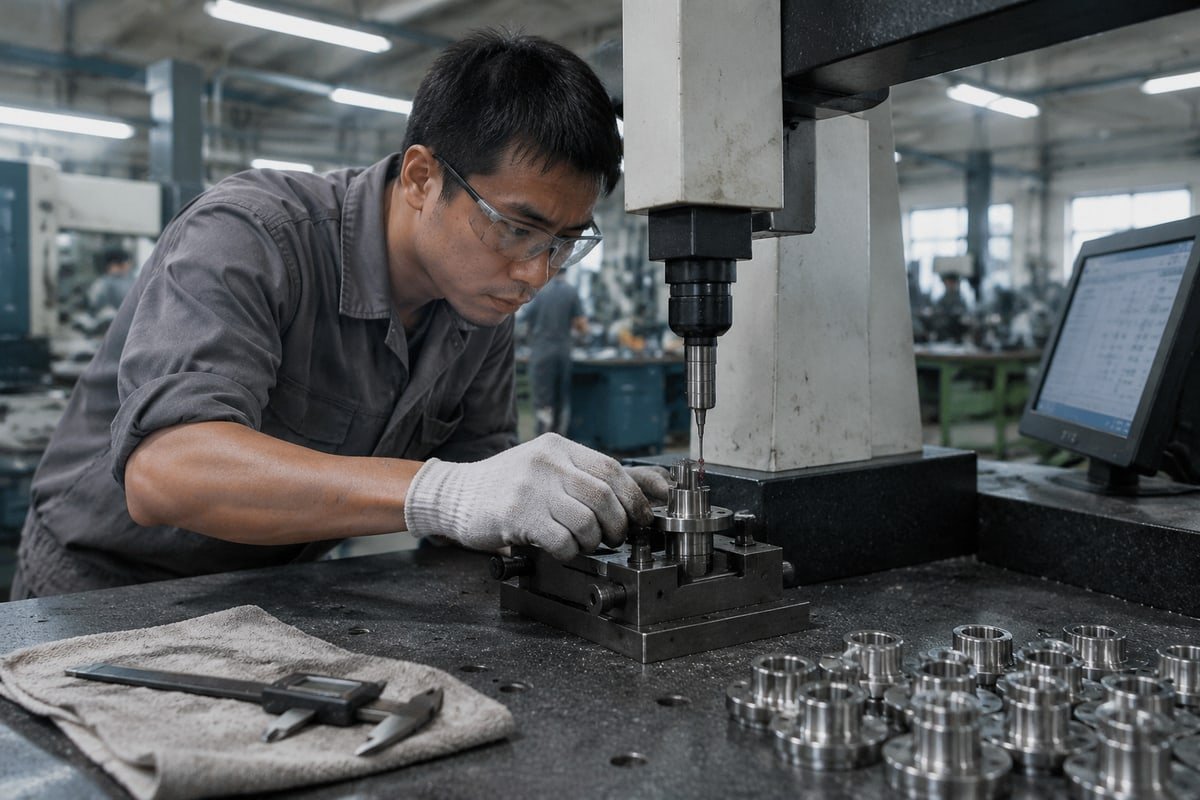
Overstated tolerance capability is one of the biggest risks in this industry. Almost every shop says it can hold ±0.01 mm. Fewer can hold it across a full batch, on multi-side parts, month after month. Our 5-axis CNC milling work regularly holds 0.01 to 0.005 mm, and we prove it with measurement data, not adjectives. You should demand the same proof from anyone.
Match the Process to the Tolerance
Not every medical part needs the most advanced machine. Matching process to geometry matters more than buying the fanciest capability.
| Prosessi | Typical Best Fit | Realistic Precision Role |
|---|---|---|
| 5-axis CNC milling | Complex contours, implants, multi-face parts | Fewer setups, so less stacked error |
| Swiss screw machining | Small, long, cylindrical parts like bone screws | Excellent repeatability on tiny turned features |
| Wire EDM | Hard alloys, intricate internal features | Fine features without cutting force distortion |
| Micromachining | Sub-millimeter features for robotic surgery tools | Miniature parts for neurovascular and endoscopic devices |
| CNC turning / mill-turn | Rotational parts, connectors, fittings | Efficient multi-operation accuracy |
Flag Your Critical Dimensions on the Drawing
Now the lesson from my own experience. Medical products carry a reputation, so suppliers default to high precision and high surface finish on every feature. If certain dimensions on your part do not need tight control, mark that clearly on the drawing. Otherwise, the shop machines the entire component to the highest standard, and your purchasing cost climbs for no functional gain. On tight tolerance components, one relaxed non-critical face can cut cycle time meaningfully. This is the single cheapest cost optimization available to any medical buyer, and most never use it.
Which materials are best suited for my medical device machining project?
Every week our engineers weigh the same trade-off: titanium's biocompatibility against 316L's lower cost, or PEEK's imaging transparency against its machining difficulty. Material choice shapes everything downstream.
The best materials for medical device machining are medical grade titanium (Ti-6Al-4V) for implants, 316L stainless steel for surgical instruments, cobalt-chrome for wear surfaces, and biocompatible plastics such as PEEK, POM, and PPSU for housings, imaging components, and single-use device parts.
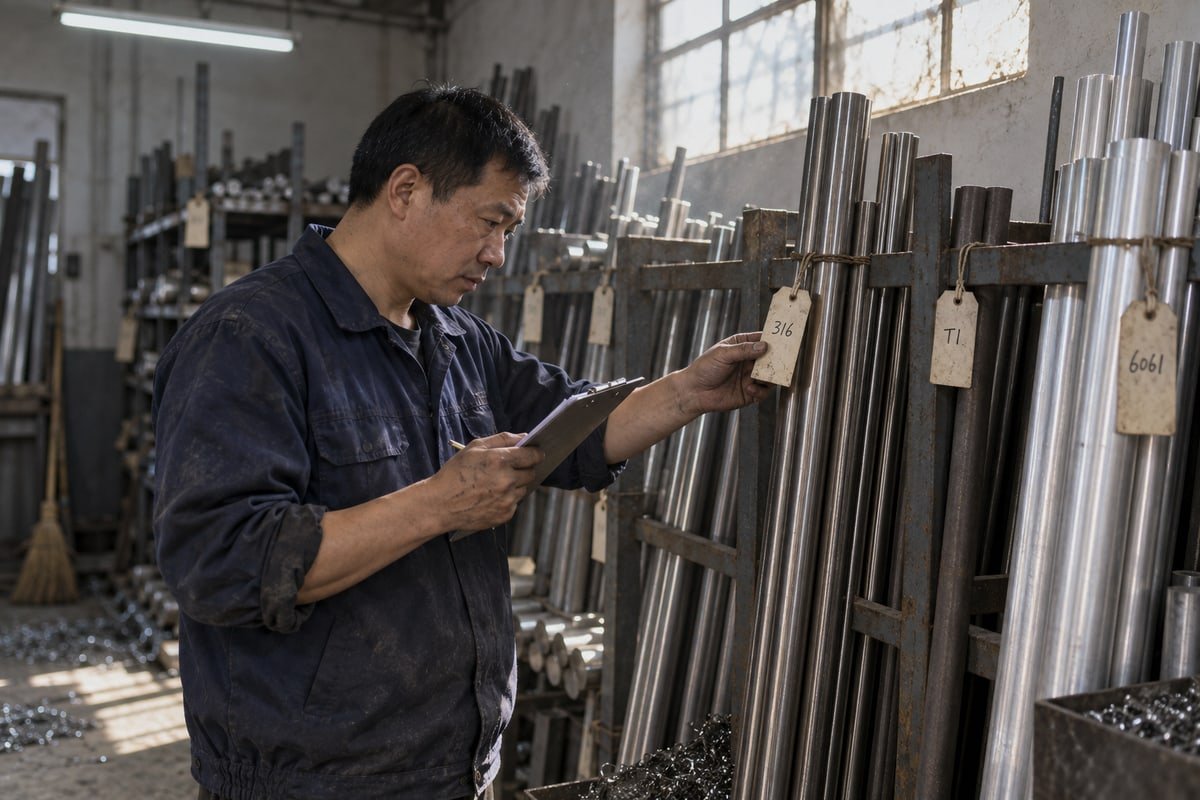
Material selection drives cost, machinability, sterilization compatibility 3, and regulatory pathway all at once. So I recommend choosing the material before you choose the supplier. Then confirm the supplier actually machines that material weekly, not occasionally. A shop that runs medical grade titanium every day sets up differently than one that mostly cuts aluminum.
Common Medical Machining Materials Compared
| Materiaali | Key Strengths | Typical Medical Uses | Machining Notes |
|---|---|---|---|
| Titanium Ti-6Al-4V | Biocompatible, strong, light | Implants, orthopedic implant production, bone plates | Low thermal conductivity; needs rigid setups and sharp tooling |
| 316L stainless steel | Corrosion resistant, sterilizable | Surgical instrument manufacturing, forceps, trays | Work-hardens; stable but demands correct feeds |
| Cobalt-chrome | Extreme wear resistance | Joint replacement wear surfaces, dental frames | Very hard on tooling; specialist experience required |
| PEEK | Radiolucent, biocompatible, sterilizable | Spinal cages, trial implants, imaging parts | Sensitive to heat; slow, controlled cutting |
| POM / PPSU / PC | Low friction, autoclave-capable options | Device housings, handles, fluid components | Easy to machine; watch dimensional stability |
At our factory we machine aluminum, stainless steel, titanium, brass, and engineering plastics including PEEK, POM, PPSU, PC, and nylon. That range matters because many medical assemblies mix metals and biocompatible materials in one build. One supplier handling both reduces handoffs and mismatched tolerances between mating parts.
Ask About Material Traceability Early
Material fraud is a real buyer fear, and a fair one. Substituting a lower grade of stainless or an uncertified titanium bar can compromise corrosion resistance and patient safety. So request mill certificates with every quote, not after production. We attach material certifications to shipments because our European customers cannot pass internal acceptance without them. Any serious supplier will do the same without complaint.
How can I verify quality control and inspection reports before choosing a supplier?
During a recent pre-shipment check, our CMM operator caught a slight dimensional drift on a batch of instrument housings. We reworked them before packing. That catch protected the customer's assembly schedule overseas.
Verify quality control by requesting sample inspection reports before ordering: first article inspection data, CMM measurement records, raw material certifications, and outgoing inspection documents. Confirm the supplier maintains full traceability from mill source to shipment and can support Device History Record requirements for regulated components.
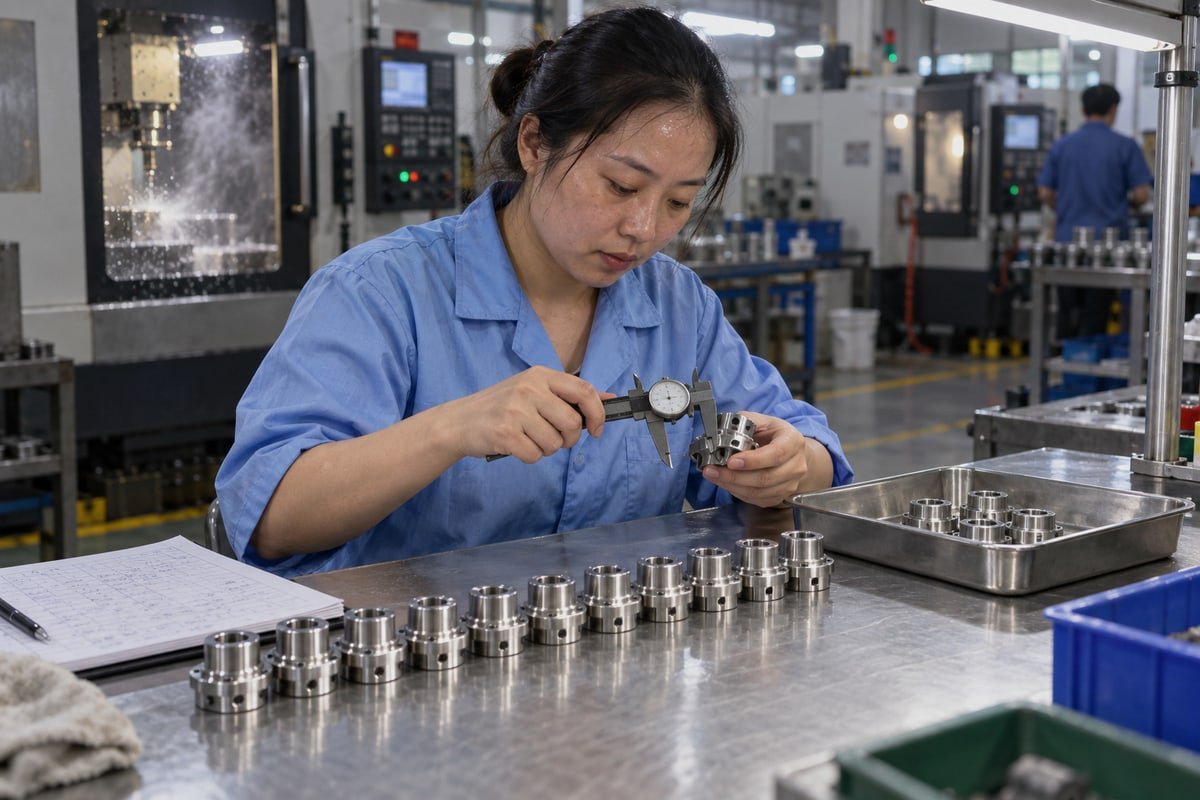
Documentation matters as much as dimensional accuracy in medical work. A part can measure perfectly, but without records, your regulatory team cannot accept it. Here is the verification process I recommend to every buyer, based on how our own customers audit us.
A Six-Step Verification Process
- Request sample reports from a past project. Ask for a redacted first article inspection report and CMM data. If a shop cannot show one within a day, that tells you something.
- Check metrology hardware. Confirm they use CMM equipment and, for micro features, automated vision systems. Calipers alone cannot verify micron-level tolerances.
- Trace one material lot backward. Ask them to walk you from a finished part back to the mill certificate. Full traceability supports your Device History Record obligations.
- Confirm marking capability. UDI laser marking supports compliance and lifecycle tracking, and it is easier done at the machining source.
- Start with rapid prototyping. A prototype or small bridge run with full inspection documents 4 reveals more than any factory brochure. We often prove capability this way, with lead times as short as five days.
- Compare quotes on scope, not price. A cheaper quote often excludes inspection reports, finishing, or traceability. For medical parts, the cheapest option is frequently the most expensive mistake.
Domestic Versus Offshore: The Honest Trade-Off
Buyers often ask me whether sourcing medical CNC machining services from China sacrifices control. It is a fair objection. Offshore sourcing trades some proximity for significant cost advantage, so the answer depends on documentation. When a supplier provides DFM feedback before cutting, first article inspection on samples, and complete outgoing records, distance stops being a quality risk and becomes a logistics detail. Forward-looking shops also add digital simulation of complex parts and predictive maintenance on their machine fleets to keep surface finish consistent, plus material recovery programs for high-value alloys that satisfy corporate ESG requirements. Judge the system, not the map.
Päätelmä
Sourcing medical parts blind invites delays and recalls. Define requirements, demand certifications, verify tolerances, audit documentation — and your medical CNC machining services search ends with a partner, not a problem.
Footnotes
1. FDA quality system regulations covering documentation and material certification requirements. ↩︎
2. Official ISO page explaining the quality management standard for medical device manufacturing. ↩︎
3. Overview of sterilization methods and material compatibility for medical devices. ↩︎
4. Overview of quality control documentation and inspection processes in manufacturing. ↩︎

 Suomi
Suomi  English
  Italiano
  Français
  日本語
日本語  Deutsch (Sie)
  Español
  Русский
  العربية
  Български
  Čeština
  Dansk
Dansk  עִבְרִית
  हिन्दी
  Nederlands
  Português
  Română
  Slovenčina
  Svenska
  ไทย
ไทย  Tiếng Việt
  Türkçe
  Slovenščina