
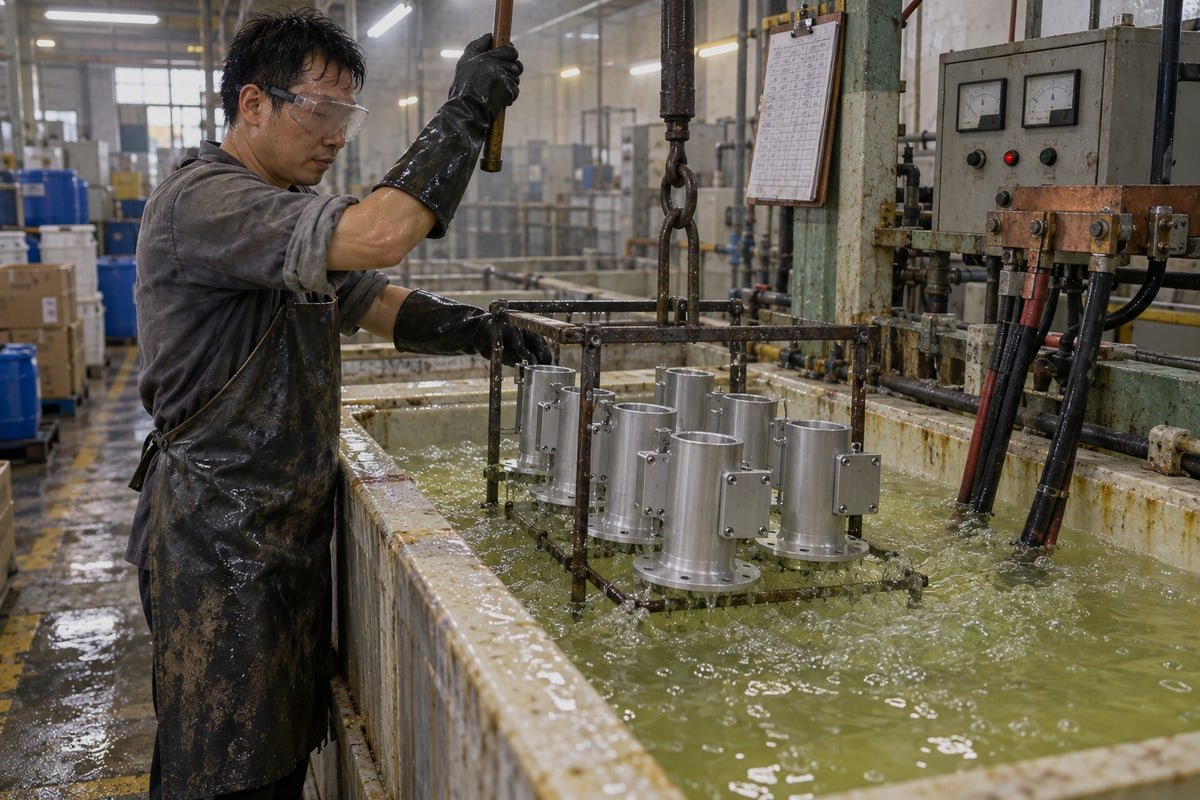
Bare 6061 aluminum parts 1 leave our machines bright and precise, then scratch, stain, and corrode in service. Anodizing for CNC machined parts solves that on our production line.
Anodizing for CNC machined parts is an electrochemical process that converts the aluminum surface into an integral aluminum oxide layer. The part becomes the anode in an acidic electrolyte bath, current grows a hard porous oxide, dye can fill the pores, and sealing locks in color and corrosion resistance.
That definition is short. The decisions behind it are not. Below I walk through why we recommend anodizing, which type fits which job, which alloys behave well, and what to put on your drawing so the finish comes back right the first time.
Why Should I Choose Anodizing Over Other Surface Finishes for My CNC Parts?
Every quote we prepare for an aluminum housing forces one trade-off: protect the surface without burying the ±0.01 mm geometry our 5-axis machines just produced.
Anodizing beats most finishes for CNC aluminum because the oxide is grown from the metal itself, not applied on top. It adds corrosion resistance and wear resistance with minimal thickness, keeps the metallic look, holds dimensional tolerances better than powder coating, and does not peel like paint.
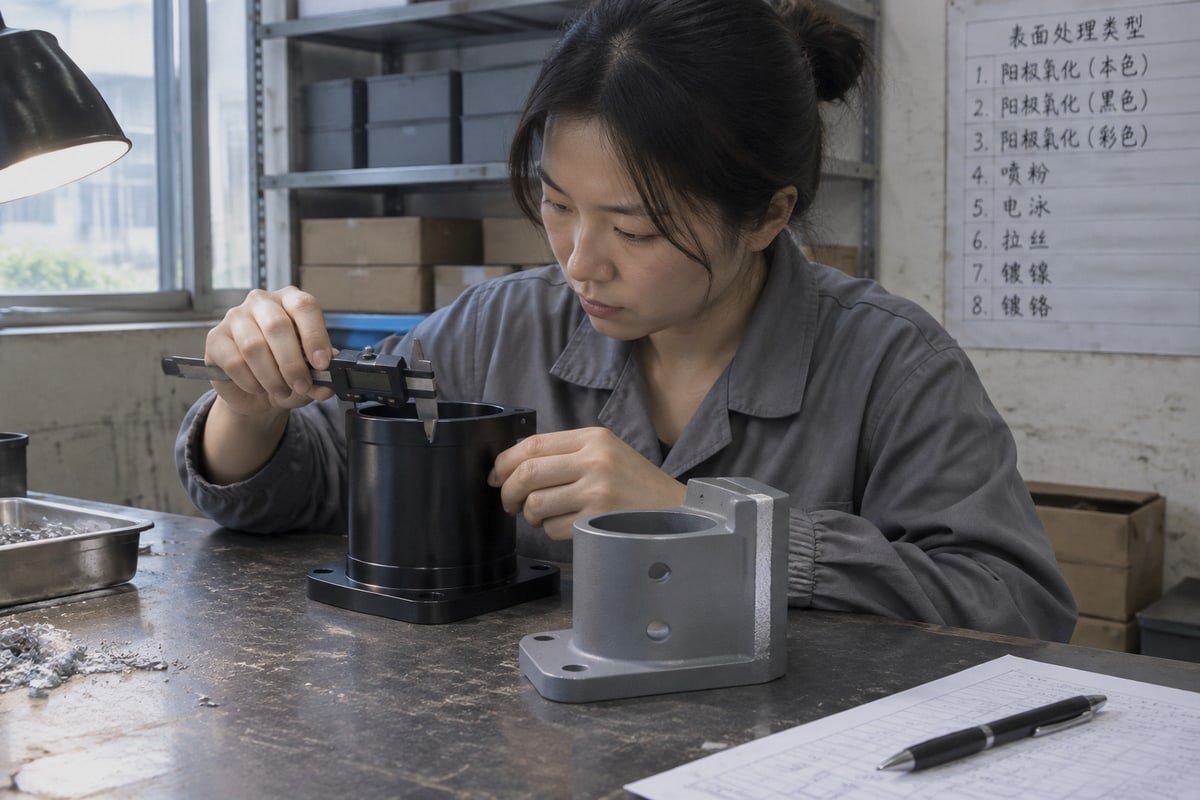
The best way to understand the advantage is to understand what actually happens in the tank. Paint sits on the part. Plating deposits a foreign metal on the part. Anodizing changes the part.
How the Aluminum Oxide Layer Actually Forms
Some engineers call anodizing electrolytic passivation, and that name is accurate. The steps we run after machining are simple to describe:
- We clean, degrease, and deoxidize the machined part.
- We rack it and connect it to the positive terminal of a DC power supply. The part is now the anode.
- A cathode sits in the same electrolyte bath, usually sulfuric acid.
- Current drives oxygen ions 2 into the aluminum surface. Aluminum becomes aluminum oxide.
- The acid partially dissolves that oxide as it grows. This creates millions of microscopic pores above a dense barrier layer.
- While the pores are open, dye can soak in.
- Sealing closes the pores and stabilizes the color and corrosion protection.
The key point is step 5. Anodizing is a balance between oxide growth and controlled dissolution. The pores are what make dyeing possible. They are also why an unsealed part will stain and fade. Natural oxidation on aluminum produces a film far too thin to matter. The electrical process makes the oxide thick, controlled, and repeatable.
How It Compares to the Other Finishes We Offer
We run sandblasting, polishing, plating, powder coating, and chemical conversion coating alongside anodizing. Here is how I frame the choice for buyers.
| Finish | How it bonds | Typical thickness | Metallic look | Conductive? | Dimensional control | Best fit |
|---|---|---|---|---|---|---|
| Anodizing (Type II) | Converted from the substrate | ~5–25 µm | Yes | No (insulating) | Good | Precision housings, brackets, optical parts |
| Hardcoat Type III | Converted from the substrate | ~25–75 µm | Dark, matte | No | Needs offset planning | Sliding and hydraulic parts |
| Powder coating | Applied film | 50–150 µm | No | No | Poor on tight features | Large visible panels, impact zones |
| Chemical conversion coating (alodine) | Thin chemical film | Under 1 µm | Yes | Yes | Excellent | Grounding faces, EMI shielding |
| Nickel or chrome plating | Deposited metal | Varies | Yes | Yes | Moderate | Steel parts, bright finishes |
Thickness values are process-dependent. Alloy, bath temperature, current density, and time all move them.
The Honest Objections
Buyers raise three concerns, and all three are fair. First, the oxide is hard but brittle. It can chip on sharp edges under impact. We ask for small radii or chamfers on cosmetic edges for that reason. Second, anodized aluminum is electrically insulating. If you need a ground path, we mask that face or use a chemical conversion coating there instead. Third, a deep scratch exposes bare metal and cannot be touched up invisibly the way paint can.
None of these cancel the core benefit. For a precision aluminum part that must look metallic, resist corrosion, and keep its tolerances, anodizing is still the finish we reach for first.
What Types of Anodizing Processes Can I Choose for My Machined Components?
Last year a customer sent us a hydraulic guide block that had worn through its black Type II finish in months. The drawing simply said anodized.
You can choose three anodizing types: Type I chromic acid for thin, fatigue-friendly protection; Type II sulfuric acid for decorative and general-purpose parts in many colors; and Hardcoat Type III for maximum wear resistance on sliding or hydraulic components. Type II is the default; Type III is the heavy-duty option.
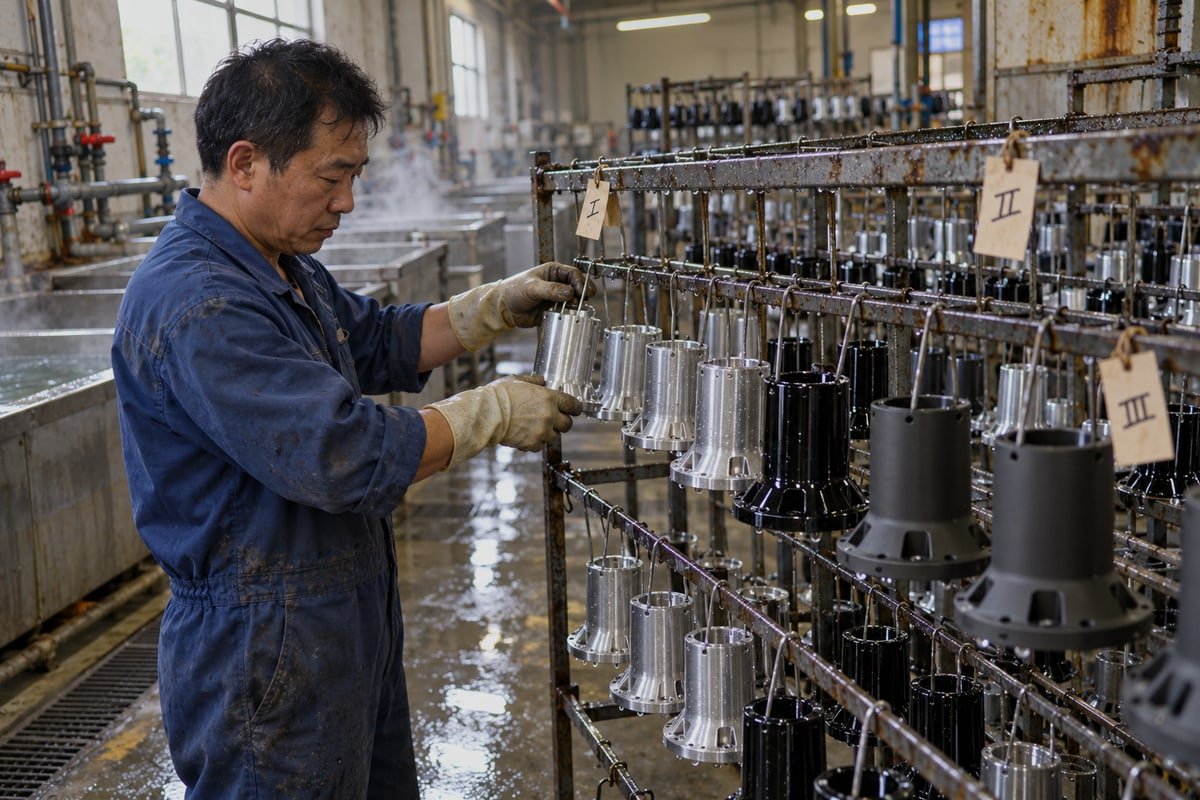
That guide block story is the reason I spend time on this section with every new buyer. The word "anodized" covers three very different processes. Picking the wrong one does not fail at inspection. It fails in the field.
| Type | Electrolyte | Typical thickness | Appearance | Wear resistance | Color options | Relative cost | Common uses |
|---|---|---|---|---|---|---|---|
| Type I | Chromic acid | Thinnest, ~0.5–2.5 µm | Gray, dull | Low | Limited | Medium | Aerospace, fatigue-critical, bonded joints |
| Type II sulfuric acid | Sulfuric acid | ~5–25 µm (0.0002–0.001 in) | Clear or dyed, metallic | Moderate | Black, red, blue, gold, many more | Lowest | Housings, brackets, consumer and optical parts |
| Hardcoat Type III | Sulfuric acid, low temp, high current | ~25–75 µm (0.001–0.003 in) | Dark gray to black, matte | Highest | Mostly black or natural dark gray | Highest | Guides, pistons, tooling, valve bodies |
Type I uses chromic acid. It produces the thinnest film 3 and barely affects dimensions or fatigue life. It also brings environmental handling concerns, so most commercial buyers skip it unless an aerospace specification calls for it.
Ordinary Anodizing vs Hard Anodizing: What Actually Changes
This is the distinction I want every engineer to carry away. Ordinary anodizing and hard anodizing both use a sulfuric acid electrolyte 4 bath. The chemistry is similar. The process window is not.
| Factor | Ordinary (Type II) | Hard (Type III) |
|---|---|---|
| Bath temperature | Room temperature, roughly 18–22 °C | Chilled, often near 0 °C |
| Current density | Lower | Two to three times higher |
| Process time | Shorter | Longer |
| Oxide hardness | Harder than aluminum | Approaches hardened steel |
| Dye uptake | Excellent, pores are open and uniform | Poor, pores are tight and the film is already dark |
| Dimensional growth | Small, usually absorbed in tolerance | Significant, must be offset at machining |
| Thermal behavior | Negligible | Thick oxide acts as a thermal barrier |
| Cost | Baseline | Noticeably higher |
The cold bath is the whole secret. At low temperature the acid dissolves the oxide more slowly. The film can grow thick and dense instead of porous and thin. That density is what gives Hardcoat Type III its wear resistance. It is also why Type III parts cannot take bright dyes and why the finish looks charcoal rather than glossy black.
Two Traps We See With Type III
The first trap is heat sinks. A thick Type III oxide is a ceramic, and ceramics insulate heat. On a finned heat sink, hardcoat can reduce dissipation efficiency. We recommend Type II or a thin Type II on thermal parts.
The second trap is tolerances. Type III growth is roughly half inward and half outward. A 50 µm coating pushes a bore smaller by about 25 µm per side. We machine the bore oversize before finishing. If the drawing does not say whether tolerances apply before or after anodizing, we ask. That one question has saved more parts than any inspection gauge in our shop.
How Do I Know Which Materials Are Best Suited for Anodizing?
A German buyer asked us why his 7075 brackets came back a different shade than the 6061 plate in the same batch. The alloy, not the bath, was the answer.
Aluminum is the best material for anodizing, especially 6061 aluminum alloy and 6063, which anodize evenly and accept dye well. 5052 and 7075 also work with care. High-silicon cast alloys and 2024 anodize poorly in color. Titanium can be anodized; steel, brass, and plastics cannot.
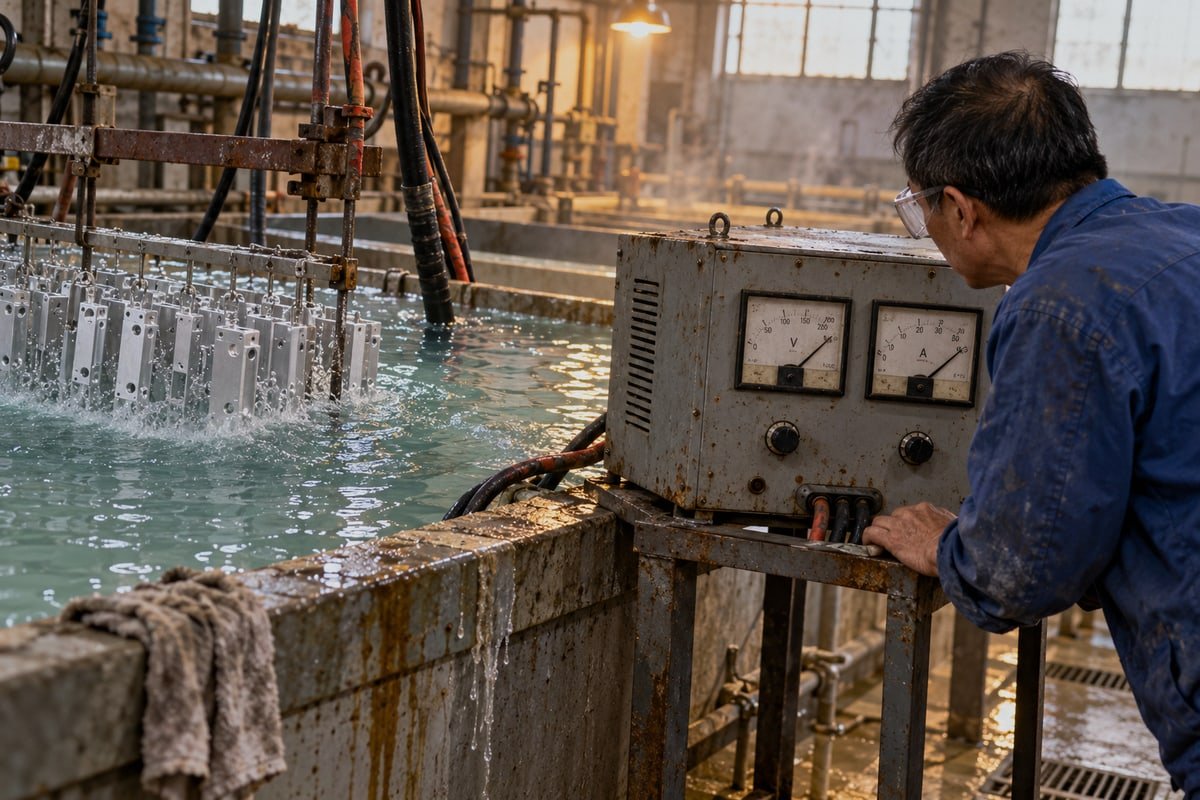
The oxide layer is transparent. It does not hide the metal underneath. It shows it. So the alloy you choose decides the color, the uniformity, and sometimes whether the finish survives the tank at all.
How Common CNC Alloys Behave in the Bath
| Alloy | Alloying elements | Type II result | Type III result | Our notes |
|---|---|---|---|---|
| 6061 aluminum alloy | Mg, Si | Clear, even, dyes well | Excellent | Our default for housings and brackets |
| 6063 | Mg, Si | Brightest, most uniform | Good | Best for cosmetic extrusions and bezels |
| 5052 | Mg | Good, slight gray cast | Good | Sheet parts, marine enclosures |
| 7075 | Zn, Cu | Yellowish or brownish tint | Good hardness, darker | Different shade from 6061; never mix in one color batch |
| 2024 | Cu | Dull, blotchy, weaker corrosion resistance | Poor | Use Type I or conversion coating instead |
| ADC12 / A380 castings | High Si | Dark, smutty, uneven | Not recommended | Silicon does not convert; shows as gray specks |
| Titanium (Grade 2, 5) | — | Interference colors, no dye needed | Not applicable | Thin oxide, color from film thickness |
Copper and silicon are the two elements that cause trouble. Copper gives 2024 and 7075 a warm tint and weaker corrosion resistance. Silicon in cast alloys stays unconverted and shows as dark specks. If your part is cast and cosmetic, we usually steer the conversation toward powder coating.
The 7000-Series Etching Risk
7075 deserves one extra warning. During the alkaline etch before anodizing, high-strength 7000-series alloys can develop microscopic surface cracking if the etch bath runs too hot or too long. We hold etch temperature tightly and shorten dwell time on 7075. A buyer will never see that step on the invoice, but it decides whether the part passes a fatigue test.
Why the Machined Surface Finish Matters More Than You Think
Because the oxide is clear, every tool mark under it becomes part of the finish. A bright machined surface, a bead-blasted surface, and a brushed surface will give three different looks from the same alloy and the same tank. Blasting gives a uniform matte. Polishing gives a bright, almost mirror result. Brushing gives a directional grain.
High-speed toolpaths add a subtle problem. Trochoidal milling leaves faint, regular wave patterns that are invisible on raw aluminum. The light-refracting oxide makes them pop. We call it ghosting. On the cylindrical optical housings we machine, we add a light bead-blast step before Type II specifically to erase it. If a surface is cosmetic, tell us. We will plan the toolpath and pre-treatment around it.
What Factors Should I Consider When Requesting Anodizing From My CNC Supplier?
We learned the hard way that a drawing note reading black anodized is not a specification. It is an invitation for two factories to interpret it differently.
When requesting anodizing, specify the alloy and temper, anodize type and class, coating thickness or MIL-A-8625 specification, color with an approved sample, sealing method, masked areas, and which dimensional tolerances apply after finishing. Also confirm pre-treatment texture, cosmetic acceptance limits, and inspection reports.
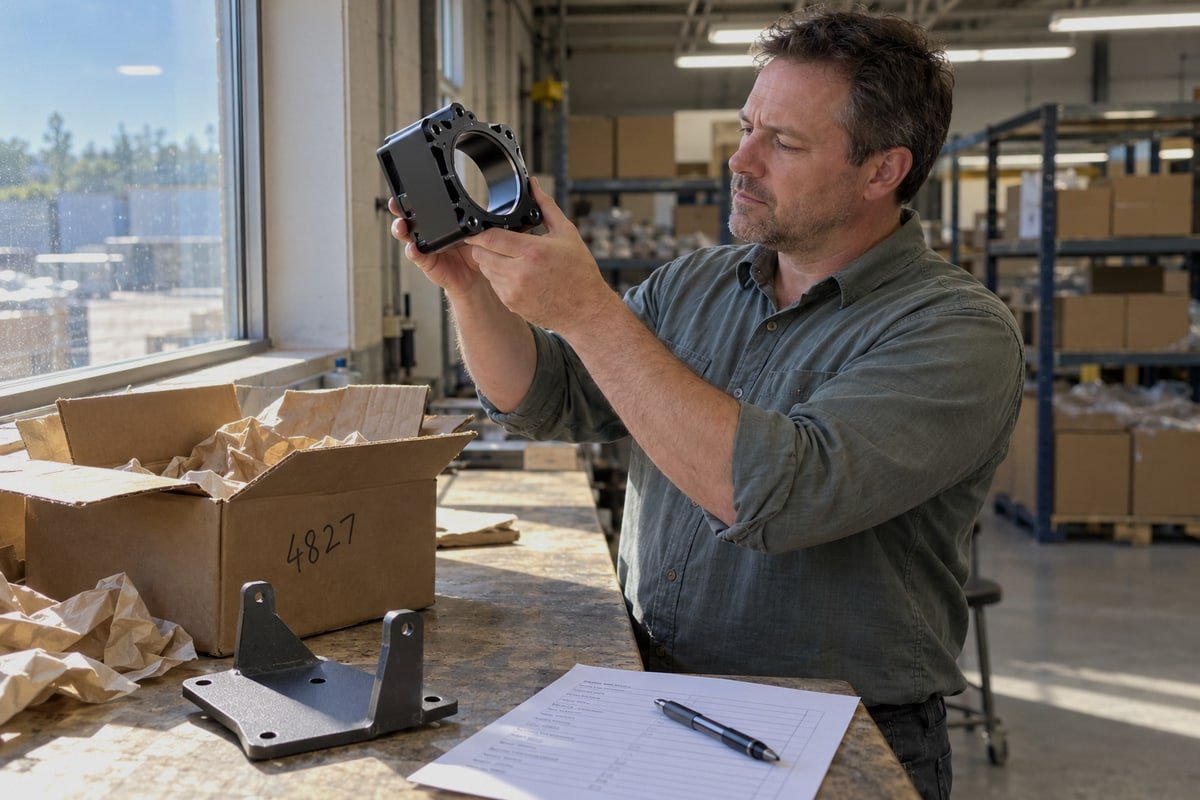
Our DFM review flags missing anodize information on a large share of the drawings we receive. The fix is cheap at quote stage and expensive after plating racks are loaded. Here is the checklist we use internally.
Build a Complete Finish Callout
| Item | Weak callout | Complete callout |
|---|---|---|
| Specification | Anodized | MIL-A-8625 Type II, Class 2 |
| Thickness | — | 15–20 µm, measured on flat cosmetic face |
| Color | Black | Black, match approved sample STC-BK-01, ΔE within agreed range |
| Sealing | — | Hot DI water seal or nickel-free cold seal |
| Masking | — | Mask M4 threads and ground pad per drawing view B |
| Tolerances | ±0.02 | ±0.02 applies after anodizing |
| Pre-treatment | — | Bead blast 120 grit before anodize, all external faces |
| Cosmetics | No defects | No rack marks on faces A and B; rack contact permitted on face C |
The MIL-A-8625 specification is the one most of our US and European buyers reference. It defines type, class, and thickness. We also work to ISO and customer internal standards, but the structure is the same. Give us a named standard and the rest of the conversation gets short.
Decide Where Dimensions Are Measured
The oxide grows about half into the metal and half out of it. For Type II at 15 µm, a bore closes by roughly 8 µm per side. That is inside most tolerances. For Type III at 50 µm, it is not. Tell us which features are critical after finishing. We machine bores slightly oversize and shafts slightly undersize, then measure again after the tank. Our ISO 9001:2015 process requires a post-finish dimensional report on those features, not just a pre-finish one.
Masking, Sealing, and Compliance
Masking adds labor, so mark only what truly needs to stay bare: ground pads, press-fit bores, threaded electrical interfaces, bonding surfaces. Everything else can take the coating.
Sealing method is the new question buyers ask. Traditional nickel-acetate seals give excellent stain resistance. Many European customers now require nickel-free cold sealing or hot DI water sealing to meet REACH and RoHS reporting. If you ship into the EU, state your preference on the drawing. We run both.
What to Ask Your Supplier Before You Order
- Can you anodize in-house or do you subcontract, and who controls the color sample?
- Will you supply thickness readings 5 and post-anodize dimensional data?
- How do you handle 7075 or cast alloys differently in the etch?
- What is your racking plan for my part, and where will contact marks land?
- Can you match a previous batch, and how do you store retained color samples?
A supplier who answers those five questions with specifics is one who has made anodized parts fail before and fixed the process. That is who you want.
Conclusion
Unprotected aluminum wastes precision machining. Anodizing converts the surface into a bonded aluminum oxide layer. Choose the type, alloy, and specification carefully, and the finish will last.
Footnotes
1. Technical properties of 6061 aluminum alloy for industrial use. ↩︎
2. Oxygen ions are the reactive species forming the aluminum oxide layer. ↩︎
3. Type I anodizing is known for producing the thinnest oxide films. ↩︎
4. Safety guidelines and properties for sulfuric acid in industrial processes. ↩︎
5. Thickness measurement is a key application of industrial metrology. ↩︎

 Tiếng Việt
 English
 Italiano
 Français
 日本語
 Deutsch (Sie)
 Español
 Русский
 العربية
 Български
 Čeština
 Dansk
 Suomi
 עִבְרִית
 हिन्दी
 Nederlands
 Português
 Română
 Slovenčina
 Svenska
 ไทย
 Türkçe
 Slovenščina