
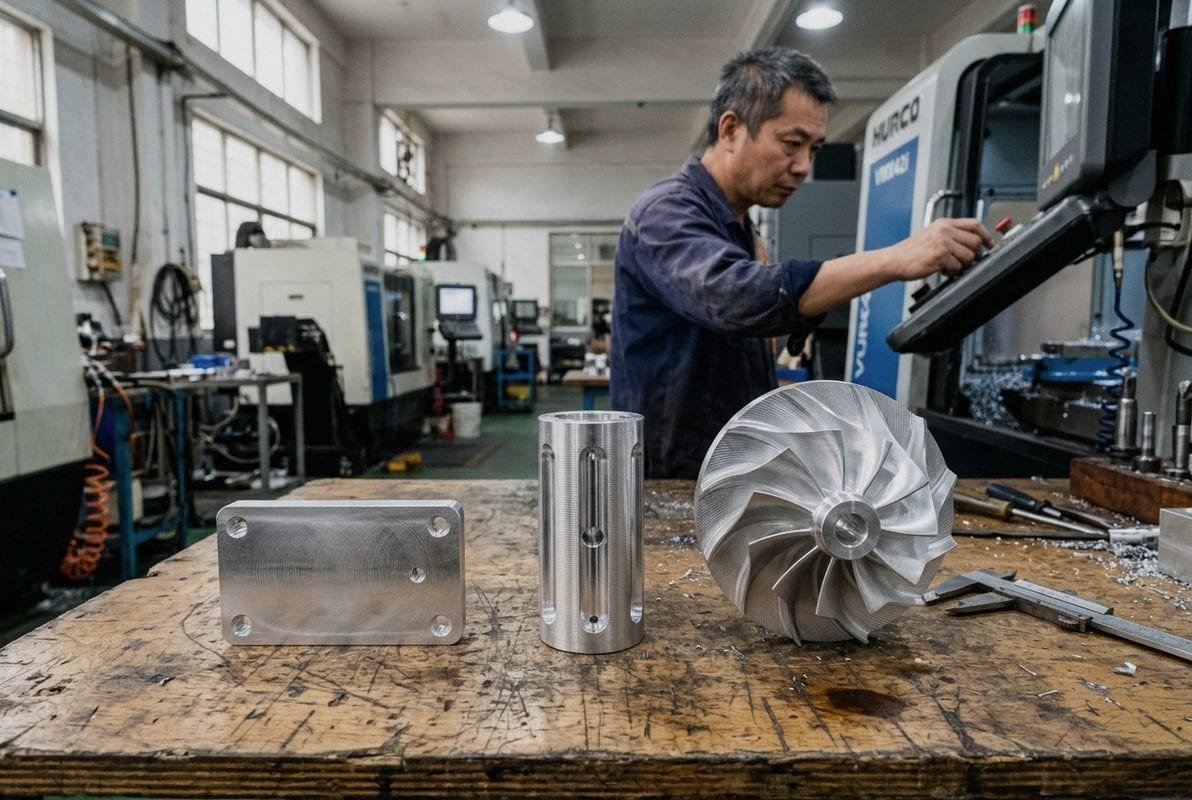
Every week, our quoting team reviews part designs that range from simple flat brackets to radial impellers 1 with compound curved blades — and picking the wrong axis count wastes money or kills tolerances.
The differences between 3-axis, 4-axis, and 5-axis CNC machining come down to how many directions the cutting tool and workpiece can move simultaneously: 3-axis uses three linear directions (X, Y, Z), 4-axis adds one rotational axis, and 5-axis adds two rotational axes, enabling complex geometries in fewer setups with superior surface finish and tighter tolerances.
Understanding these differences matters for every procurement decision — from budget allocation to lead-time planning. Below, I walk through the practical questions buyers ask us most often, with real comparisons drawn from parts we machine every day in our Dongguan facility.
How do I know if my part design requires 3-axis, 4-axis, or 5-axis machining?
A US-based automation engineer recently sent us a 3D model of a sensor housing with angled pockets on three faces — he assumed it needed full 5-axis, but we machined it on a 4-axis mill and saved him 20 percent on unit cost.
Your part design dictates the axis count based on geometric complexity, number of tool-access angles, and whether undercut features or compound curves exist. Simple top-face features need 3-axis; multi-sided prismatic parts suit 4-axis; organic shapes and compound angles require 5-axis machining.
Start With Geometry: The Single Most Important Factor
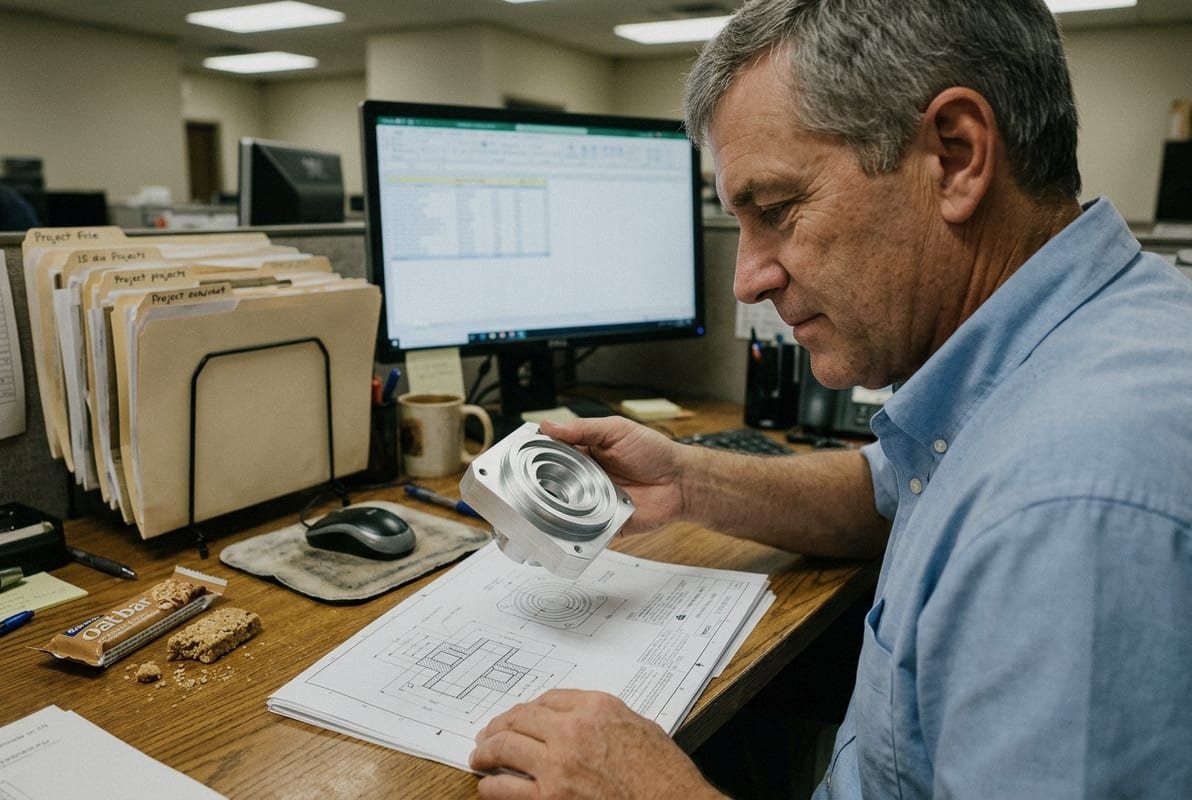
The fastest way to decide is to look at how many distinct orientations the cutting tool needs to reach every feature on the part. If all cuts happen from one direction — straight down into the top face — a 3-axis machine handles it. When features wrap around a cylindrical or box-shaped body, the workpiece needs to rotate, which is where the fourth rotary axis 2 comes in. And when surfaces curve in multiple directions at once, or the tool must tilt to maintain an optimal angle against a sculpted wall, you need two rotational axes — that is 5-axis territory.
A Practical Decision Matrix
| Design Feature | Recommended Axis | Why |
|---|---|---|
| Flat pockets, holes, and slots on one face | 3-Axis | Tool access is straight-line only; no rotation needed |
| Features on 2–4 sides of a rectangular block | 4-Axis (indexed) | Part rotates to expose each face in a single setup |
| Cylindrical profiles with cross-holes or flats | 4-Axis (continuous) | Rotation around one axis while cutting |
| Angled surfaces at compound angles | 5-Axis (3+2 indexed) | Workpiece tilts to a fixed angle, then 3-axis cuts proceed |
| Freeform curves, turbine blades, impellers | 5-Axis (simultaneous) | Tool and workpiece move in five directions at once |
| Deep undercut features behind walls | 5-Axis (simultaneous) | Only a tilted tool path can reach the hidden geometry |
The Role of Number of Setups
Every time a machinist unclamps a part, flips it, re-indicates it, and reclamps it, positional error stacks up. On our 3-axis machines, a six-sided enclosure might need four or five setups. That same part on a 4-axis machine drops to one or two setups because the rotary axis indexes the part automatically. A 5-axis machine can often finish a complex part in a single setup. Fewer setups mean tighter tolerances, shorter cycle times, and lower labor cost per piece.
When 3-Axis Is Still the Smart Choice
Do not assume more axes always equals better. For flat brackets, simple housings, and 2D profiles, 3-axis machining delivers excellent results at the lowest programming and operating cost. Our shop runs more 3-axis jobs than any other type — they account for most prototype and low-volume orders from electronics and packaging equipment customers. The CAM software 3 programming time is minimal, workholding solutions are straightforward, and the machines are easy to keep in tolerance.
When You Should Move Up
Move to 4-axis when your part has features on multiple faces that reference the same datum, or when you need to wrap a cut around a cylinder. Move to 5-axis when the part has sculpted surfaces, compound draft angles, or features that a straight tool simply cannot reach without collision. Aerospace components 4 like turbine blades and medical implants with organic contours are textbook 5-axis parts.
Will switching to 5-axis machining significantly increase my unit price?
One lesson I learned early in my career was that the most expensive machine does not always produce the most expensive part — sometimes it produces the cheapest one, because it finishes the job in a single setup while a 3-axis approach needs five.
Switching to 5-axis machining does increase the hourly machine rate, but it does not always increase your unit price. For complex parts, 5-axis often lowers total cost by eliminating multiple setups, reducing cycle time, extending tool life, and cutting scrap rates — making the per-part price competitive or even lower than multi-setup 3-axis approaches.
Breaking Down the Real Cost Drivers
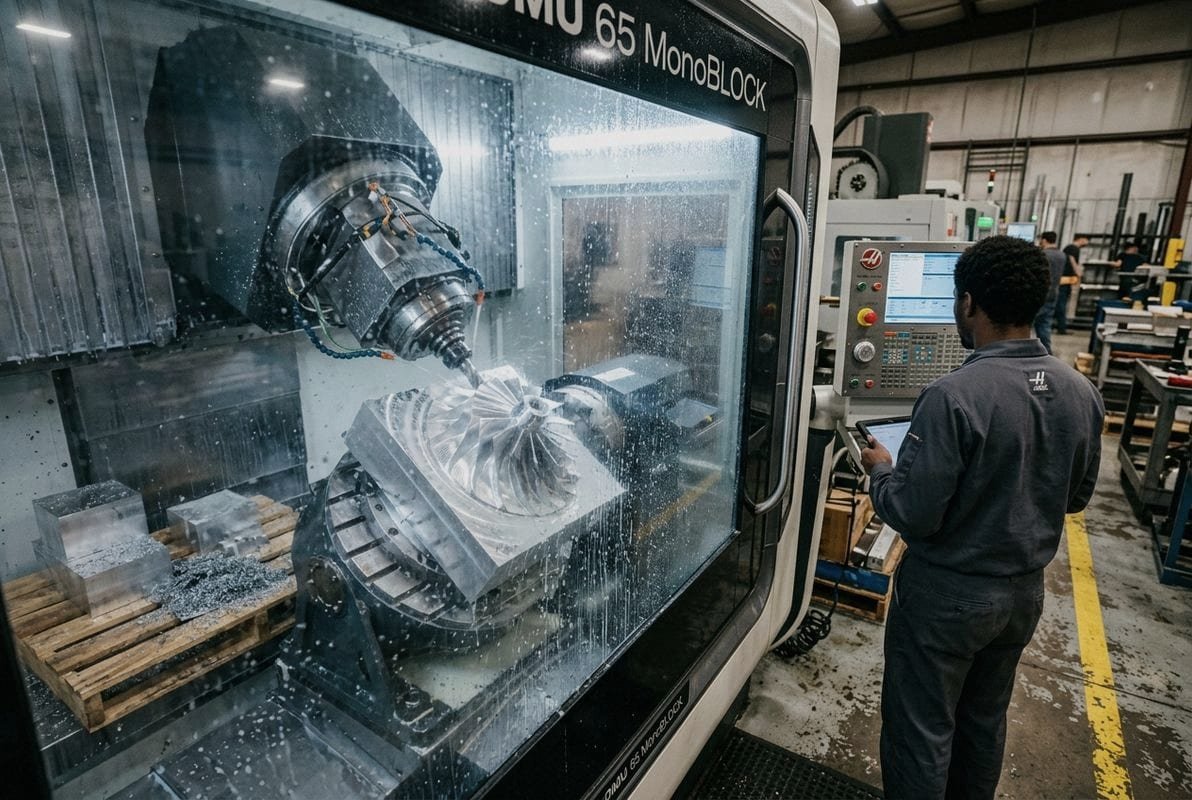
Buyers understandably focus on the machine-hour rate. A 5-axis machine in our shop does carry a higher rate than a 3-axis machine — the equipment investment is larger, the CAM software licenses are more advanced, and the operators need deeper training. But the machine-hour rate is only one line item in the total unit cost. Here is how the math works on a real-world comparison for a multi-sided aluminum housing we quoted last quarter:
| Cost Element | 3-Axis Route (4 setups) | 5-Axis Route (1 setup) |
|---|---|---|
| Programming & CAM time | 2 hours | 3 hours |
| Setup time per part | 40 min (4 × 10 min) | 8 min (1 setup) |
| Machining cycle time | 28 min | 18 min |
| Inspection (inter-op) | 3 checks | 1 check |
| Scrap rate | ~4% | <1% |
| Fixture cost (amortized) | 4 fixtures | 1 fixture |
| Estimated unit price (100 pcs) | Higher | Lower |
For this particular part, the 5-axis route was about 15 percent cheaper per unit at a production volume of 100 pieces. The savings came from drastically fewer setups, a shorter cycle, and almost no scrap.
Where 5-Axis Does Cost More
If your part is geometrically simple — say a flat plate with pockets and through-holes — running it on a 5-axis machine wastes expensive spindle time on a job a 3-axis machine handles just as well. In that scenario, the unit price 6 goes up for no functional benefit.
The Middle Ground: 3+2 Indexed Machining
Many of our customers get the best of both worlds with 3+2 indexed machining. The two rotary axes tilt and lock the workpiece into a fixed orientation, then the machine cuts using standard 3-axis tool paths. This approach avoids the premium of full simultaneous 5-axis programming while still offering single-setup capability and improved tool access. It is the strategy we recommend most often for parts with geometric complexity 7 that falls between simple and organic.
Production Volume Matters
At low volumes — say 1 to 10 prototypes — the programming and setup cost dominates, so the axis choice has less impact on unit price. At medium to high volumes (50 to 5,000+ pieces), the per-part savings from fewer setups and shorter cycles on a 4-axis or 5-axis machine compound dramatically. We always run the numbers both ways and present the comparison in our DFM feedback so buyers can make an informed decision.
Can I get the same precision for my complex parts using 4-axis instead of 5-axis?
During a recent project for an optical instrument manufacturer in Europe, we tested both 4-axis and 5-axis approaches on a lens mount with a compound-angle bore. The 4-axis route hit ±0.02 mm — acceptable for some applications — but the 5-axis approach consistently held ±0.008 mm because the tool stayed perpendicular to the angled surface throughout the cut.
You can achieve high precision on 4-axis machines for parts with features organized around a single rotational axis, but for parts with compound angles, freeform surfaces, or tight tolerances on multiple non-orthogonal faces, 5-axis machining delivers measurably better accuracy and surface finish because it maintains optimal tool orientation throughout the cut.
Understanding Where Precision Comes From
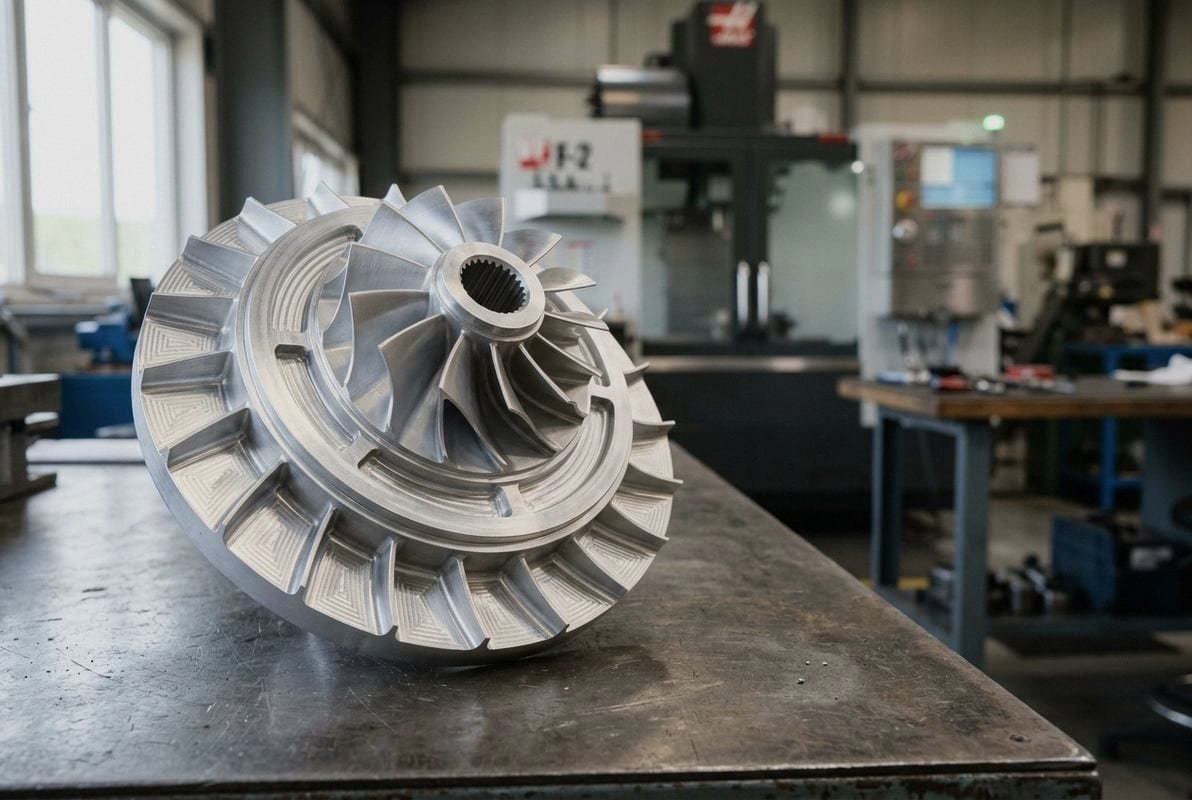
Precision in CNC machining 8 is not just about the machine's stated resolution. It is the sum of several factors: spindle rigidity, thermal stability 9, fixture repeatability, tool deflection, and — critically — how well the cutting tool meets the workpiece surface. On a 4-axis machine, the tool can only approach from directions allowed by three linear axes plus one rotation. If a surface is angled in two planes at once, the tool cannot align perfectly. It cuts at a skewed angle, which causes larger effective chip loads on one side of the flute, increased vibration, and poorer surface finish.
Comparing Precision Outcomes
| Precision Factor | 4-Axis Capability | 5-Axis Capability |
|---|---|---|
| Flat faces and perpendicular holes | Excellent (±0.01 mm achievable) | Excellent (±0.005 mm achievable) |
| Features around one rotational axis | Excellent | Excellent |
| Compound-angle bores and pockets | Limited — requires angled fixtures | Native — tool tilts to match surface |
| Freeform 3D surfaces | Not feasible without multiple setups | Full simultaneous control; smooth scallop-free finish |
| Surface finish on curved walls | Ra 1.6–3.2 µm typical | Ra 0.4–1.6 µm achievable with ball-nose optimization |
| Cumulative tolerance across faces | Stacks with each additional setup | Minimal — single-setup datum holds |
Tool Access and Tool Life
When a 5-axis machine tilts the tool to keep it normal to the surface, the cutting edge engages evenly. That even engagement reduces localized wear and extends tool life. It also means shorter, more rigid tools can be used because the spindle head adjusts instead of relying on long-reach cutters. Shorter tools deflect less, which directly improves dimensional accuracy.
The Practical Limit of 4-Axis Machining
For many industrial parts — cylindrical housings, shafts with flats, brackets with features on four sides — 4-axis precision is more than sufficient. Our 4-axis lathes and mills regularly hold ±0.01 mm on aerospace brackets and automotive sensor bodies. The problem arises only when the design demands features that a single rotary axis cannot present to the spindle. If your part has undercut features hidden behind walls, or sculpted surfaces that curve in two directions, only simultaneous 5-axis tool paths can maintain tool contact and dimensional control.
A Note on Workholding Solutions
Even on a 5-axis machine, poor fixturing kills precision. We design custom workholding solutions for complex parts — often a single fixture that grips minimal material so the tool can reach every surface. On 4-axis jobs, we sometimes use angled soft jaws or tombstone fixtures with indexed faces. The quality of the fixture matters just as much as the axis count, and our engineering team reviews every setup before the first chip flies.
How does the choice of axis configuration affect my project's overall lead time?
A medical device customer in the Middle East once asked us to machine 200 titanium bone plates 10. The initial plan called for 3-axis machining with six setups per part. Our team proposed a 5-axis single-setup approach that cut the total lead time from 18 working days down to 9.
Axis configuration directly affects lead time through three channels: programming time, per-part cycle time, and number of setups. Higher-axis machines require longer initial programming but dramatically reduce per-part cycle time and setup count, so for medium-to-large batches of complex parts, 4-axis and 5-axis machining significantly shorten overall project delivery.
Where Time Gets Spent
Lead time is not just machining time. It includes quoting, DFM review, CAM programming, fixture fabrication, machine setup, cutting, inspection, surface finishing, and packing. The axis choice affects several of these stages differently.
Lead-Time Breakdown by Stage
| Project Stage | 3-Axis Impact | 4-Axis Impact | 5-Axis Impact |
|---|---|---|---|
| CAM programming | Fastest — simple tool paths | Moderate — rotary axis adds complexity | Longest — simultaneous paths need advanced simulation |
| Fixture design & build | Multiple simple fixtures | Fewer fixtures, moderate complexity | Often one fixture, may be custom |
| Setup time per part | High (multiple re-clamps) | Moderate (one or two setups) | Low (single setup) |
| Cutting cycle per part | Can be longer due to conservative tool paths | Shorter — fewer tool changes | Shortest — optimized angles, shorter tools |
| Inspection | Multiple inter-op checks | Fewer checks | Single final check in most cases |
| Surface finishing | May need extra deburring from multiple setups | Less post-processing | Minimal — better as-machined finish |
The Front-Loading Effect
5-axis projects front-load time into programming. Our CAM engineers may spend an extra day writing and simulating a complex simultaneous 5-axis program compared to a 3-axis equivalent. But that investment pays back across every single part in the batch. For a run of 50 or more pieces, the per-part time savings overwhelm the upfront programming cost.
Batch Size and Axis Selection
For a single prototype, the axis choice has a small effect on total lead time because programming dominates no matter what. For 10–50 pieces, setup reduction starts to matter. For 100+ pieces, cycle time per part becomes the dominant factor, and this is where higher-axis machines shine. Our production schedulers factor all of this in when they commit to delivery dates.
Matching the Machine to the Job
Our shop floor has a full matrix of machines — 3-axis vertical mills, 4-axis horizontal machining centers, 5-axis gantry mills, CNC lathes, and mill-turn machines. When a project comes in, we do not default to the fanciest machine. We match the axis configuration to the part's needs and the customer's delivery deadline. Sometimes that means running roughing on a 3-axis machine and finishing on a 5-axis machine — a split-operation strategy that balances throughput and precision.
How We Compress Lead Time Further
Beyond axis selection, we shorten lead time with parallel operations. While one part is being machined, the next fixture is being loaded on a pallet changer. Our 5-axis machines with automatic pallet changers can run lights-out overnight, adding 8–10 hours of unattended production to every day. For urgent projects, this capability lets us offer lead times as short as 5 days — something that would be impossible if every part needed four manual setups on a 3-axis mill.
Conclusion
Choosing between 3-axis, 4-axis, and 5-axis CNC machining is not about picking the most advanced option — it is about matching the right process to your part's geometry, precision needs, budget, and timeline.
Does your part need 5-axis? Not necessarily. We operate a complete machine matrix — from 3-axis mills to simultaneous 5-axis centers, from CNC turning to mill-turn — so we match the most economical process to your design requirements and budget, not the most expensive one. Send your drawings to sales@stcncmaching.com and our engineering team will recommend the optimal route with a transparent DFM analysis.
Footnotes
1. Replaced with a Wikipedia page providing a general definition of impellers, including radial flow types, which is an authoritative and accessible source. ↩︎
2. Explains the function and types of rotary axes in CNC machines. ↩︎
3. Defines Computer-Aided Manufacturing (CAM) software and its role in production. ↩︎
4. Provides information on materials and manufacturing for aerospace components. ↩︎
5. Replaced with an article from Methods Machine Tools that clearly explains simultaneous 5-axis contouring, an authoritative source in manufacturing. ↩︎
6. Explains the concept of unit price in manufacturing and economics. ↩︎
7. Explores the concept of geometric complexity in manufacturing and its impact. ↩︎
8. Provides a foundational understanding of Computer Numerical Control machining. ↩︎
9. Replaced with the Wikipedia page on thermostability, an authoritative source providing a comprehensive definition. ↩︎
10. Offers insights into the manufacturing process of medical titanium bone plates. ↩︎

 Tiếng Việt
  English
  Italiano
  Français
  日本語
日本語  Deutsch (Sie)
  Español
  Русский
  العربية
  Български
  Čeština
  Dansk
Dansk  Suomi
Suomi  עִבְרִית
  हिन्दी
  Nederlands
  Português
  Română
  Slovenčina
  Svenska
  ไทย
ไทย  Türkçe
  Slovenščina