
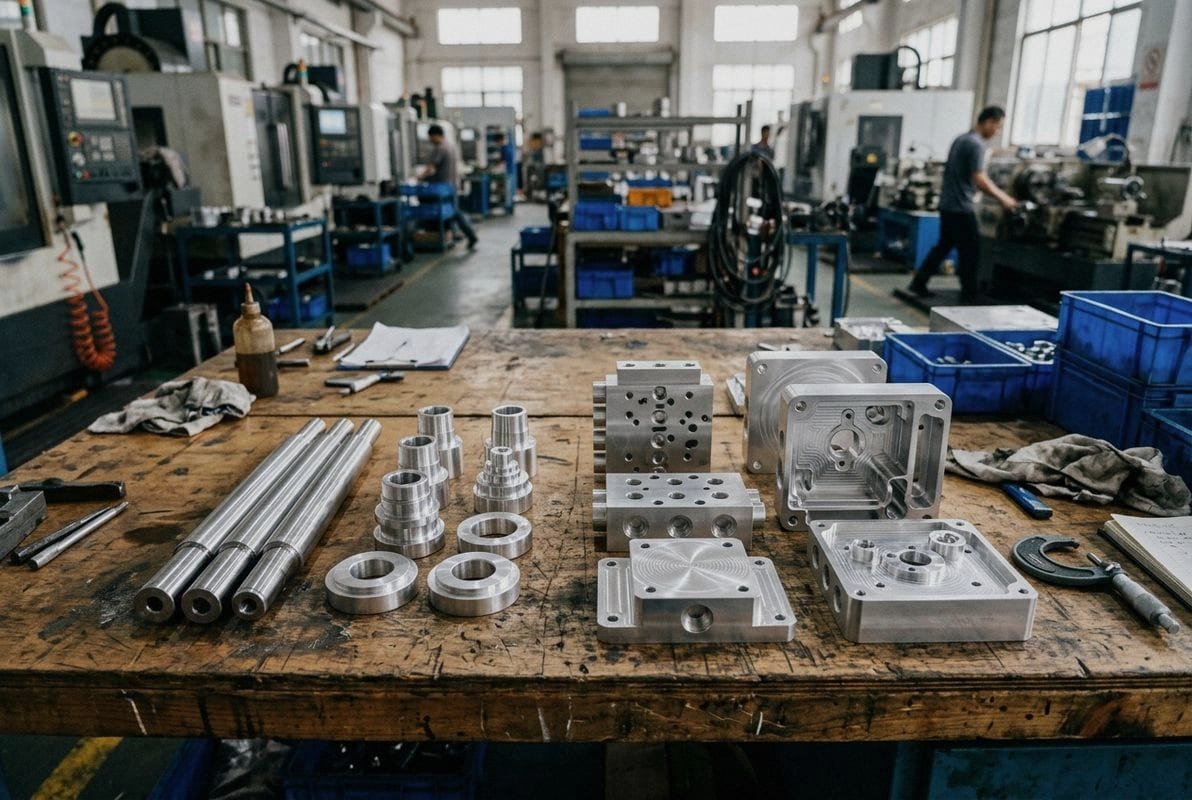
Every week on our shop floor in Dongguan, we see the same question land in our inbox: “Should I mill this part or turn it?” Engineers send over drawings for aluminum housings, stainless-steel shafts, and complex impeller geometries—and choosing the wrong process burns money, wastes lead time, and risks missing tight tolerances that an assembly demands.
The key differences between CNC milling and CNC turning come down to what rotates: in milling, a multi-point cutting tool spins against a stationary workpiece to create complex geometries; in turning, the workpiece itself rotates while a single-point cutting tool removes material, producing cylindrical parts quickly and cost-effectively.
Below, I break this topic down through four practical questions our buyers ask most multi-point cutting tool 1. I also cover the mill-turn hybrid approach that is reshaping how we quote and produce parts today.
How do I determine whether my part design is better suited for CNC milling or CNC turning?
A US-based automation customer once sent us a 3D model for a round housing with deep internal pockets—at first glance it looked like a turning job, but the pockets and angled slots told a different story multi-axis machining 2. That single file sparked a DFM conversation that saved the customer two days of cycle time.
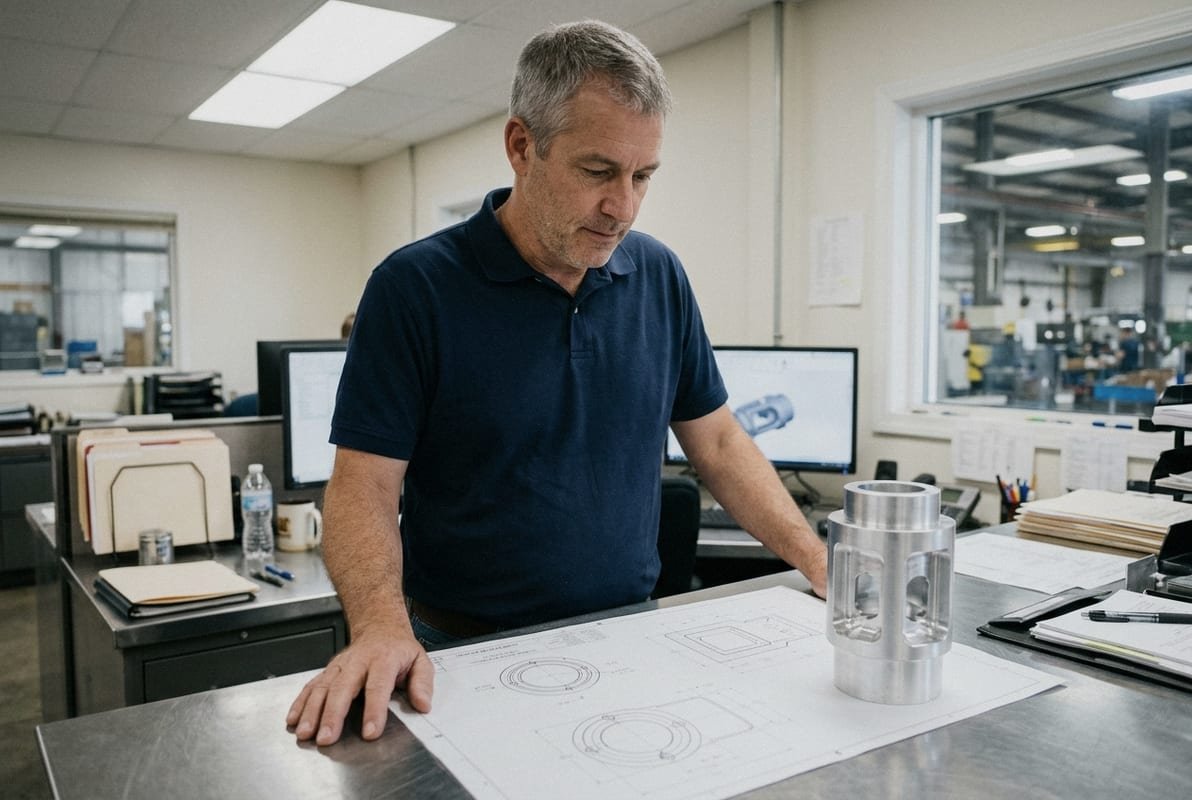
To determine the best process, examine your part's dominant geometry: if the design is rotationally symmetrical—shafts, bushings, or cones—CNC turning on a lathe is the natural choice; if it features flat surfaces, pockets, slots, or irregular 3D contours, CNC milling with multi-axis machining is the better fit.
Start With the Shape
The simplest rule of thumb on our production floor is: "If it's round, turn it. If it's anything else, mill it." A CNC lathe spins the workpiece at high RPM while a stationary single-point cutting tool 3 removes material in a continuous motion. This workpiece rotation is efficient for producing concentric features—threads, tapers, grooves, and smooth cylindrical surfaces.
A CNC milling machine, on the other hand, keeps the workpiece clamped to a table while rotating cutting tools (end mills, face mills, drills) move across multiple axes. This setup excels at prismatic shapes, angular pockets, and complex 3D contours that a lathe simply cannot reach.
Look Beyond the Primary Shape
Many real-world parts are not purely round or purely prismatic. When we review a customer's drawing, our engineers check for secondary features:
- Does the round shaft also need a keyway or flat? That may require a milling operation after turning.
- Does the rectangular block have a central bore with tight concentricity? A turning step could improve that tolerance.
This is exactly where a mill-turn machine 4 becomes valuable. It combines both processes in one setup, eliminates re-fixturing error, and cuts handling time—something we recommend frequently for hybrid parts.
A Quick Decision Checklist
| Question | If Yes → | If No → |
|---|---|---|
| Is the part rotationally symmetrical? | CNC-drejning | CNC-fræsning |
| Does it have flat faces, pockets, or slots? | CNC-fræsning | CNC Turning may suffice |
| Are there both cylindrical and prismatic features? | Mill-Turn combination | Single process |
| Is wall thickness below 1 mm in some areas? | Milling with careful fixturing | Either process works |
| Does the design need undercuts or 5-axis access? | Multi-axis milling | Standard 2- or 3-axis OK |
Workholding Matters Too
In turning, the part is gripped by a chuck or collet and rotates. The gripping surface must be cylindrical enough to hold securely. In milling, a vise, clamp, or custom fixture holds the part stationary on a table. When we provide DFM feedback, we flag features that make fixturing difficult—because poor workholding 5 leads to vibration, dimensional drift, and scrapped parts.
Material and Geometry Interaction
Some materials behave differently under continuous versus intermittent cutting. Turning provides continuous contact, which generates steady heat—good for most aluminum and stainless-steel alloys we machine daily. Milling produces intermittent cuts; each tooth engages and disengages, creating thermal cycling 6 on the tool edge. For harder materials like titanium, this cycling can accelerate tool wear. Our team factors material choice into the process decision alongside geometry.
Should I use CNC turning for my cylindrical parts or is milling a more efficient option for my project?
Last month a European buyer asked us to quote a batch of 500 stainless-steel pins—simple cylindrical parts with external threads and a chamfer. He had originally planned to mill them from square bar stock. After we ran the numbers, turning cut the per-piece cycle time nearly in half.
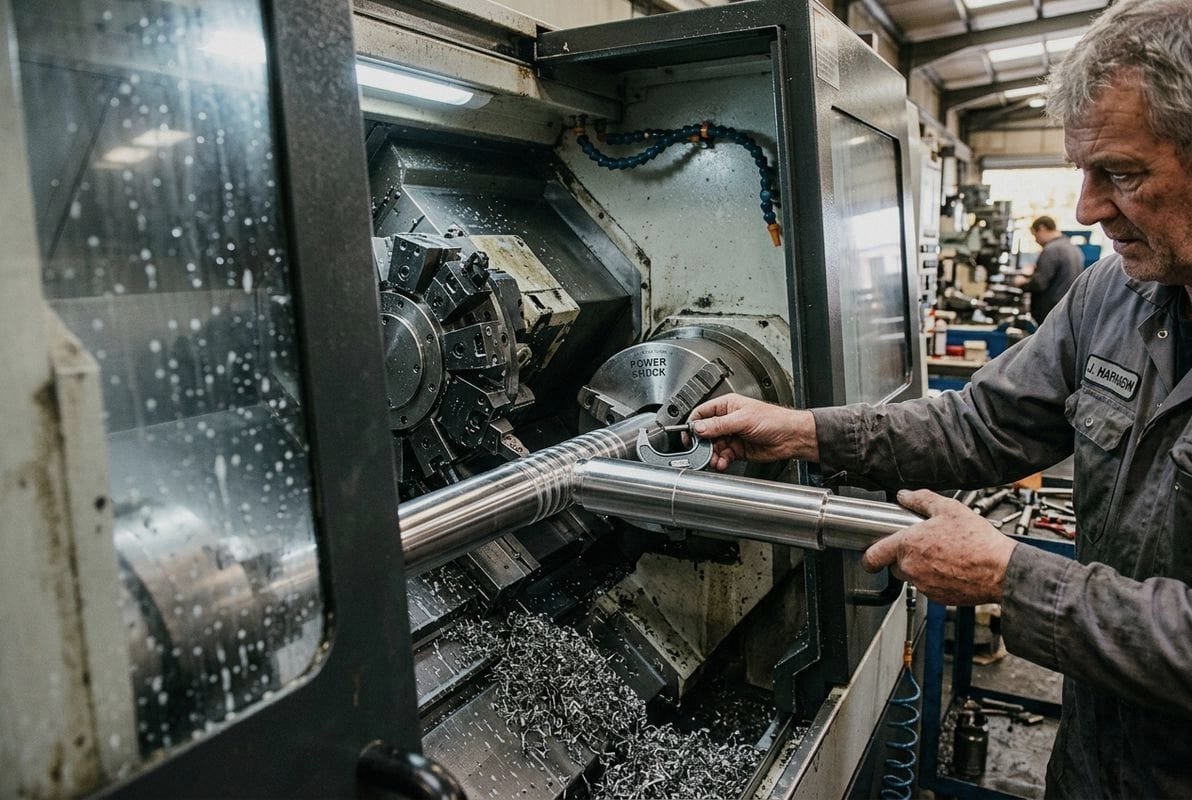
For straightforward cylindrical parts like shafts, pins, bushings, and threaded fasteners, CNC turning is almost always more efficient because the continuous cutting action of a CNC lathe removes material faster, requires simpler setup, and delivers a smoother surface finish on concentric surfaces than milling would.
Why Turning Wins on Round Parts
Turning uses a single-point cutting tool that stays in continuous contact with the rotating workpiece. There is no intermittent engagement. This means:
- Higher material removal rates 7 on bar stock.
- Less tool wear per unit of material removed.
- A naturally smooth, concentric surface finish.
Milling a cylindrical profile, by contrast, requires the rotating cutter to trace a circular tool path around the part. Each pass is a series of intermittent cuts, which is slower and can leave visible tool marks that need extra finishing.
When Milling Might Still Be the Answer
Even for a round part, milling can be the better choice if:
- The part has complex non-round features (deep pockets, cross-holes at odd angles, flat faces on multiple sides).
- The part starts as a plate or block rather than bar stock.
- Production volume is very low (one or two pieces), and the milling machine is already set up.
On our floor, we keep both 5-axis milling centers and CNC lathes running. When a part needs both cylindrical and prismatic features, we often program a mill-turn machine to handle everything in one clamping.
Cycle Time and Cost Comparison for a Typical Cylindrical Part
| Factor | CNC-drejning | CNC-fræsning |
|---|---|---|
| Setup time | Short — chuck the bar and go | Longer — fixturing required |
| Cycle time per piece (simple shaft) | ~2–4 minutes | ~6–10 minutes |
| Surface finish on OD | Excellent (continuous cut) | Good (may need extra pass) |
| Tool cost per 1,000 parts | Lower (single-point inserts) | Higher (multi-point end mills) |
| Best for production volume | Medium to high | Low to medium |
These figures are general ranges based on what we see across our shop. Actual times depend on part size, material, and tolerance. But the trend is clear: for cylindrical parts, turning is the faster, cheaper path in most scenarios.
The Mill-Turn Hybrid Advantage
When a cylindrical part also requires milling features—like a keyway, a cross-drilled hole, or a flat—a mill-turn machine handles it without removing the part from the chuck. This eliminates re-clamping error and keeps concentricity tight. We have seen tolerance improvements of 0.01 mm or better simply by avoiding a second setup. For production volume above a few dozen pieces, the time savings compound quickly.
Chip Formation and Heat Management
Turning generates continuous or semi-continuous chips, which carry heat away from the cut zone in a predictable stream. Coolant application is straightforward. Milling produces discontinuous chips because each tooth enters and exits the cut. This thermal cycling can cause micro-cracking on tool edges when machining tough alloys. For long production runs of cylindrical parts in stainless steel or titanium, turning's steady heat profile extends tool life and keeps our per-part cost stable.
How will the difference between milling and turning affect my final unit price and manufacturing speed?
One trade-off we weigh every day is cost versus capability. A procurement manager from a medical device company recently asked us to quote the same part two ways—fully milled from billet, and turned with secondary milling ops. The price difference was 30 percent, and delivery was five days shorter on the turning route.
Milling and turning affect unit price and speed differently: turning is generally cheaper and faster for round, symmetrical parts because of simpler setup, continuous cutting, and lower tool costs; milling costs more per part but is essential for complex geometries that a lathe cannot produce, so total cost depends on your part's shape and production volume.
Breaking Down the Cost Drivers
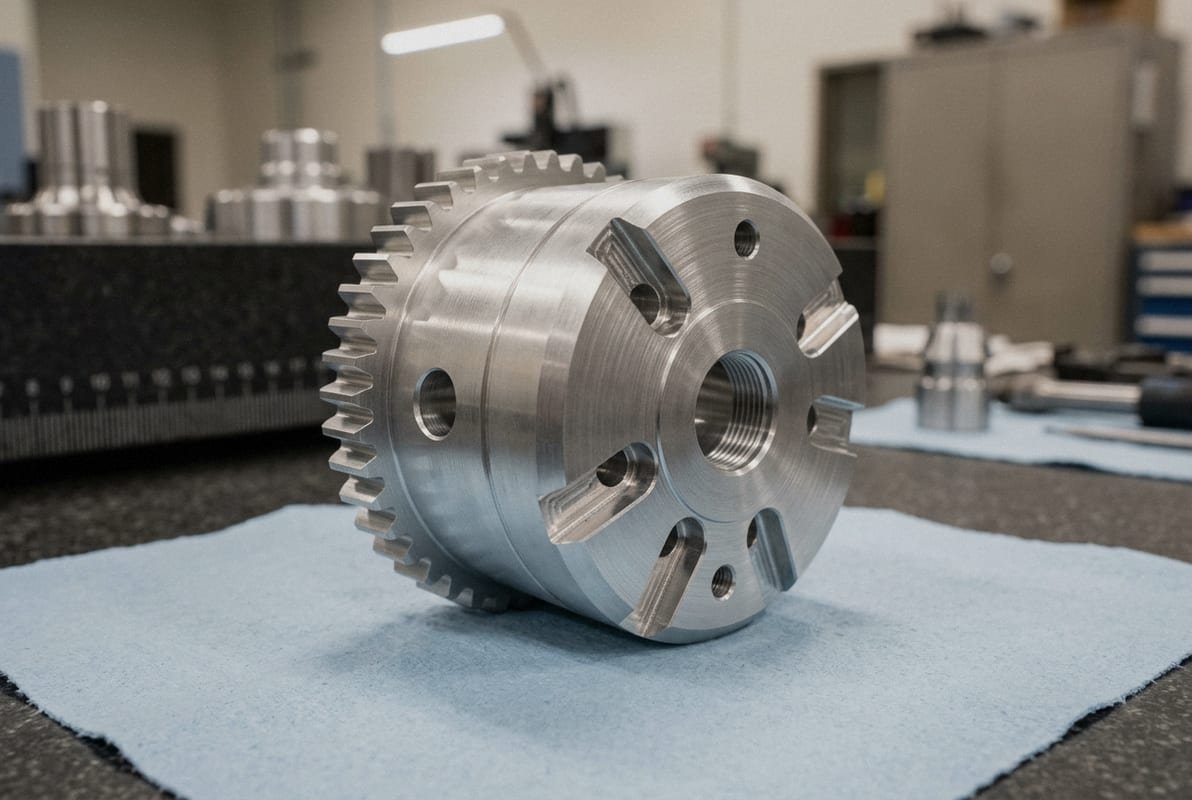
Unit price in subtractive manufacturing 8 comes from four main buckets: material, machine time, tooling, and labor (including programming and setup). Let me walk through how each one shifts between milling and turning.
Materiale
Turning typically starts from round bar stock, which is closer to the final shape of a cylindrical part. Less material is wasted. Milling often starts from rectangular billet, and for a round part that means cutting away far more excess metal. More waste equals higher material cost.
Machine Time
Cycle time is the single biggest driver of unit price on our shop floor. Turning's continuous cut is inherently faster for concentric features. Milling's intermittent cut and multi-pass tool paths add time—especially on 3D contoured surfaces where the cutter must trace complex tool paths generated by CAD CAM software 9.
Tooling
Single-point turning inserts are inexpensive and each one handles a wide range of operations (facing, OD turning, threading). Milling uses multiple specialized cutting tools—end mills, face mills, drills, taps—each with a different role. More tool changes mean more non-cutting time and more tool cost.
Cost Comparison by Part Type
| Part Type | Lower-Cost Process | Reason |
|---|---|---|
| Simple shaft or pin | Drejning | Fast cycle, cheap tooling, minimal setup |
| Threaded fastener | Drejning | Thread cutting is native to lathes |
| Rectangular housing | Fræsning | Prismatic shape requires flat-face cuts |
| Impeller or turbine wheel | 5-axis milling | Complex 3D contours, tight tolerances |
| Shaft with keyway and cross-holes | Mill-turn | Combines both to avoid double setup |
| Low-volume prototype (any shape) | Depends on geometry | Evaluate case by case |
Speed: Setup Time vs. Cycle Time
For high-volume runs, cycle time dominates total production time. Turning wins here for round parts. But for low-volume or prototype work, setup time matters more. Milling setups can be faster if the part can be clamped in a simple vise—no custom chuck jaws needed.
We often advise customers to consider the full picture: a part that takes two minutes to turn but needs fifteen minutes of setup is expensive at quantity one, but very cheap at quantity one thousand.
How We Optimize Pricing for Our Buyers
When a drawing arrives, our team runs a DFM review before quoting. We look for features that drive cost up unnecessarily:
- Overly tight tolerances on non-critical surfaces.
- Deep pockets with small radii that require tiny, slow end mills.
- Features that force a second setup when a mill-turn approach could handle it in one.
By suggesting small design adjustments—widening a pocket radius, relaxing a non-functional tolerance—we can often reduce the quote by 10 to 20 percent without affecting part function. This is the kind of transparent, engineering-driven quoting that our repeat buyers in the US and Europe value.
Can I achieve the high-precision tolerances I need for my assembly using both milling and turning processes?
During a recent first-article inspection for an aerospace bracket, we held ±0.005 mm on a bore concentricity call-out using a combination of turning and finish milling. The customer's quality engineer was surprised—he expected to need grinding as a secondary operation.
Yes, both CNC milling and CNC turning can achieve high-precision tolerances—typically ±0.01 mm as standard and ±0.005 mm with careful process control. Turning excels at concentric tolerances on round features, while multi-axis milling handles positional and profile tolerances on complex geometries; combining both in a mill-turn setup often delivers the best overall accuracy.

Understanding Tolerance Types
Not all tolerances are the same. When a customer spec says "±0.01 mm," the type of tolerance matters:
- Dimensional tolerance (length, diameter, depth) — achievable on both mills and lathes.
- Geometric tolerance (concentricity, cylindricity, flatness, perpendicularity) — the process choice matters more here.
- Surface finish (Ra value) — directly tied to cutting mechanics.
Turning's continuous cut produces inherently round surfaces. Concentricity and cylindricity are natural outcomes of workpiece rotation around a fixed axis. Milling's strength is positional accuracy across multiple features—hole patterns, slot locations, and profile tolerances on 3D surfaces.
Tolerance Capabilities by Process
| Tolerance Type | CNC-drejning | CNC-fræsning | Mill-Turn |
|---|---|---|---|
| Diameter ±0.01 mm | ✔ Standard | ✔ Possible but slower | ✔ Standard |
| Concentricity ≤0.01 mm | ✔ Excellent | △ Difficult without rotation | ✔ Excellent |
| Flatness ≤0.01 mm | △ Limited to faced surfaces | ✔ Excellent | ✔ Excellent |
| Position tolerance ±0.02 mm | △ Limited axes | ✔ Multi-axis capable | ✔ Full capability |
| Surface finish Ra 0.8 µm | ✔ Achievable | ✔ Achievable | ✔ Achievable |
| Surface finish Ra 0.4 µm | ✔ With fine turning | △ May need extra pass | ✔ With fine turning |
How We Maintain Tight Tolerances in Production
Holding tight tolerances on one prototype is one thing. Holding them across a batch of 500 or 5,000 pieces is the real challenge. Here is what we do on our shop floor:
- Tool wear monitoring. We track insert life by part count and replace tools before they drift out of spec—not after.
- In-process measurement. Critical dimensions are checked at regular intervals during the run, not just at the end.
- Temperature control. Coolant temperature and ambient shop temperature affect thermal expansion. We keep our facility climate-controlled.
- First-article inspection (FAI). Every new job gets a full dimensional report before batch production begins. We share these reports with the customer for sign-off.
- Fixture rigidity. A loose vise or worn chuck jaw is the fastest path to dimensional drift. We inspect workholding components on a maintenance schedule.
Surface Finish: Continuous vs. Intermittent Cutting
Surface finish is closely tied to how the tool contacts the workpiece. Turning's continuous engagement leaves a helical tool mark pattern that is uniform and easy to control. By adjusting feed rate and nose radius, we can hit Ra 0.4 µm or better on a turned surface.
Milling's intermittent cuts leave a scalloped pattern. The height of these scallops depends on step-over distance and cutter diameter. Achieving the same Ra value on a milled surface often requires a finishing pass with a ball-nose end mill at very small step-overs—adding cycle time.
For parts that need both a smooth bore (turning strength) and a precise flat datum (milling strength), a mill-turn machine delivers both in one setup. This avoids the re-clamping error that can push concentricity or perpendicularity out of tolerance.
The Role of CAD CAM Software
Modern CAD CAM software lets our programmers simulate the entire machining process before cutting metal. We verify tool paths, check for collisions, and predict surface finish quality on screen. This digital step is critical for multi-axis milling of complex geometries—like the radial impeller blades we machine from solid aluminum billet. Without simulation, the risk of a crash or an out-of-tolerance feature goes up sharply.
Konklusion
Choosing between CNC milling and CNC turning depends on part geometry, tolerance requirements, production volume, and cost targets. For many projects, a mill-turn combination delivers the best balance—and our team is here to help you decide. If you are new to the process, learning what CNC machining is and how to source custom parts is a great starting point.
Footnotes
1. Found a relevant and informative article from a reputable commercial source explaining multi-point cutting tools. ↩︎
2. Describes multi-axis machining, its benefits, and how it expands on traditional methods. ↩︎
3. Explains single-point cutting tools, their function, and applications in machining. ↩︎
4. Defines mill-turn machines as hybrid CNC equipment combining milling and turning capabilities. ↩︎
5. Explains workholding’s importance in CNC machining for part stability and accuracy. ↩︎
6. Describes thermal cycling’s impact on cutting tools due to repeated heating and cooling. ↩︎
7. Defines material removal rate as the volume of material removed per unit time. ↩︎
8. Explains subtractive manufacturing as a process where material is removed from a solid block. ↩︎
9. Describes CAD/CAM software’s role in designing and manufacturing products, including toolpath generation. ↩︎
10. Explains fundamental differences and applications of both processes. ↩︎

 Dansk
Dansk  English
  Italiano
  Français
  日本語
日本語  Deutsch (Sie)
  Español
  Русский
  العربية
  Български
  Čeština
  Suomi
Suomi  עִבְרִית
  हिन्दी
  Nederlands
  Português
  Română
  Slovenčina
  Svenska
  ไทย
ไทย  Tiếng Việt
  Türkçe
  Slovenščina