

Over the past 20 years, our shop floor in Dongguan has seen one costly pattern repeat itself: engineers specifying unnecessarily tight CNC machining tolerances 1 on every single dimension of a drawing, then wondering why quotes come back two or three times higher than expected. The problem is real — roughly 90% of the cost waste we track on incoming projects traces back to what our team calls “fake tight tolerances,” dimensions marked ±0.01 mm that serve no functional purpose. It frustrates buyers, inflates lead times, and burns budgets Design for Manufacturability approach 2. The good news? A smarter approach exists, and it starts with understanding which numbers on your drawing actually matter.
Choose the right CNC machining tolerances by defaulting to the industry standard of ±0.005″ (±0.127 mm) for non-critical dimensions, then selectively tightening only features that affect fit, function, or assembly. This function-first approach controls cost, shortens lead times, and ensures reliable part performance.
This guide walks through every decision point — from standard versus tight tolerances, to material effects, to identifying critical dimensions on your drawing Maximum Material Condition (MMC) 3. Let’s break it down step by step.
What are the standard CNC machining tolerances I should expect for my custom metal parts?
A question we hear almost weekly from new buyers in the US and Europe is: "What tolerance do I get if I don't specify anything?" It is a fair question, and the answer depends on how your supplier defines their default standard.
Standard CNC machining tolerances are typically ±0.005″ (±0.127 mm) for linear dimensions on milling and turning operations. Our facility follows ISO 2768-mK or ISO 2768-H as the default free-tolerance standard, with the ability to hold ±0.005 mm on critical features when drawings require it.
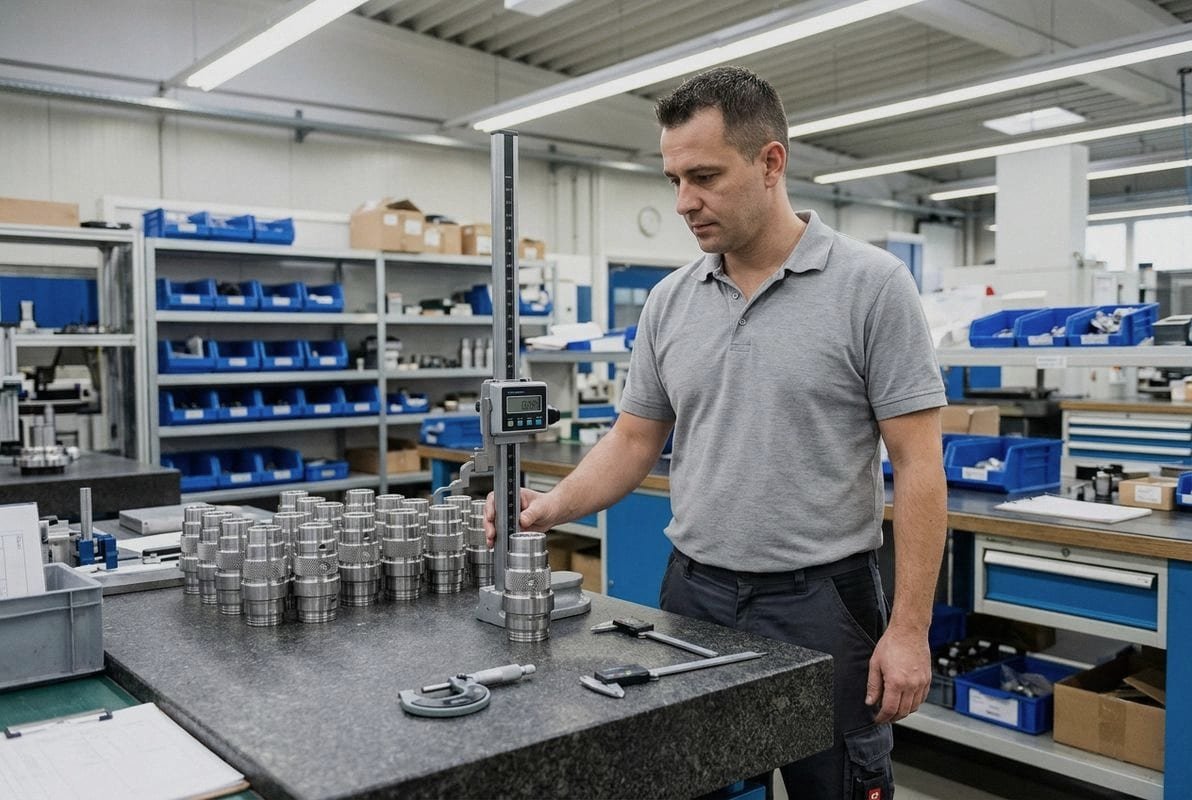
Understanding What Tolerance Really Means
Tolerance is the allowable variation in a dimension, shape, or position from its nominal value. No CNC machine produces the exact same result on every cycle. Tool wear, thermal expansion 4, and material behavior all introduce tiny variations. Tolerances define the acceptable range so that every part still works.
There are three common ways to express a tolerance:
- Bilateral: The variation goes both ways from nominal — for example, 25.00 mm ±0.05 mm.
- Unilateral: The variation goes only one direction — for example, 25.00 mm +0.000 / –0.010 mm.
- Limit-based: You state the upper and lower acceptable sizes directly — for example, 25.05 / 24.95 mm.
Beyond linear dimensions, tolerances also cover angular dimensions, geometric characteristics 5 (flatness, straightness, roundness), and surface roughness. A complete tolerance specification addresses all three categories.
Typical Tolerances by CNC Process
Here is a reference table we share with first-time buyers so they know what to expect before requesting a quote:
| CNC Process | Standard Tolerance | Notes |
|---|---|---|
| 3-Axis / 5-Axis Milling | ±0.005″ (±0.127 mm) | Most common for custom metal parts |
| CNC Turning (Lathe) | ±0.005″ (±0.127 mm) | Cylindrical features |
| CNC Router | ±0.005″ (±0.127 mm) | Larger sheet or plate work |
| Wire EDM | ±0.0002″ (±0.005 mm) | For ultra-precise profiles and slots |
| Gasket / Rail Cutting | ±0.030″ (±0.762 mm) | Non-precision processes |
| Steel Rule Die Cutting | ±0.015″ (±0.381 mm) | Soft materials, low precision |
| Surface Finish (default) | 125 RA (3.2 µm Ra) | Unless otherwise specified |
To put this in perspective, a human hair is about 0.002″ (0.05 mm) thick. The standard ±0.005″ tolerance is roughly 2.5 times a hair's thickness. Precision machining 6 can push that down to ±0.001″ or even ±0.0005″, but that level of dimensional accuracy requires slower feeds, sharper tooling, temperature-controlled environments, and more inspection — all of which add cost.
ISO 2768 Tolerances as a Baseline
When a drawing arrives at our facility without explicit tolerances on every dimension, we apply ISO 2768-mK 7 (medium tolerance class for linear, K class for geometric) or ISO 2768-H, depending on the customer's preference. This gives both sides a shared starting point. It eliminates ambiguity and keeps quoting fast. If a buyer's drawing references a different general tolerance standard, we follow that instead.
How can I balance my need for high precision with my project budget to avoid over-engineering?
Last year, a medical-device buyer in California sent us a bracket drawing with every dimension toleranced to ±0.01 mm. After our DFM review, only four of the thirty-two dimensions actually needed that precision — the rest were clearance holes and cosmetic surfaces. Relaxing those non-critical features to ±0.05 mm cut the unit price by nearly 35% and shortened the lead time by two days.
Balance precision and budget by applying tight tolerances only to features critical for fit, function, or assembly, and using standard ±0.005″ tolerances everywhere else. This Design for Manufacturability approach avoids over-engineering, reduces machining time, and keeps inspection costs in check.

The Real Cost of Tight Tolerances
Tighter tolerances are not just a number on paper. They translate directly into slower spindle speeds, more tool changes, additional setups, and extended quality-control time. Here is a simplified cost-impact framework our quoting team uses internally:
| Tolerance Range | Relative Cost Impact | Typical Requirements |
|---|---|---|
| ±0.005″ (±0.127 mm) | Baseline (1×) | Standard tooling, normal feeds and speeds |
| ±0.002″ (±0.050 mm) | 1.5× – 2× baseline | Sharper tooling, slower feeds, in-process checks |
| ±0.001″ (±0.025 mm) | 2× – 3× baseline | High-precision equipment, temperature control, CMM inspection |
| ±0.0005″ (±0.013 mm) | 3× – 5× baseline | Specialized machines, dedicated fixturing, 100% CMM verification |
Every step down in tolerance roughly doubles — or more — the cost of that feature. When you multiply that across dozens of dimensions, the price escalates fast. The cost of tight tolerances is the single biggest controllable variable in most CNC quotes.
A Step-by-Step Method to Avoid Over-Engineering
- List every dimensioned feature on the drawing.
- Classify each feature as critical (affects fit, function, or assembly) or non-critical (cosmetic, clearance, or non-mating).
- Assign ±0.005″ to all non-critical features.
- Apply tighter tolerances only to features you classified as critical. Start at ±0.002″ and go tighter only if analysis proves it necessary.
- Consider GD&T for form, orientation, and position controls. A position tolerance within a feature control frame often communicates your intent more precisely than an overly tight linear dimension.
This function-first tolerance design takes about 30 minutes of engineering review but can save thousands of dollars on a production run.
Opposing Views: Function vs. Price
Some engineers argue tolerances should be based purely on function, never on price. The logic is sound: if a part needs ±0.001″ to work, you must pay for it. But in practical engineering reality, many drawings carry tight tolerances inherited from earlier revisions, CAD defaults, or a cautious "just in case" mindset. The smart move is to question every tight callout. If you cannot point to a specific functional reason for it, relax it. This is not cutting corners — it is engineering discipline.
Will my choice of material or surface finishing affect the final tolerances of my components?
When we machine a batch of 6061-T6 aluminum impeller wheels on our 5-axis centers, the process is predictable — chips clear easily, tools stay sharp, and dimensions hold within ±0.01 mm all day. Switch that same geometry to titanium Ti-6Al-4V, and the conversation changes. Feeds drop, tool life shortens, and heat distortion becomes a constant battle.
Yes — material hardness, thermal expansion, and machinability directly influence achievable tolerances, and post-machining surface treatments like anodizing or plating add dimensional changes that must be accounted for in your tolerance budget from the start.
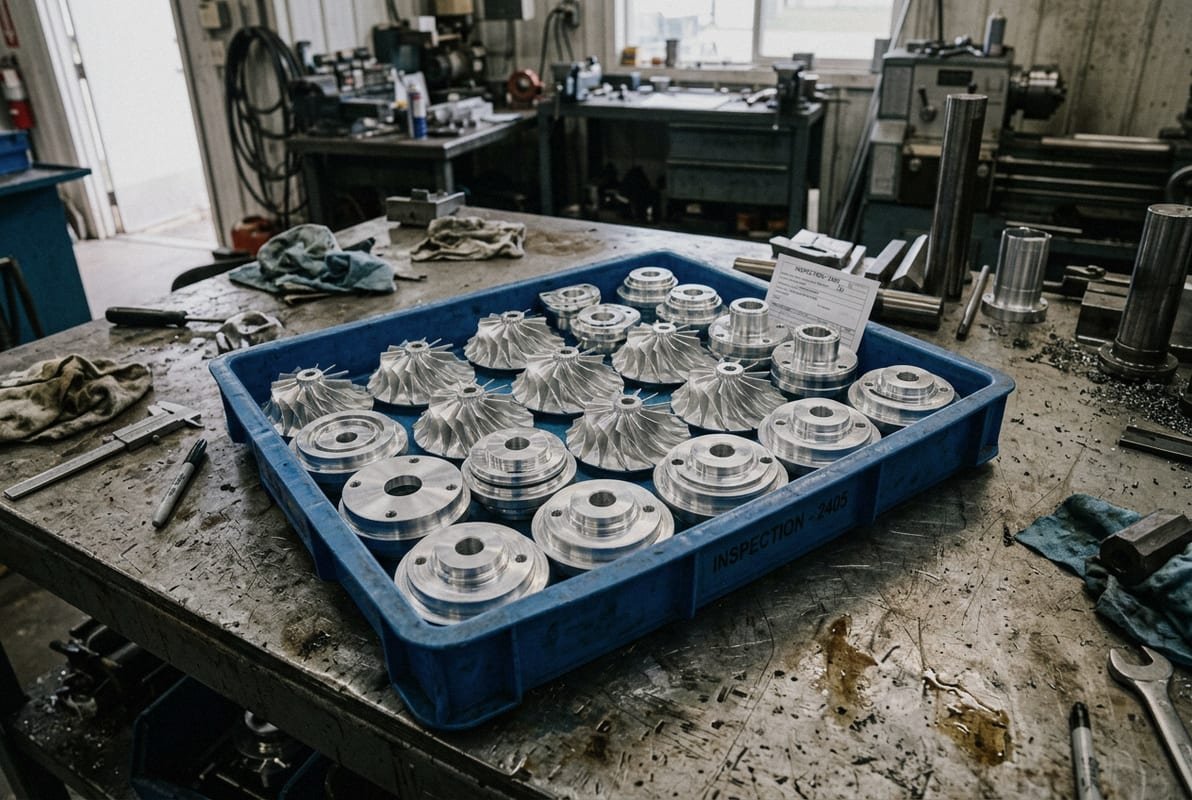
How Material Properties Drive Tolerance Outcomes
Different metals respond differently under a cutting tool. Softer materials like aluminum are forgiving and easy to hold to tight tolerances. Harder or tougher alloys resist the cut, generate more heat, and wear tools faster. Cross-grained or inconsistent microstructures add another variable. Here is a practical comparison:
| Matériau | Machinability | Achievable Tolerance (Practical) | Key Challenge |
|---|---|---|---|
| Aluminum 6061-T6 | Excellent | ±0.005 mm readily | Minimal — easy to cut and holds dimensions well |
| Stainless Steel 304 | Moderate | ±0.01 mm typical | Work-hardens; requires sharp tools and correct speeds |
| Stainless Steel 316 | Moderate-Hard | ±0.01–0.02 mm | More gummy than 304; higher tool wear |
| Titanium Ti-6Al-4V | Difficult | ±0.02–0.03 mm without special care | Low thermal conductivity causes localized heat buildup |
| Hardened Tool Steel (HRC 50+) | Very Difficult | ±0.02–0.05 mm | Extreme tool wear; may require EDM for tight features |
| Engineering Plastics (POM, PEEK) | Variable | ±0.03–0.05 mm | Thermal expansion, flex under clamping pressure |
Material condition modifiers in GD&T 8 — Maximum Material Condition (MMC) and Least Material Condition (LMC) — become especially relevant when tolerancing features in materials that expand or contract more than expected. A bore in aluminum that measures perfectly at room temperature may shift after anodizing or after the part reaches its operating temperature.
Surface Finishing and Its Dimensional Impact
Post-machining treatments change dimensions. Anodizing aluminum adds roughly 0.0005″ to 0.001″ per surface. Hard anodizing can add 0.001″ to 0.002″. Electroless nickel plating 9, chrome plating, and powder coating each add their own thickness. If you tolerance a feature to ±0.005 mm and then add a 0.02 mm coating, you have already blown the tolerance.
Our standard practice is to ask buyers about surface finishing plans up front. We then adjust the machined dimension to compensate, so the final coated dimension falls within spec. This is where a tolerance stack-up analysis becomes essential — you must account for every layer between the raw machined surface and the finished part.
Surface roughness also plays a role. A smoother finish (lower Ra value) generally requires lighter finishing passes, which means tighter dimensional control. A rougher surface (higher Ra) may be faster to produce but introduces more variation at the microscopic level.
Practical Advice
If you are designing a part in a challenging material and need tight tolerances, consult your machining supplier early. Our team provides DFM feedback specifically to flag tolerance-material conflicts before cutting starts. It is far cheaper to adjust a drawing than to scrap parts. For more guidance on selecting the right alloy for your project, see our overview of the best materials for precision CNC machining.
How do I identify which critical dimensions in my drawing actually require tighter tolerances for assembly?
One of our engineers likes to say, "If you highlight every dimension on a drawing, you have highlighted nothing." The point is clear: when everything is flagged as critical, nothing gets the special attention it deserves. The skill lies in separating the dimensions that truly govern fit and function from the ones that simply exist because a CAD system generated them.
Identify critical dimensions by examining each feature’s role in the assembly: mating surfaces, bearing bores, dowel-pin holes, sealing faces, and alignment datums demand tighter tolerances, while clearance holes, cosmetic edges, and non-mating surfaces can safely use standard ±0.005″ tolerances.

A Practical Classification Process
Here is the method we recommend — and the one we use internally during DFM reviews:
- Open your assembly model. Look at how each part interfaces with its neighbors.
- Mark every mating surface. Any surface that contacts another part at assembly is a candidate for tighter tolerance.
- Identify locating features. Dowel holes, keyways, alignment slots, and datum surfaces define the part's position in the assembly. These need precision.
- Check functional interfaces. Bearing bores, shaft fits, O-ring grooves, and threaded holes all have published fit standards. Use those standards (e.g., H7/g6 for a bearing bore) rather than inventing arbitrary tolerances.
- Flag sealing surfaces. If a surface must seal against fluid or gas, flatness and surface roughness matter as much as linear dimensions. This is where Geometric Dimensioning and Tolerancing shines — a flatness callout of 0.02 mm communicates your intent far better than simply tightening the thickness tolerance.
- Leave everything else at standard. Outer edges, through-holes for clearance bolts, cosmetic surfaces, and non-functional pockets do not need ±0.001″. They need ±0.005″ or looser.
When GD&T Beats Linear Tolerances
Geometric Dimensioning and Tolerancing, governed by the ASME Y14.5 standard 10, gives you tools that linear dimensions alone cannot provide. A feature control frame lets you control position, flatness, perpendicularity, concentricity, and runout — each tied to a datum reference frame. This means you can allow a looser size tolerance on a hole while still controlling its position to ±0.05 mm relative to a datum.
For example, consider two mounting holes that must align with pins on a mating part. You could tolerance each hole's X and Y position to ±0.002″ using coordinate dimensions. Or you could use a position tolerance of ⌀0.004″ at MMC relative to datums A, B, and C. The GD&T approach actually gives you more usable tolerance (because of the cylindrical tolerance zone) while ensuring the holes still align. It also communicates your intent to the machinist clearly — they know what matters and why.
Tolerance Stack-Up in Multi-Part Assemblies
When multiple parts assemble together, individual tolerances accumulate. A three-part stack where each part contributes ±0.005″ can yield a worst-case total variation of ±0.015″. If your assembly gap only allows ±0.010″, you have a problem. This is tolerance stack-up analysis, and it is essential for complex assemblies.
Simple stack-ups can be done by hand using worst-case addition. For more complex assemblies, statistical methods (RSS — Root Sum of Squares) give a more realistic picture. Advanced simulation tools can model these accumulations before you cut a single chip.
Our recommendation: run a basic stack-up analysis on every assembly with more than three interfacing parts. It often reveals that one or two features truly drive the stack — those are the ones that deserve tighter tolerances. The rest can stay standard.
Specifying Tolerances Clearly on Drawings
A few practical tips for clean, unambiguous tolerance callouts:
- Use three-place decimal dimensions (e.g., 1.005, not 1.00500) to signal the intended precision level.
- Clearly state units — inch or metric — in the title block. Never assume.
- Use bilateral tolerances (±) for general features and limit-based tolerances for fits (e.g., bore: 25.021 / 25.000 mm).
- Avoid extra trailing zeros that imply tighter precision than you need.
- Reference your general tolerance standard (ISO 2768-mK, for example) in the title block so unstated dimensions have a clear default.
If you are new to sourcing custom CNC parts, getting comfortable with these drawing conventions early will streamline communication with your supplier and reduce revision cycles.
Conclusion
Choosing the right CNC machining tolerances comes down to one principle: let function drive the numbers. Default to ±0.005″ for non-critical features, tighten only where fit or assembly demands it, use GD&T to communicate intent precisely, and account for material behavior and surface finishing early. Consult your machining partner during design — not after. That single habit saves more money and avoids more quality issues than any other step in the process.
Footnotes
1. Explains the definition and importance of CNC machining tolerances. ↩︎
2. Describes the principles and benefits of Design for Manufacturability. ↩︎
3. Clarifies the meaning and application of Maximum Material Condition in GD&T. ↩︎
4. Explains the physical phenomenon of thermal expansion in materials. ↩︎
5. Defines various geometric characteristics used in tolerancing. ↩︎
6. Reference 4. ↩︎
7. Reference 2. ↩︎
8. Introduces the concept of Geometric Dimensioning and Tolerancing. ↩︎
9. Reference 9. ↩︎
10. Links to the official standard for Dimensioning and Tolerancing. ↩︎

 Français
  English
  Italiano
  日本語
日本語  Deutsch (Sie)
  Español
  Русский
  العربية
  Български
  Čeština
  Dansk
Dansk  Suomi
Suomi  עִבְרִית
  हिन्दी
  Nederlands
  Português
  Română
  Slovenčina
  Svenska
  ไทย
ไทย  Tiếng Việt
  Türkçe
  Slovenščina