

Powder coating and anodizing both land on our finishing request forms weekly, and choosing wrong can scrap a batch. Our Dongguan line has seen it. Here is how to choose.
Powder coating and anodizing differ in how they protect metal. Powder coating applies a thick 50–150 micron polymer film with wide color choice and impact resistance on steel or aluminum. Anodizing converts aluminum into a thin, hard oxide layer with better abrasion resistance and tighter dimensional control.
The two processes are not rivals for the same job. Powder coating uses electrostatic spray deposition 1 and an oven. Anodizing uses an electrolytic process in an acid bath. One is an applied layer. The other is a converted surface. That single difference drives almost every trade-off below. In our experience, most customers choose anodizing for their aluminum parts. A smaller group picks powder coating because the part lives outdoors or needs a specific brand color. The next four sections explain why.
How do powder coating and anodizing differ in durability and corrosion resistance for my CNC machined parts?
A black anodized optical housing once showed a bare spot at the rack contact point during our final inspection. That small mark started a long talk about edges.
Anodizing gives aluminum parts higher surface hardness and abrasion resistance, and the oxide layer cannot peel. Powder coating gives a thicker, flexible film that absorbs impacts better. Both resist corrosion well when pretreatment and sealing are correct, but damage exposes bare metal under either finish.
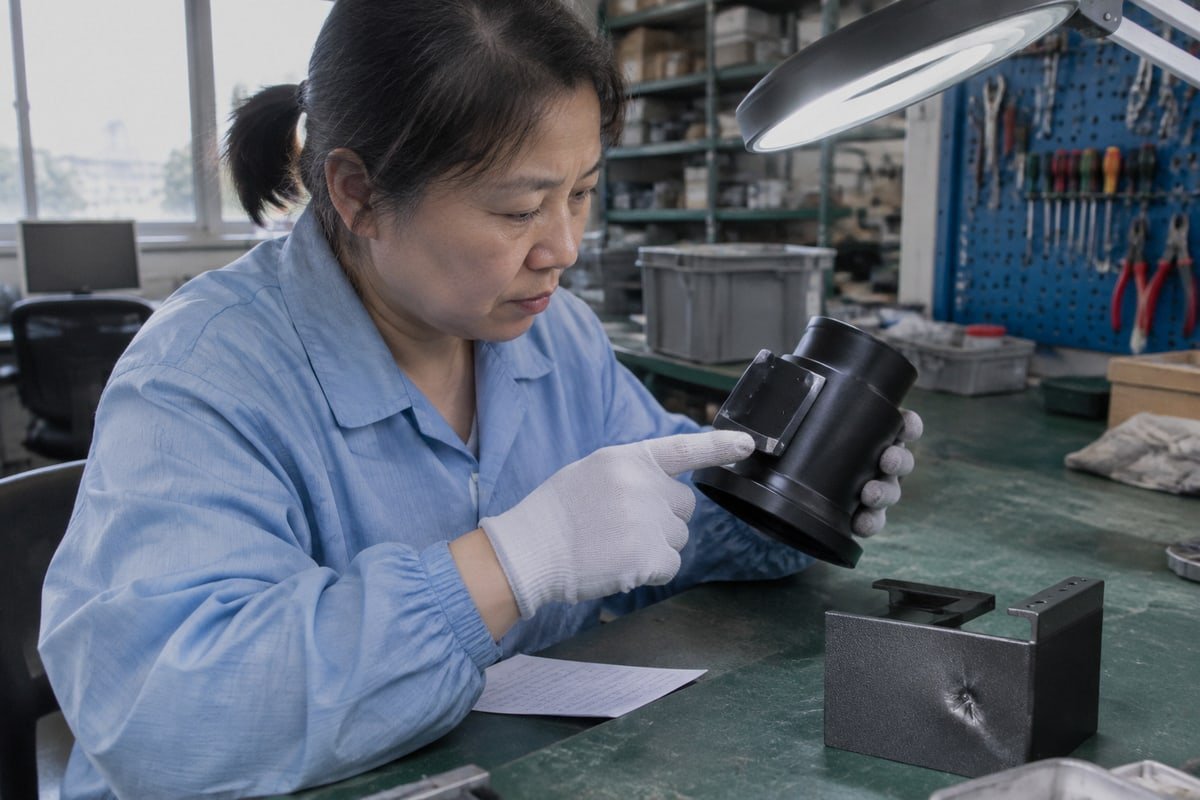
Durability is not one number. A finish that resists sliding wear may crack under a sharp knock. So we break the question into failure modes before we recommend anything.
Durability by failure mode
| Damage type | Revêtement en poudre | Anodizing (Type II / Type III) | Usual winner |
|---|---|---|---|
| Impact and denting | Thick, flexible film deforms and recovers | Brittle oxide can crack | Revêtement en poudre |
| Abrasion and sliding wear | Moderate, around 3–4 Mohs | Very hard, around 8–9 Mohs | Anodisation |
| Chipping and peeling | Possible after poor prep or edge impact | Cannot delaminate; it is the base metal | Anodisation |
| Scratching | Depends on resin grade | Depends on type and sealing | Case by case |
| Heat above 80°C | Stable within resin rating | Can show crazing from expansion mismatch | Revêtement en poudre |
The Mohs figures are broad comparisons from published sources. Real results depend on the powder formulation, the anodizing type, and the test method. We never treat pencil hardness, Taber abrasion 2, and scratch tests as the same thing. They measure different failures.
Where the oxide layer wins
Anodizing grows the oxide layer 3 from the aluminum substrate itself. Nothing sits on top to flake off. That is why wear-prone aluminum parts, such as guide blocks on our mold bases or sliding housings, go to hardcoat. Type III at 25–50 microns handles repeated sliding contact that would wear through a polymer film.
Where the polymer film wins
Powder coating cures at roughly 175–205°C into a continuous barrier of 50–150 microns. That thickness absorbs handling knocks and vibration. Steel brackets we ship to German automation customers often get powder because steel cannot be anodized conventionally.
Corrosion resistance, honestly
Buyers often tell us anodizing always beats powder coating for corrosion resistance. That is not true. A sealed Type II finish performs well in humid and marine air. But a deep scratch exposes the aluminum directly. A powder-coated part with proper pretreatment forms a strong barrier, yet a pinhole or chip can let corrosion creep under the film. The pretreatment and sealing matter as much as the process name. We have seen a well-prepared powder part outlast a poorly sealed anodized one. Specification beats branding.
Which finishing option, powder coating or anodizing, is more cost-effective for my low-volume or mass production order?
A German automation buyer asked us last quarter to quote the same 6061 bracket both ways. The anodized version came in cheaper at 50 pieces, which surprised him.
For small aluminum batches, anodizing is usually more cost-effective because setup is minimal and parts share a bath. Powder coating becomes cheaper for mixed metals, steel parts, or large runs in one color where oven throughput is high. Masking, color changes, and rework drive both prices.
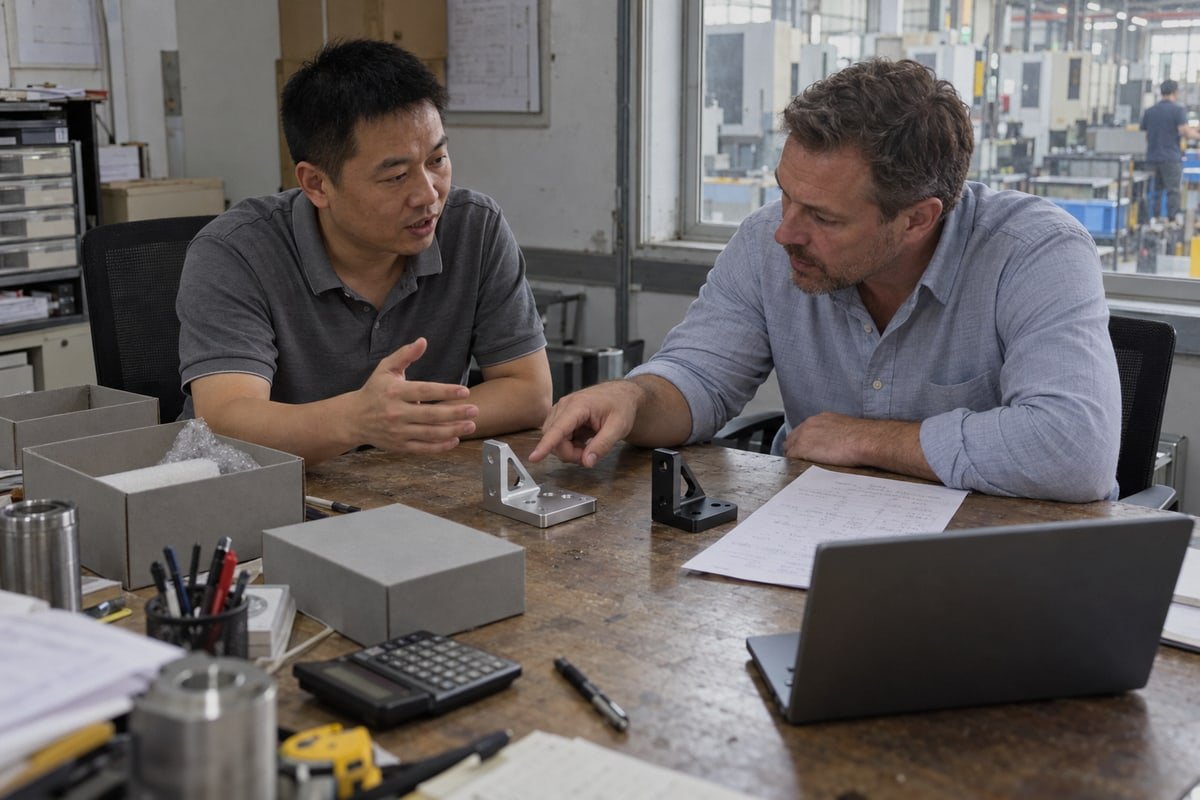
Cost questions get the vaguest answers online. Prices really do vary by region, geometry, and quantity. But the cost drivers are not vague at all. We can list them.
What moves the price
| Cost driver | Revêtement en poudre | Anodisation |
|---|---|---|
| Material compatibility | Aluminum, steel, iron, most conductive metals | Aluminum, plus titanium and magnesium with special baths |
| Setup per batch | Color change and booth cleaning between colors | Racking and bath prep; same bath for many parts |
| Masking | Plugs for threads, tape for mating faces | Masking plus rack contact points that leave marks |
| Color cost | One color per run is cheap; many colors add changeovers | Clear is cheapest; dyed and hardcoat add steps |
| Energy and waste | Oven curing; overspray recycled but not fully | Electricity, acid baths, wastewater treatment |
| Rework risk | Uneven coverage in recesses, contamination | Alloy shade variation, rack marks |
Low volume versus mass production
For prototypes and runs under a few hundred aluminum pieces, anodizing wins in our quoting more often than not. The parts hang on racks already in use. There is no color changeover. This matches what we see across orders. Most of our customers choose anodizing, and cost is one reason.
Powder coating pulls ahead in three cases. First, the assembly mixes steel and aluminum and must be finished as one unit. Second, the order is large and all one color, so oven throughput stays high. Third, the part is big and simple, where a thick film costs less than careful electrochemical control.
Lifecycle cost, not just unit cost
Some industry sources quote service life around 5–10 years for powder coating and 15–30 years for anodizing. We treat those figures as directional only. Environment, product grade, and maintenance change them completely. Still, a longer wear life can cut recoating and replacement. For a sliding aluminum guide, hardcoat anodizing may cost more per piece and less over ten years.
The environmental line item
Both processes avoid solvent paint and keep VOC emissions near zero. Powder overspray can be collected and reused. Anodizing needs acid, dye, sealing chemicals, and wastewater treatment. Low VOC does not mean zero impact. Oven energy and powder waste still count. We include this in DFM feedback when a customer has a sustainability audit to pass.
Can I achieve the color and surface appearance I need with powder coating versus anodizing on aluminum or steel parts?
We learned years ago that anodized color matching across two alloy heats is a promise we should rarely make without a sample. 6061 and 7075 seldom dye the same.
Powder coating offers nearly unlimited colors, textures, and gloss levels on aluminum or steel and hides minor marks. Anodizing keeps a metallic look limited to clear, black, bronze, and dyed shades on aluminum only, and color matching varies between alloys and batches. Choose by the look you want.

The real question is not how many colors each process has. It is whether you want a painted look or an architectural-metal look. Those are different products.
Painted look versus metal look
| Appearance factor | Revêtement en poudre | Anodisation |
|---|---|---|
| Palette | Thousands of RAL and custom colors | Clear, natural, black, bronze, gold, limited dyed shades |
| Texture | Smooth, matte, wrinkle, hammertone, metallic effects | Reflects the machined or blasted surface beneath |
| Opacity | Opaque; hides small scratches and weld discoloration | Translucent; reveals tool marks and alloy differences |
| Batch consistency | High with the same powder lot | Sensitive to alloy, bath age, and dye time |
| Substrate range | Aluminum and steel in the same color | Aluminum only |
Powder coating conceals. A thick opaque film covers minor machining marks and weld zones. That is why brackets, frames, and enclosures with branded colors go to powder. Anodizing reveals. The polished cylindrical housings we machine on our 5-axis cells look best clear anodized because the finish shows the metal, not a paint layer. If a customer wants that machined aluminum character, powder coating is the wrong tool.
UV stability and fade
Here buyers raise a fair objection. They have heard anodizing is permanent and powder fades. The truth is split. The oxide layer itself has excellent UV stability. The organic dyes used for black or bronze can fade in strong sun over time. Meanwhile, super-durable polyester powders hold color better than many dyed anodized finishes in high-UV climates. Exterior architectural powders meeting AAMA specifications such as AAMA 2604 5 or 2605 are not the same product as a cheap interior epoxy. Ask which grade you are getting.
Why some of our customers still pick powder
Most of our customers choose anodizing. The minority who choose powder do so for two reasons. Their part sits outdoors on equipment, or their product line needs an exact brand color across steel and aluminum parts. Both are good reasons. We always send a color chip or a first-article sample before the batch runs, whichever process is chosen.
What should I consider when choosing between powder coating and anodizing for my precision tolerances and assembly requirements?
Every time we quote a ±0.01 mm bore with a finish, we weigh film thickness against masking cost. The trade-off is rarely obvious on the drawing.
Anodizing adds only 5–25 microns for Type II, so threads and bores usually stay within tolerance. Powder coating adds 50–150 microns and can bind fits, fill threads, and need masking. Also consider thermal conductivity, electrical grounding, oven heat on assemblies, and rack-mark placement before finalizing.
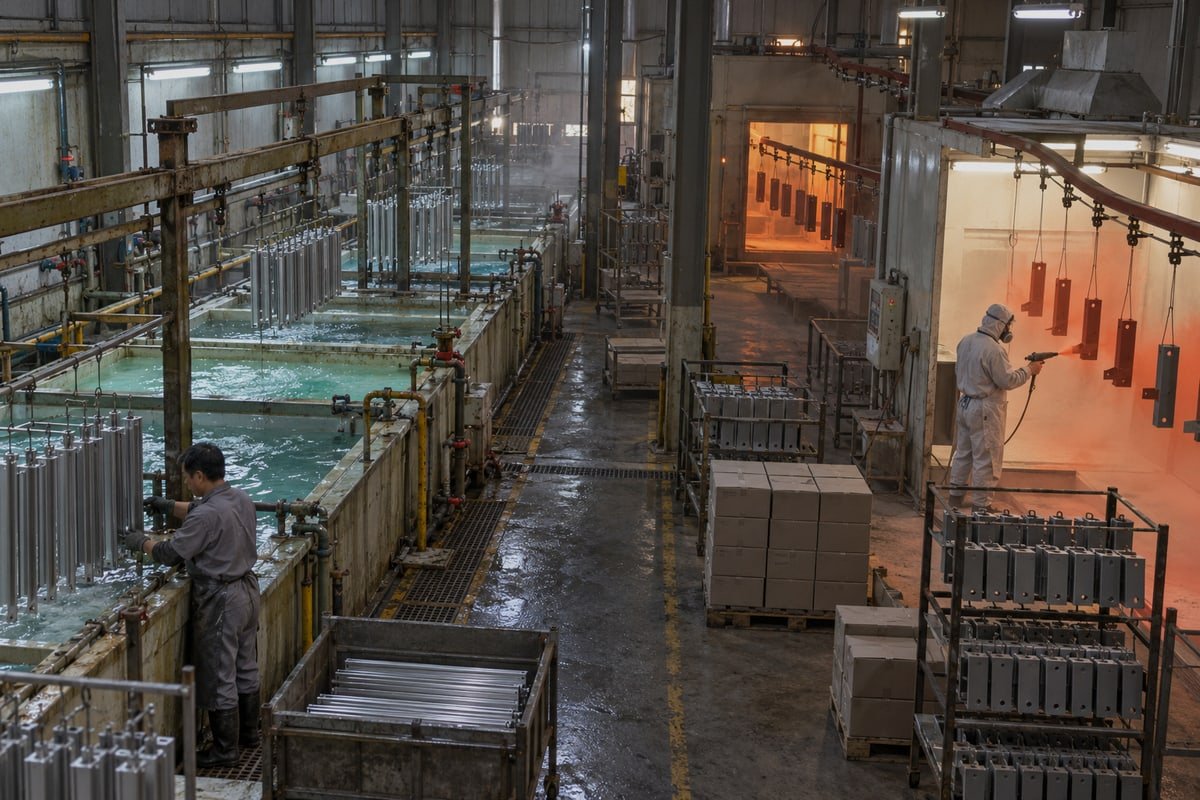
Precision parts are where powder coating and anodizing separate most sharply. A thick film is a feature on a railing. It is a defect on a bearing seat.
Thickness and what it does to fits
| Finish | Thickness added per surface | Effect on a 10 mm H7 bore |
|---|---|---|
| Type II anodizing | 5–25 microns, often 10–15 in production | Usually inside tolerance; about half grows inward |
| Type III hardcoat | 25–50 microns, sometimes higher | Must be designed into the tolerance |
| Revêtement en poudre | 50–150 microns, about 2–6 mils | Bore closes noticeably; masking required |
Hard anodizing is not free of dimensional effect. Roughly half the oxide layer grows outward and half consumes base metal. We add that to the tolerance stack on our drawings. For powder, we mask or plug every thread and mating face, which adds labor and cost.
A pre-finish checklist we run on every order
- Mark every thread, bore, and datum face that must stay bare.
- Decide where rack contact points can go. Anodizing needs them, and they leave marks.
- Check for Faraday-cage recesses that powder cannot reach evenly.
- Confirm the assembly can survive 175–205°C if it is powder coated. Seals and adhesives often cannot.
- Ask whether the part needs grounding or heat sinking. Anodized aluminum is an insulator, and a thick powder film cuts thermal conductivity at mating faces.
- Note the alloy. Welds and heat-affected zones anodize to a different shade.
Special environments
Optical and inspection equipment customers often need vacuum compatibility. Anodized finishes are the standard there because they outgas far less than organic powder resins. Aerospace project buyers ask for the same reason. On the other side, a steel mold base leg or a mixed-metal frame cannot be anodized as a unit, so powder or plating is the only route.
When one process is not enough
Sometimes we combine treatments. Anodizing followed by a specialized topcoat adds a color layer over a hard base. Primer plus powder handles severe corrosion. E-coat under powder protects recesses the spray gun misses. Each combination adds cost, inspection steps, and compatibility risk. We only suggest it when the failure mode demands it.
Conclusion
Picking the wrong finish wastes a batch and a deadline. Most buyers pick anodizing for aluminum. Choose powder coating for outdoor use, mixed metals, or exact colors.
Footnotes
1. ISO provides international standards for coating processes and quality control. ↩︎
2. ASTM International defines the standard test methods for abrasion resistance of organic coatings. ↩︎
3. Wikipedia provides a detailed explanation of the electrochemical process that forms the protective oxide layer. ↩︎
4. The Aluminum Association is the primary authority on aluminum production and finishing standards. ↩︎
5. FGIA maintains the AAMA standards for high-performance organic coatings on aluminum extrusions. ↩︎

 Français
 English
 Italiano
 日本語
 Deutsch (Sie)
 Español
 Русский
 العربية
 Български
 Čeština
 Dansk
 Suomi
 עִבְרִית
 हिन्दी
 Nederlands
 Português
 Română
 Slovenčina
 Svenska
 ไทย
 Tiếng Việt
 Türkçe
 Slovenščina