
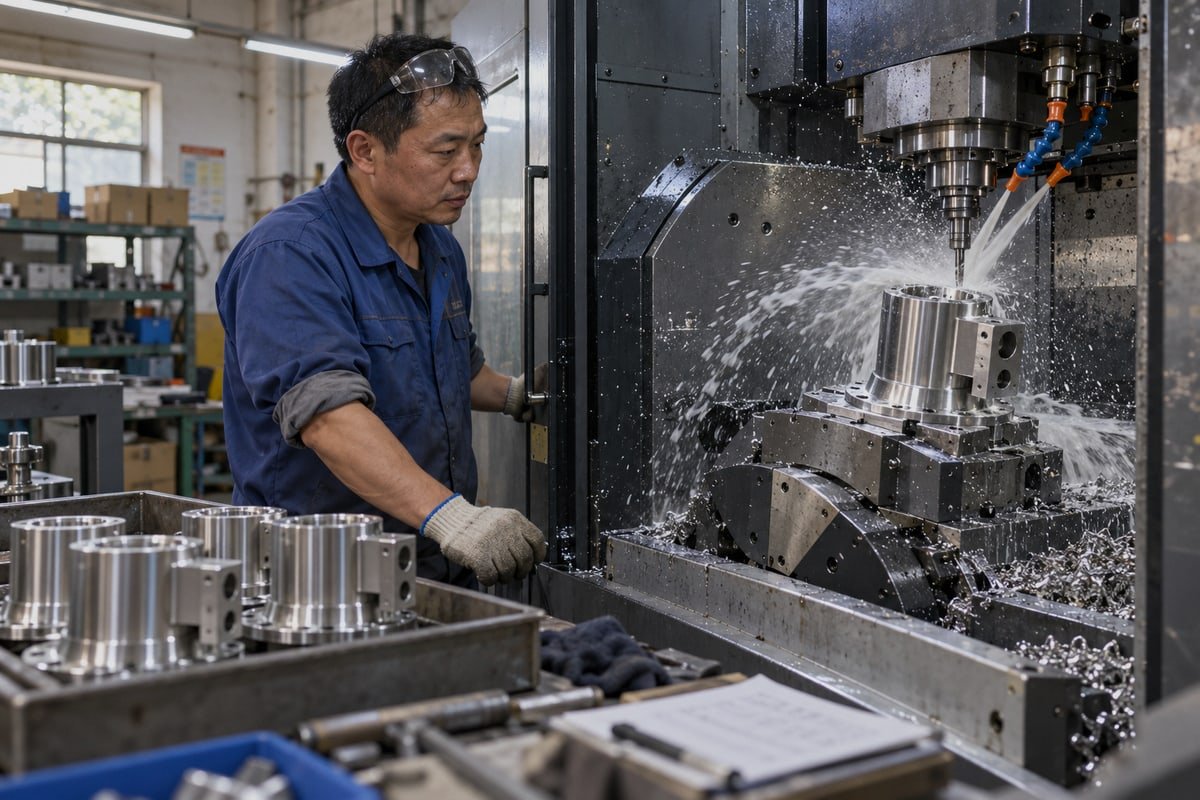
[CNC machining for medical devices](https://stcncmachining.com/?p=15446) once humbled our line: a stainless probe housing passed every dimension, yet one hidden burr forced us to rework the whole batch.
CNC machining for medical devices uses computer-controlled milling, turning, Swiss turning, 5-axis, and EDM tools to cut metal or polymer stock into components defined by CAD models and drawings. Each part is inspected, deburred, cleaned, and documented so geometry, material, surface, and traceability support its clinical use.
That burr taught us something simple. A medical part is not finished when the dimensions are right. It is finished when the surface is clean, the edges are burr-free, the material is proven, and the paperwork follows the part. In this article, I will walk through how we approach tolerances, materials, quality verification, and the full process from prototype to production.
How can I ensure my medical device parts meet strict tolerance requirements through CNC machining?
Tighter is not free. On our 5-axis cells, holding 0.005 mm instead of 0.01 mm adds real tool wear and inspection time, so we first ask which feature needs it.
Meet strict medical tolerances by marking critical-to-function dimensions on the drawing, using DFM review to confirm feasibility, choosing 5-axis or Swiss machining to reduce setups, controlling fixturing and thermal drift, and verifying parts with calibrated CMM, in-process checks, and first-article inspection before batch release.

Tight tolerances are the first thing buyers ask about. They are also the first place where suppliers overstate what they can do. I want to break this down into three practical questions.
Which dimension actually matters?
Not every number on a drawing deserves the same effort. A bone screw thread, an implant taper, or a bearing bore in a robotic-surgery joint controls clinical function. The outside corner of an equipment housing usually does not. Our DFM review starts by asking you to flag the critical-to-function dimensions. We then build the inspection plan around those features. This keeps cost down. It also keeps attention where patient safety depends on it.
Supplier websites publish impressive numbers. One cites ±0.001 inch. Another cites ±0.005 mm, or even ±0.0025 mm for micromachining work. Those are capability claims for specific features under specific conditions. They are not a promise for every surface of every part. Our own 3-, 4-, and 5-axis milling cells hold 0.01 mm reliably and reach 0.005 mm on selected features. We say that plainly in the quote. Nobody should discover a limit at first-article inspection.
How machine strategy protects tight tolerances
Repositioning is the enemy. Every time a part leaves a fixture, you add a small location error. 5-axis milling reaches several faces in one setup, so the relationships between those faces stay intact. Swiss screw machining supports the bar stock right at the cutting point, which suits long, slender instrument shafts and small threaded connectors. Wire EDM cuts hardened steel and narrow slots with no cutting force, so thin features do not bend.
| Method | Best for | Tolerance risk it reduces |
|---|---|---|
| 3-axis milling | Housings, brackets, prismatic parts | Cost on simple geometry |
| 5-osové frézovanie | Contoured implant surfaces, angled holes, multi-face parts | Re-fixturing error between faces |
| Swiss screw machining | Shafts, pins, bone screws, connectors a few millimeters across | Deflection on long, slender parts |
| Wire EDM | Hardened tool steel, thin slots, intricate profiles | Distortion from cutting force and heat |
| Micromachining | Fluidic channels, tiny holes, laparoscopic tips | Burr formation on very small features |
Where batches drift and how we hold them
The real fear of a procurement manager is this: the sample passes, the batch fails. Tool wear, thermal growth, and chip buildup cause drift. Titanium cuts hot and work-hardens. PEEK and other polymers move with temperature and can deform under clamping. We counter this with in-process probing, scheduled tool changes, soft jaws or vacuum fixtures for thin walls, and statistical process control on the critical features. The goal is repeatability across lots, not one good inspection report. CNC machining for medical devices only earns its reputation when lot twenty looks like lot one.
What materials should I choose for CNC machining medical device components?
A procurement manager in Germany once asked us why we quoted 316L instead of 304 for a reusable instrument handle. The answer was repeated autoclave cycles, not price.
Choose materials by intended body contact and function: 316L stainless steel for surgical instruments, medical grade titanium Ti-6Al-4V for orthopedic implants, PEEK for radiolucent implants, and POM, PTFE, or PPSU for housings and fluid paths. Confirm biocompatibility, sterilization resistance, machinability, and mill certificates.

Material choice should follow the device's job. A list of alloys means little without that link. Here is how we think about it when a drawing arrives.
| Materiál | Common medical use | Why it is chosen | Machining notes |
|---|---|---|---|
| 316L stainless steel | Surgical instruments 1, reusable handles, cannulas | Corrosion resistance through repeated steam sterilization; passivates well | Gummy chips; sharp tools; passivate after machining |
| Ti-6Al-4V (medical grade titanium) | Orthopedic implants, bone plates, dental abutments | High strength-to-weight, fatigue resistance, proven biocompatibility | Cuts hot; lower speeds; rigid fixturing; strong coolant flow |
| Cobalt-chromium | Joint bearing surfaces | Wear resistance | Very hard; heavy tool wear; EDM for fine profiles |
| PEEK | Spinal cages, radiolucent implants, instrument parts | Modulus close to bone, sterilizable, radiolucent | Absorbs moisture; deforms under clamping; cryogenic CO2 or nitrogen cooling reduces burrs |
| POM, PTFE, PPSU, PC | Housings, valve seats, fluid-path parts, sterilization trays | Low friction, chemical resistance, repeated steam cycles for PPSU | Dimensional stability; avoid heat marks |
| Aluminum 6061 / 7075 | Equipment housings, imaging brackets, lab fixtures | Light, cheap, easy to anodize | Not for implants; anodize for durability |
Why machinable does not mean medically suitable
PEEK machining is easy compared with titanium. That does not make a PEEK part automatically safe for an implant. Biocompatible materials become biocompatible parts only when the whole system is controlled. That system includes the base material, coolant residue, coatings, surface treatment, and handling. On our floor, this is why cleanliness and burr-free edges get the same attention as dimensions. A smear of cutting oil on a spinal spacer is a material problem, not just a cosmetic one.
Material fraud and mill certificates
Buyers worry that 304 gets mixed with 316L, or that ordinary aluminum replaces 6061. I understand that fear. We attach mill certificates with heat or lot numbers to each shipment. We keep bar stock segregated by grade. If your acceptance process needs it, we support third-party composition verification. Ask for this up front. A good supplier will not flinch.
Matching material to finishing
The alloy and the finish must be planned together. Stainless instruments often get electropolishing and passivation. Titanium implants are passivated to build a stable oxide layer, and some shops now integrate that step directly after cutting. Aluminum housings get anodized. PEEK usually gets careful deburring and ultrasonic cleaning. Ceramics and hard composites are a growing niche, and ultrasonic-assisted machining is spreading in the industry to reduce cutting force and heat on those brittle materials. We discuss all of this during DFM, because changing the finish later can change the tolerance you need.
How do I verify quality and compliance when sourcing CNC machined medical parts?
Our final inspection once rejected a batch of PEEK spacers for a faint oily film. Every dimension was in spec. Cleanliness still mattered more.
Verify quality by requesting material certificates, first-article inspection reports, CMM dimensional reports, and surface roughness data for each lot. Confirm the supplier's quality management system, calibration records, and traceability, then align with your own ISO 13485 and FDA compliance requirements, since component makers rarely hold device approval themselves.
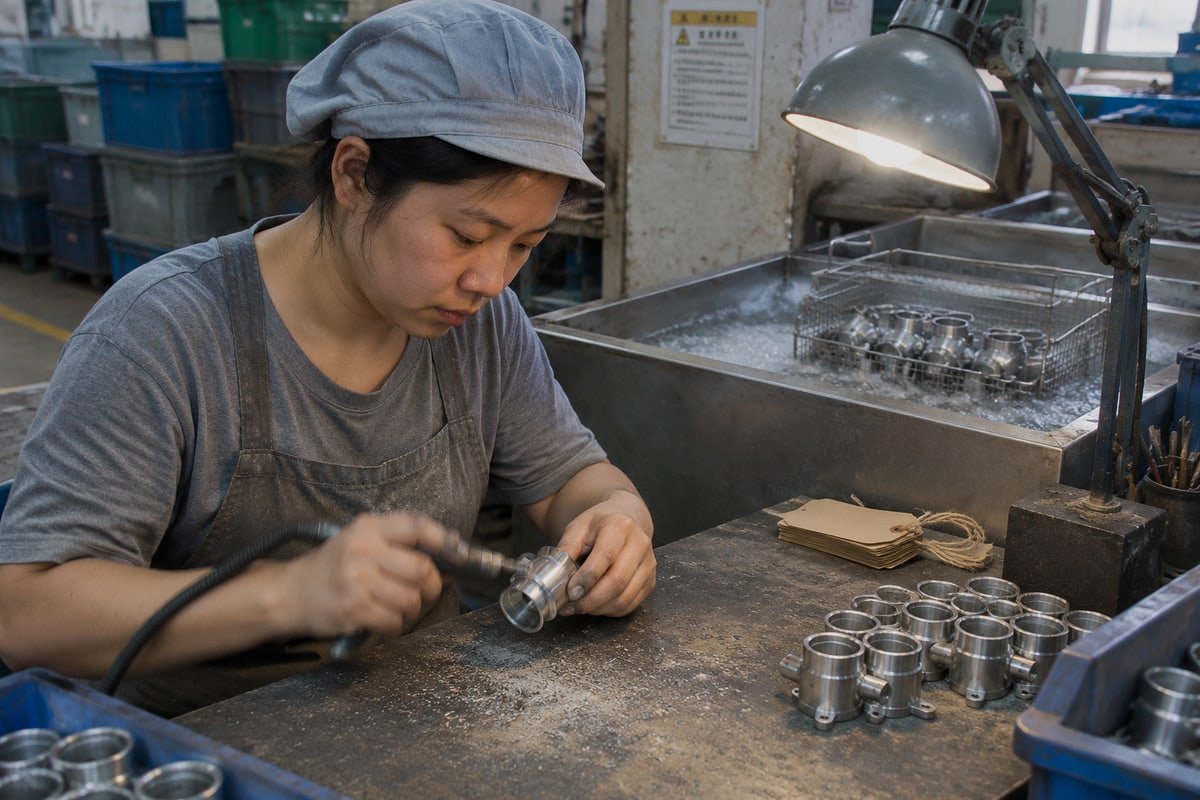
Compliance is a word that gets stretched. Before you sign a purchase order, it helps to separate three different things.
Three things people call compliance
- Making a precision part to your drawing. This is the machining supplier's job.
- Manufacturing a medical device under a quality management system. This is the device maker's responsibility 2, usually under ISO 13485.
- Obtaining regulatory authorization in a market. This covers FDA compliance in the United States, MDR in Europe, and similar schemes elsewhere.
Our factory is ISO 9001:2015 certified. We do not design, clear, or assemble finished devices. Medical device manufacturers qualify us as an approved component supplier 3 inside their own ISO 13485 quality management system. If your project requires ISO 13485 certification 4 at the machining shop itself, ask that question in the first email. An honest answer there saves everyone months.
Documents to request
| Document | What it proves | When to request |
|---|---|---|
| Mill certificate | Alloy grade, heat or lot number | With every lot |
| First-article inspection report | First parts match the drawing and revision | Before batch release |
| CMM dimensional report | Critical features are in spec | Each lot, per agreed sampling plan |
| Surface roughness report | Ra on functional surfaces | When finish is functional |
| Route card or process record | Machine, operator, date, tool changes | Traceability audits |
| Certificate of conformance | Lot meets PO and drawing | At shipment |
| Nonconformance record | How defects were handled | Whenever one occurs |
Surface, burrs, and cleanliness are inspection items
This is where my own experience pushes hardest. Medical parts carry very high requirements for surface finish, burr-free edges, and freedom from contamination. Microscopic pits can harbor bacteria and defeat sterilization. Some polished surgical instruments specify Ra at or below 0.1 µm, though that is an application-specific example, not a rule. Implant surfaces may instead need controlled roughness to encourage bone growth. We check edges, hole intersections, and thread starts under magnification. We measure roughness on the surfaces the drawing calls functional. We clean parts ultrasonically and pack them individually. Our machining floor is not a cleanroom, and I will not pretend it is. Where a part needs a classified environment for assembly or packaging, that step belongs to a validated process downstream. A machined part is not a sterile part.
What to ask on a first order
Ask how measuring equipment is calibrated. Ask what the sampling plan is. Ask how drawing revisions are controlled so an old program never runs again. Ask what happens if a dimension fails at your incoming inspection. We offer a 30-day warranty and rework or remake quickly, because a late response hurts your project more than the defect itself. CNC machining for medical devices depends as much on that paper trail as on the spindle.
What is the typical CNC machining process for producing medical device prototypes and production parts?
We learned the hard way that a prototype fixture rarely survives mass production. Now we design workholding for the batch from the very first quote.
The typical process runs: CAD and drawing review with DFM feedback, material sourcing with certificates, CAM programming and fixturing, CNC milling, turning, or EDM, in-process and first-article inspection, then deburring, finishing, cleaning, marking, and documented release. Prototypes validate the design; production adds frozen programs and SPC.

The CAD model says what the part should be. CAM and setup decide how it will be made the same way every time. Here is the sequence we follow on a medical job.
The step-by-step sequence
- Drawing review and DFM. We check tool access, wall thickness, thread depth, and every tolerance. We flag anything that will raise scrap rate or cost. We also recommend the process: 3-axis, 5-axis milling, Swiss turning, or wire EDM.
- Material sourcing. We buy certified stock for the grade on the drawing and record the lot.
- CAM programming and fixturing. Programmers set datums, pick tools for small holes and threads, set feeds for titanium or PEEK 5, and simulate the toolpath for collisions.
- Material removal. Milling cuts pockets, contours, and angled holes. Turning cuts shafts, collars, and connectors. EDM handles hardened steel and narrow slots. Coolant strategy matters here; cryogenic cooling helps polymer parts stay dimensionally stable and burr-free.
- Inspection. In-process probing catches drift. First-article inspection confirms the setup. Final inspection releases the lot.
- Finishing and cleaning. Deburring, passivation, electropolishing, anodizing, laser marking for traceability, and ultrasonic cleaning.
- Release and packaging. Individual bagging, documents attached, no mixed lots.
Prototype versus production
| Aspect | Prototype | Low volume | Mass production |
|---|---|---|---|
| Goal | Prove the design | Verify the process | Repeat reliably |
| Lead time | As short as 5 days | A few weeks | Scheduled deliveries |
| Fixturing | Vise or soft jaws | Dedicated fixture | Multi-part fixtures, automation |
| Inspection | 100% first-article | FAI plus sampling | SPC plus sampling |
| Program status | Editable | Frozen after FAI | Frozen and change-controlled |
The same digital CAD/CAM file carries from the first prototype to the production run. That continuity is a real strength of CNC machining for medical devices. You do not pay for a mold to test a design change. You pay for programming time.
When CNC is not the right answer
I will raise the objections buyers bring us, because they are fair. CNC wastes material; a titanium implant may start as a billet several times its finished weight. For very high volumes, injection molding, stamping, or forging often beat CNC on unit cost. Additive manufacturing builds lattice structures and internal channels that no cutter can reach. Our answer is hybrid thinking. Forged or printed near-net blanks can be finish-machined for the surfaces that need tight tolerances and fine finish. We recycle chips and manage coolant to limit waste. And for surgical instrument manufacturing, patient-specific guides from CT data, and micromachining of fine fluidic channels in diagnostic devices, CNC still offers the best mix of accuracy, material consistency, and established inspection.
Záver
Medical CNC machining is a controlled chain, not just cutting. Send us your drawings for DFM feedback, and we will help you get burr-free, traceable parts on schedule.
Footnotes
1. Overview of the types and materials used in the production of surgical instruments. ↩︎
2. The FDA defines the responsibilities of device manufacturers regarding quality and compliance. ↩︎
3. ISO 9001 provides the framework for qualifying and managing approved component suppliers. ↩︎
4. Official ISO standard for quality management systems specific to the medical device industry. ↩︎
5. Technical details on Ti-6Al-4V, a primary material used alongside PEEK in medical machining. ↩︎

 Slovenčina
 English
 Italiano
 Français
 日本語
 Deutsch (Sie)
 Español
 Русский
 العربية
 Български
 Čeština
 Dansk
 Suomi
 עִבְרִית
 हिन्दी
 Nederlands
 Português
 Română
 Svenska
 ไทย
 Tiếng Việt
 Türkçe
 Slovenščina