
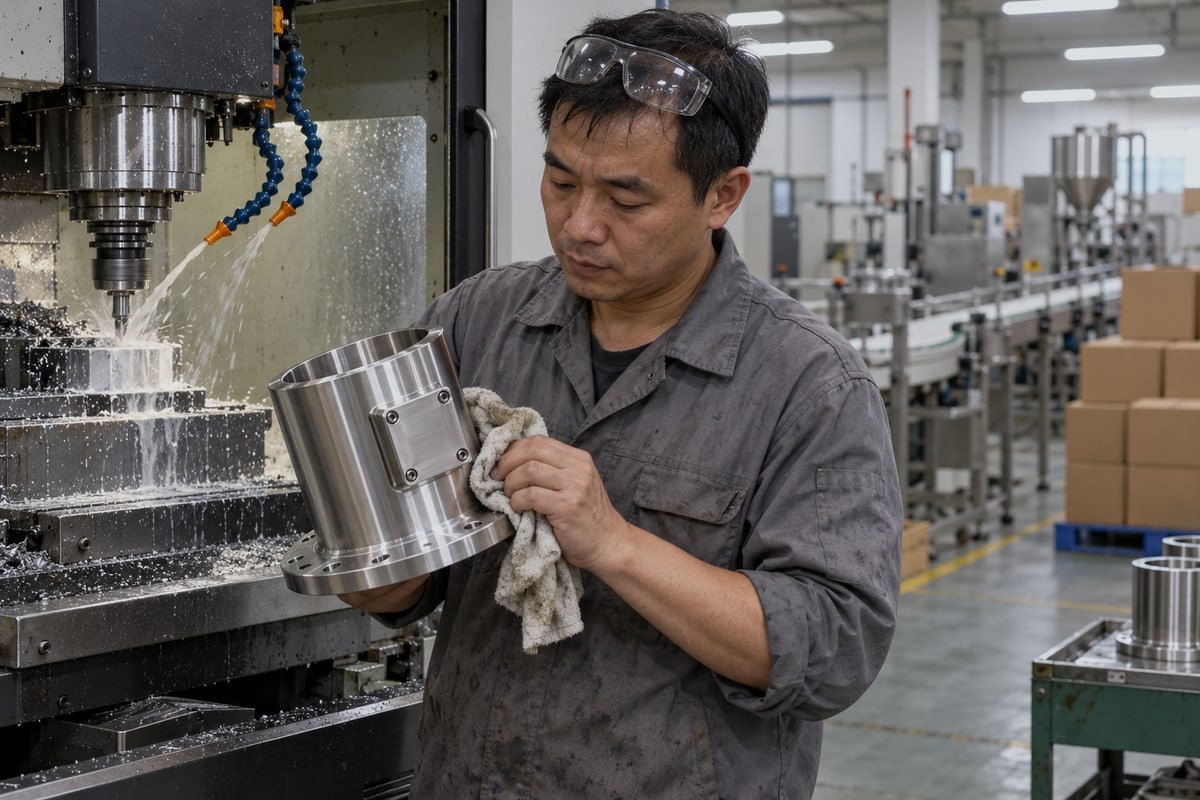
A dosing valve we machined failed a customer’s swab test. It looked perfect. CNC machining for food processing equipment only pays off when hygiene is designed in from the start.
CNC machining improves food processing equipment by producing repeatable, tight-tolerance parts in corrosion-resistant materials like 316 stainless steel and food-grade plastics. Controlled geometry, smooth surface finishes, and documented processes make components easier to clean, longer-lasting, and more reliable on automated production lines.
That valve taught our team something simple. Precision is the tool. Hygiene is the goal. Below, I walk through how we combine the two for food equipment builders in Europe and North America.
How Can CNC Machining Help Me Meet Hygiene and Food-Grade Material Standards?
A procurement manager in the Netherlands once asked me if our 304 parts were food grade. My honest answer was: it depends on where the part sits.
CNC machining helps you meet hygiene standards by holding the geometry that sanitary design demands: generous radii, drainable surfaces, no blind holes, and controlled surface roughness Ra. Pair that with certified food-grade materials such as 316 stainless steel or PEEK, and you have a cleanable, traceable component.
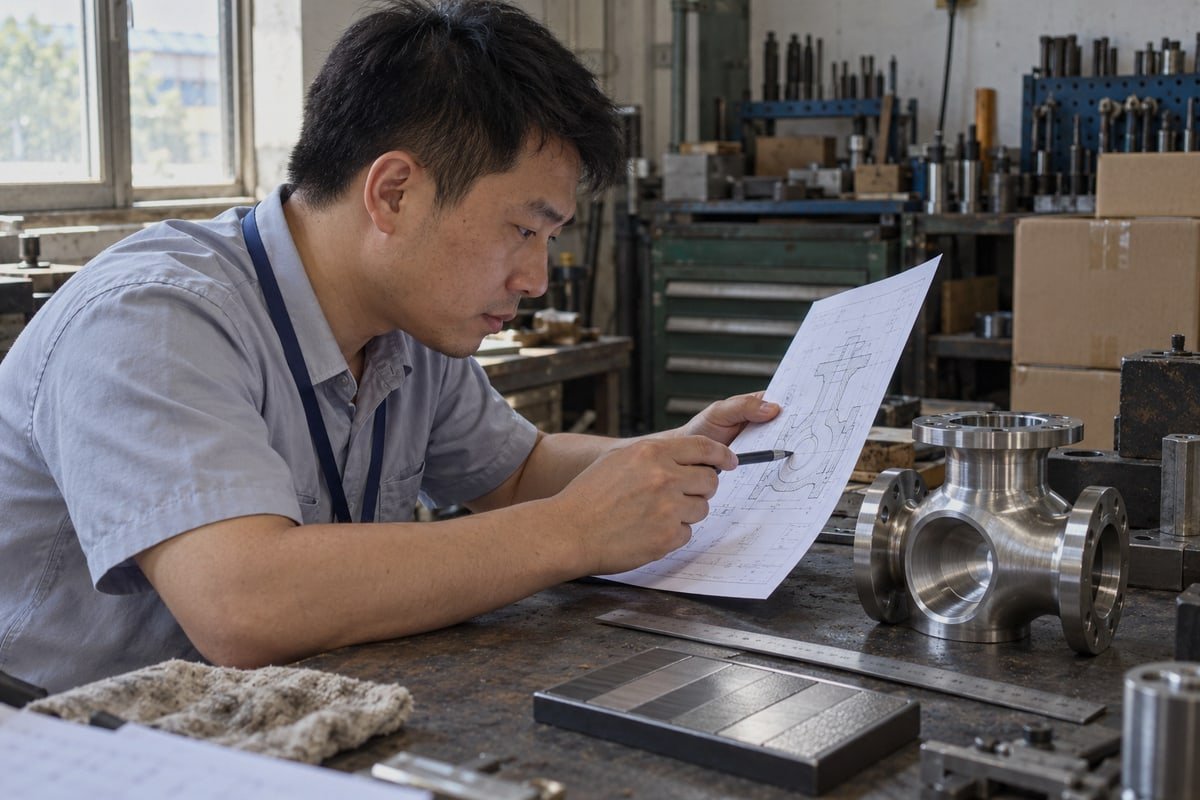
The question from that Dutch buyer comes up every month. So let me break it down the way we do it at our factory in Dongguan.
Food-grade is a context, not a stamp
No material is food grade on its own. A 316 stainless steel 1 block becomes a food-contact part only when the alloy, the surface finish, the lubricants it touched, and the cleaning regime all fit the application. The same is true for food-grade plastics. PEEK is excellent in a hot, acidic product zone. POM is fine for many dry-food guides. Neither is safe if it was cut with ordinary machine oil and never degreased.
A common buyer objection is: "You use CNC, so the part must be compliant." I push back on that. CNC machining does not deliver FDA compliance 2 or EU food-contact compliance by itself. Those come from material certificates, finishing records, and cleaning validation. For dairy and liquid-food lines in the US, 3-A Sanitary Standards 3 add geometry rules on top of material rules. Our role is to machine to those rules and document what we did. The equipment builder still validates the installed assembly.
Geometry rules we apply before cutting
When a drawing lands in our DFM review, we check for these hygiene killers:
- Blind holes and deep threaded pockets that hold cleaning fluid.
- Sharp internal corners where residue packs in.
- Exposed threads inside the product zone.
- Ledges and steps that stop a surface from draining.
- Recesses an operator cannot see or reach with a brush.
We then suggest through-holes, larger internal radii, and self-draining orientations. Most of these changes cost nothing extra on a 3-axis or 5-axis mill. They just need to be decided before the first chip flies.
Surface roughness targets by zone
Smoothness matters, but it is zone-dependent. Here is how we usually frame surface roughness Ra 4 with customers. Treat these as common engineering references, not legal limits.
| Equipment zone | Common Ra reference | Why it matters | Our note |
|---|---|---|---|
| High-risk direct food contact (dairy, ready-to-eat) | 0.4 μm Ra or better | Fewer micro-crevices for bacteria to colonize | Often needs polishing or electropolishing after milling |
| Standard direct food contact | 0.8 μm Ra | Cleanable with normal CIP and washdown | Achievable from the machine with good tooling |
| Splash zone, no direct contact | 1.6 μm Ra or similar | Must shed water and resist corrosion | Machined finish usually sufficient |
| Non-food, enclosed area | Per drawing | Function over hygiene | Cost should drive the spec |
Material choices we machine for food lines
| Material | Where we see it used | Strength | Caution |
|---|---|---|---|
| 316 / 316L stainless steel | Pump bodies, valve seats, dosing parts | Best corrosion resistance against salts and sanitizers | Harder to machine than 304; needs passivation |
| 304 stainless steel | Frames, covers, dry-food guides | Lower cost, good general hygiene | Chloride-rich washdown can pit it |
| PEEK | Seals, wear rings, hot product inserts | Chemical and heat resistance, low friction | High material cost; machine with care |
| POM / Nylon / HDPE | Guides, star wheels, bushings | Light, quiet, cheap to machine | Check moisture absorption and chemical exposure |
| Aluminum (6061, 7075) | Non-contact brackets, mold bases | Light and fast to machine | Avoid bare aluminum in acidic or wet product zones |
The point is simple. Choose the material for the real chemical, thermal, and mechanical environment. Then let CNC machining give you the geometry and finish that material needs to stay hygienic.
What CNC Machining Processes Improve Durability and Corrosion Resistance of My Food Processing Equipment?
During final inspection on a batch of 316L valve seats, our QC team caught faint rust. The alloy was fine. The trial parts had skipped passivation.
The CNC processes that most improve durability and corrosion resistance are: machining in 316L stainless steel or engineering polymers, full deburring, passivation or electropolishing after cutting, wire EDM for hardened cutters, 5-axis machining to remove welded joints, and food-safe coolant with thorough post-machining cleaning.
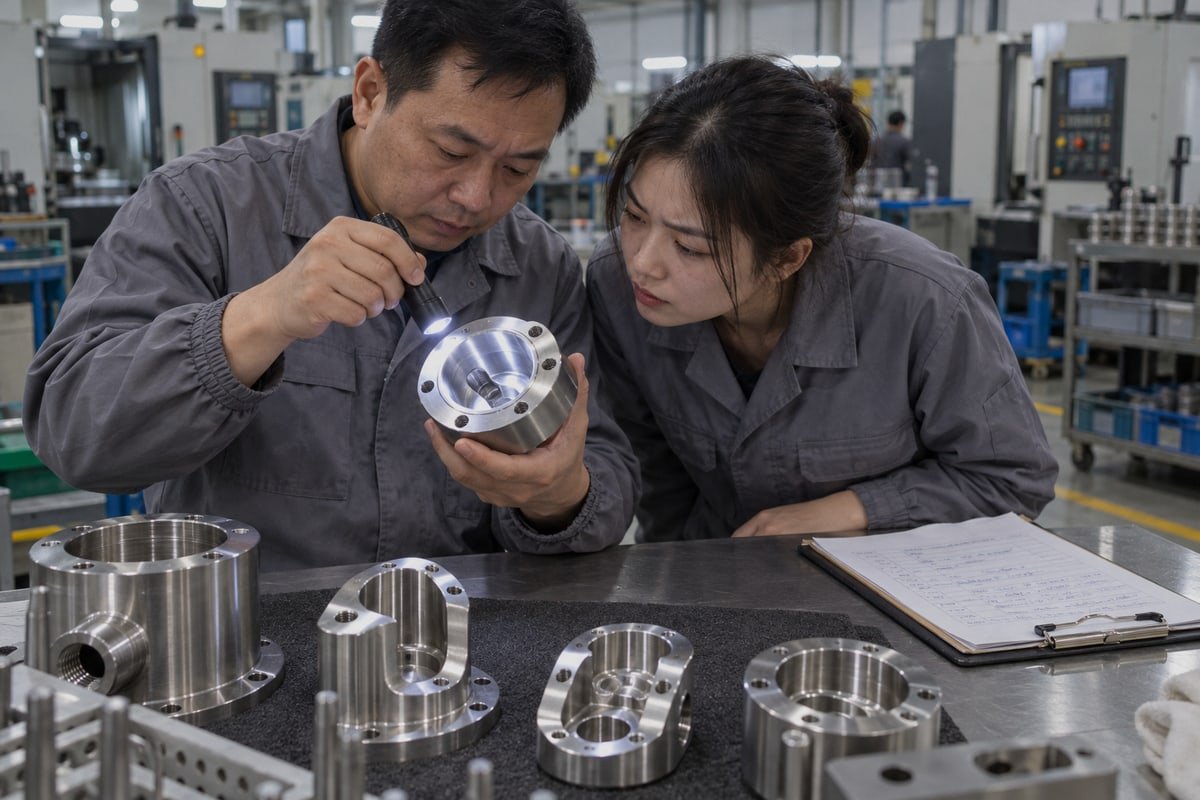
That rust incident reminded me that the machining step is only half the story. What happens after the spindle stops decides how long a part survives in a washdown environment.
Our post-machining sequence for washdown parts
For food-contact components, we run a fixed sequence. It looks like this:
- Deburr every edge. Burrs trap residue and can break off into product. We deburr by hand or with controlled media, then inspect under magnification on critical edges.
- Degrease and clean. Coolant, chips, and cutting residue must come off before any finishing. For food parts we specify coolant that is compatible with later cleaning, and we flush deep features.
- Polish to the target Ra. Where the drawing calls for 0.4 μm Ra or better, we polish or electropolish. Electropolishing also removes a thin, stressed surface layer, which helps corrosion behavior.
- Passivate stainless steel. Machining smears free iron onto the surface. Passivation removes it and rebuilds the chromium oxide layer. This is the step that trial batch missed.
- Final clean and dry. We clean again, dry fully, and avoid handling bare surfaces with ungloved hands.
- Pack for cross-contamination prevention. Each part goes into its own clean bag. Stainless and aluminum are never packed together, because mixed metal contact can start galvanic corrosion in transit.
Why fewer joints means longer life
Welded fabrications fail at the welds. Heat-affected zones corrode first, and weld roots trap residue. When a customer sends us a multi-piece bracket or housing, our DFM feedback often proposes machining it from one billet on a 5-axis center. The cylindrical sensor housing in the first product photo is a good example of that thinking. One body, one flange, one internal mounting pocket, no welds. Fewer joints also means fewer gaps for CIP chemicals to hide in and fewer places for high-pressure washdown to lift a seam.
Wire EDM for wear parts
Slicer blades, cutter dies, and hardened guides take abrasion all day. We use wire EDM on hardened tool steel and stainless so the part gets its final shape after heat treatment. That avoids the distortion you get when you machine soft and harden later. The edges come out burr-free, which matters when the cutter sits in a product zone.
Emerging techniques worth watching
Two trends come up in buyer conversations. Cryogenic machining uses chilled coolant to keep soft food-grade plastics from deforming under the cutter, which helps hold tolerances on thin PEEK or HDPE parts 5. Biomimetic surface texturing aims to create micro-topographies that discourage bacterial attachment without additives. Both are promising. Neither is standard practice yet, and both need validation for your specific cleaning regime before you rely on them.
One objection I hear is that a smooth finish will scratch and degrade anyway. That is true. So we design for maintenance. Choose a material that resists the actual sanitizer, keep radii generous so brushes reach everything, and plan replacement intervals for wear parts. Durability is a system property, and CNC machining is the part of the system we control.
Can CNC Machining Help Me Achieve Precise Tolerances for My Food Equipment Components?
Every hundredth of a millimeter we tighten adds machine time, inspection time, and cost. So before we quote, we ask which dimensions actually control sealing or dosing.
Yes. CNC machining holds tight tolerances of 0.01 mm, and down to 0.005 mm on critical features, repeatably across batches. That precision engineering keeps shafts running true, seals seating evenly, and dosing pistons delivering consistent portions on automated production lines.
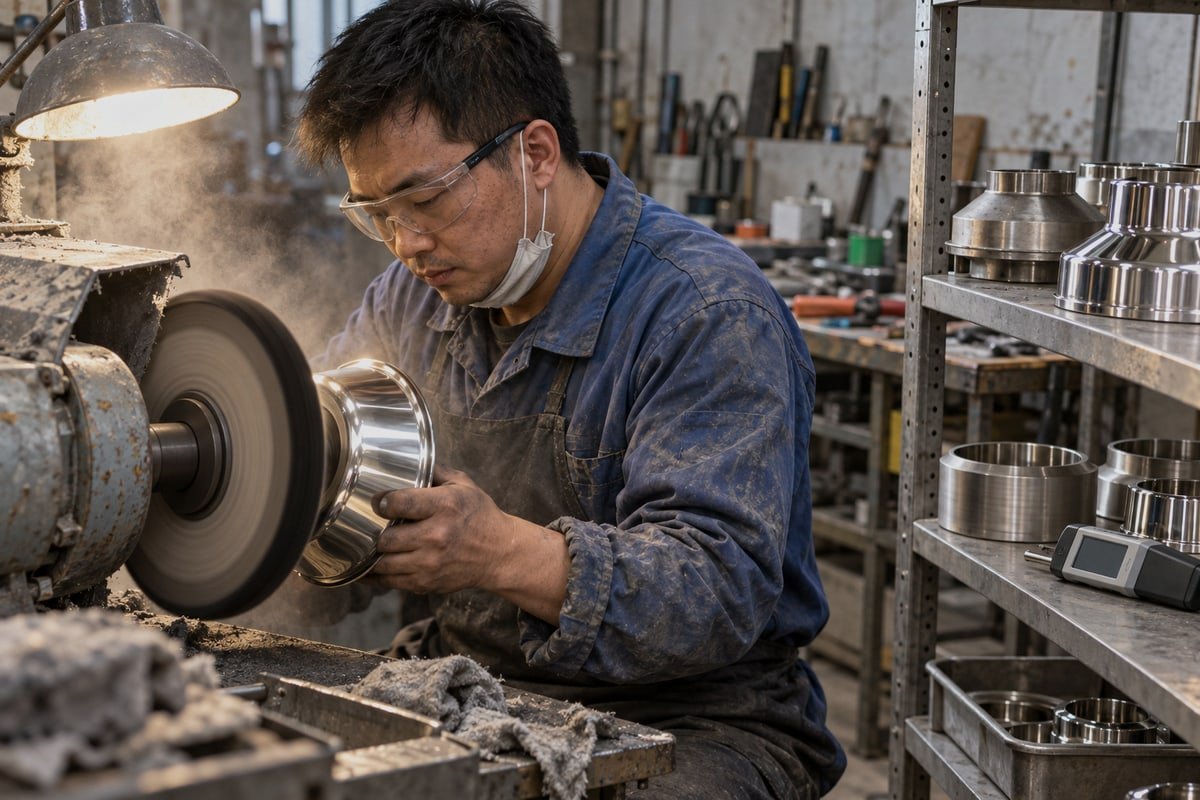
The trade-off I mentioned is real. Our 3-axis, 4-axis, and 5-axis mills can hold 0.01 mm to 0.005 mm. But not every feature on a food machine needs that, and asking for it everywhere just inflates the price.
Where precision actually matters
| Component | Critical feature | Why it matters for food equipment | Our typical approach |
|---|---|---|---|
| Pump shaft | Runout and bearing fit | Reduces vibration and seal wear, prevents leaks | Turning plus grinding on the journal only |
| Valve seat and plug | Seat angle and concentricity | Reliable shutoff, no product drip | 5-axis milling, inspected on CMM |
| Dosing piston and bore | Clearance between piston and cylinder | Consistent fill weight, no product bypass | Matched pairs, tight tolerances on both parts |
| Conveyor roller | Diameter and parallelism | Belt tracking, fewer jams | Standard turning tolerance is enough |
| Mounting bracket | Hole position | Sensors and guards align on first fit | Mid-range tolerance, cost kept low |
| Packaging die or mold base | Cavity dimensions and alignment pins | Clean seals and repeatable package shape | Precision milling, like the mold base in our photos |
The ±0.0001 inch question
Some ranking pages mention tolerances of ±0.0001 inch, which is about 0.0025 mm. Can precision machines reach that? On selected features, with grinding and temperature-controlled inspection, yes. Does your slicer bracket need it? Almost never. In our experience, most food-contact parts function well in the 0.01 mm to 0.05 mm range, with a few mating features held tighter. We state this in DFM feedback because an honest tolerance discussion saves our customers money without touching food safety.
A filling-line example
Picture a dosing valve on a sauce line. The original piston was turned loosely and finished by hand. Fill weights drifted. Product crept past the piston and dried in a shoulder recess. Sanitation took longer, and the line stopped often for seal changes.
Now picture the CNC version. The piston and bore are machined as a matched pair in 316L with tight tolerances on the sealing diameter only. The shoulder recess is replaced with a radius. The contact surfaces are polished and passivated. The expected outcome is conceptual but clear: tighter fill consistency, less product bypass, faster cleaning, and longer intervals between seal changes. None of that comes from precision alone. It comes from precision applied to the right features, plus sanitary design.
Precision as a platform for automation
Automated production lines rely on repeatable interfaces. A robot gripper only places a tray correctly if the fixture is the same every time. Topology-optimized moving parts cut inertial mass so pick-and-place cycles can speed up, but only if the lightened geometry is machined accurately. Precision-machined cavities also let equipment builders embed IoT sensors for temperature or pressure without creating a new crevice. Because every part we cut comes from the customer's CAD file, a reorder years later matches the original. That digital repeatability is one of the quietest benefits of CNC machining for food processing equipment.
How Do I Choose a CNC Machining Supplier for My Food Processing Equipment Parts?
The hardest lesson from twenty years of exporting machined parts is this: buyers rarely lose money on the quote. They lose it on the second batch.
Choose a CNC supplier that reads your drawing correctly, gives DFM feedback, proves material traceability with certificates, controls coolant and cleaning for food parts, holds tolerances in batch production, documents inspection, protects parts in packaging, and commits to clear lead times.
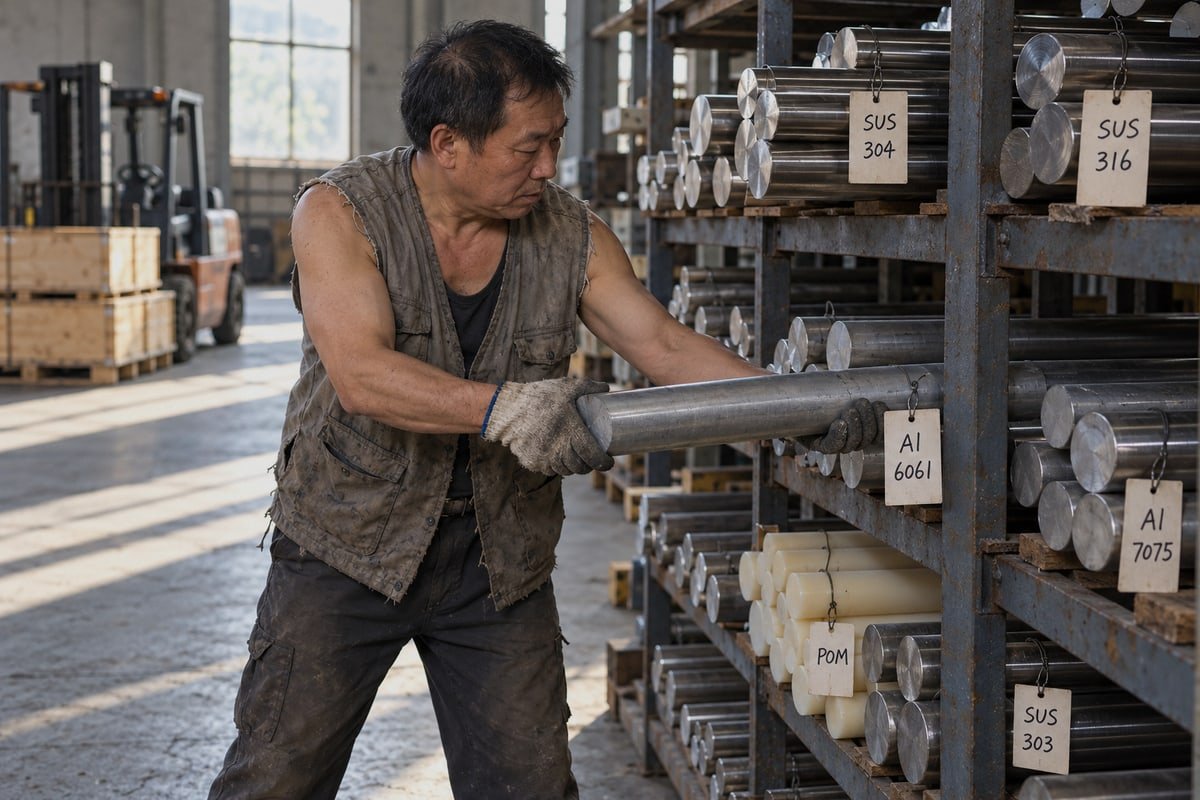
I have watched equipment builders accept a perfect first sample, then struggle when batch two arrived with burrs and a mixed stainless grade. So here is the checklist I would use if I were sitting on your side of the table.
Ten questions I would ask before placing a food-equipment order
- Which dimensions on my drawing do you consider functionally critical, and which would you relax?
- Is this part treated as direct food contact, splash zone, or non-contact in your process?
- What coolant and cutting fluids will touch the part, and how will you remove them?
- What surface roughness Ra will you deliver, and how will you measure it?
- How do you deburr, and do you inspect edges on food-contact surfaces?
- Will you passivate or electropolish stainless parts, and will I get a record?
- Can you provide material certificates for 316 stainless steel, PEEK, or other specified grades?
- What inspection reports come with the first article and with each batch?
- How are parts cleaned and packed to prevent scratches and cross-contamination in transit?
- Would casting, molding, or fabrication actually serve this part better than CNC?
A supplier with real engineering depth will answer all ten without hesitation. A trading company usually stalls on question one.
Red flags and green flags
| What you observe | Red flag | Green flag |
|---|---|---|
| Quotation | Low price, vague scope, surcharges appear later | Itemized quote covering material, finishing, inspection, packaging |
| Drawing review | Accepts drawing as-is, no questions | Returns DFM notes on radii, threads, drainability, cost |
| Materials | Cannot show mill certificates, mixes 304 and 316 | Certificates per lot, traceable to the batch |
| Quality system | No formal system | ISO 9001:2015 6 certified, documented inspection before shipment |
| Batch consistency | Sample passes, production drifts | In-process checks, first article inspection, stable fixtures |
| Lead time | Promises everything, delivers late | Realistic dates, prototypes in days, honest schedules |
| After-sales | Blames the drawing | Clear rework or remake policy with a stated warranty |
How we try to meet that bar
At our Dongguan factory we built our process around these pain points. Every drawing gets DFM feedback from engineers, not just a sales reply. We machine stainless steel, aluminum, titanium, tool steel, and food-grade plastics like PEEK, POM, nylon, PC, PPSU, and HDPE in-house, with wire EDM and surface finishing under the same roof. The ISO 9001:2015 system means specifications are checked during production and inspected again before shipment, and every order carries a 30-day warranty. For urgent projects, lead times can be as short as 5 days, and we support the same part from a one-piece prototype through low-volume runs to mass production. The positioning we use, German quality at Asia price, is really just a promise to European and North American buyers that the second batch will match the first.
When CNC is not the right answer
A good supplier tells you when to walk away. For very high volumes of simple shapes, casting, stamping, or injection molding will beat CNC on unit cost. Additive manufacturing can win on extreme internal geometry. We say this in DFM reviews because a customer who trusts our judgment on a mold base will come back for the next two hundred valve seats. Long-term cooperation is worth more to us than one over-priced order.
Conclusion
Food lines punish parts that trap residue, corrode, or drift out of tolerance. CNC machining fixes that only when hygienic design, verified materials, and controlled finishing come together.
Footnotes
1. Authoritative technical overview of 316 stainless steel, the standard corrosion-resistant material for food processing equipment. ↩︎
2. Official US government resource for food safety regulations and food-contact material compliance standards. ↩︎
3. Official organization providing industry-standard sanitary design criteria for food, beverage, and pharmaceutical equipment. ↩︎
4. Scientific explanation of surface roughness parameters used to define cleanability and hygiene in engineering components. ↩︎
5. Technical details on high-performance food-grade polymers used in precision machining for food processing lines. ↩︎
6. Official ISO page for the international standard governing quality management systems in manufacturing environments. ↩︎

 Español
 English
 Italiano
 Français
 日本語
 Deutsch (Sie)
 Русский
 العربية
 Български
 Čeština
 Dansk
 Suomi
 עִבְרִית
 हिन्दी
 Nederlands
 Português
 Română
 Slovenčina
 Svenska
 ไทย
 Tiếng Việt
 Türkçe
 Slovenščina