
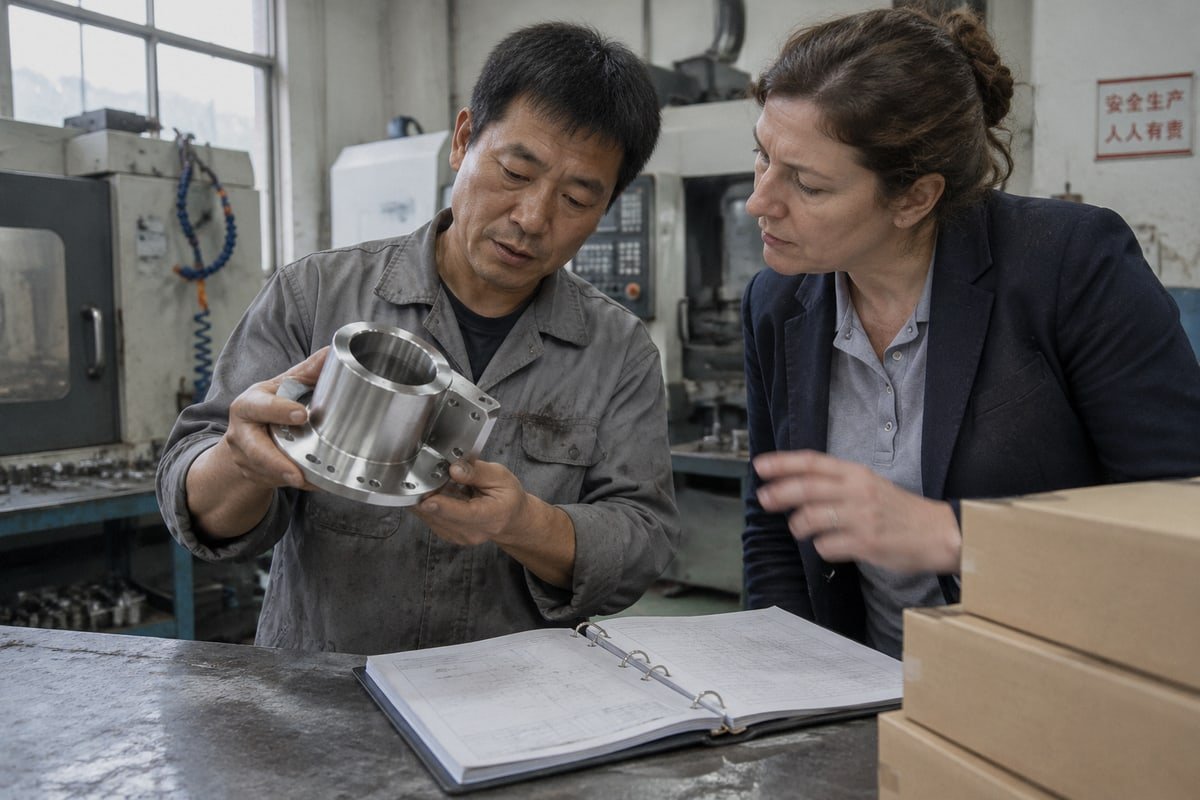
Stainless steel fights back. A stainless steel [CNC machining supplier](https://stcncmachining.com/?p=15429) who treats it like aluminum hands you drift, burrs, and late shipments. We learned that on our Dongguan line.
Choose a stainless steel CNC machining supplier by defining your part requirements first, then verifying grade-specific experience, precision tolerances on similar parts, material traceability with mill certificates, documented quality assurance protocols, DFM support, and realistic production lead times. Compare total landed cost and supply risk, never unit price alone.
That answer is short. The work behind it is not. Below, I break the decision into four questions buyers ask us most often. Each one comes with a checklist, a table, and the mistakes I see repeated.
What Should I Look for When Evaluating a Stainless Steel CNC Machining Supplier's Precision and Tolerance Capabilities?
A German customer once sent us a 17-4 PH valve seat with ±0.005 mm on one bore. Our first question was not price. It was how many parts per batch.
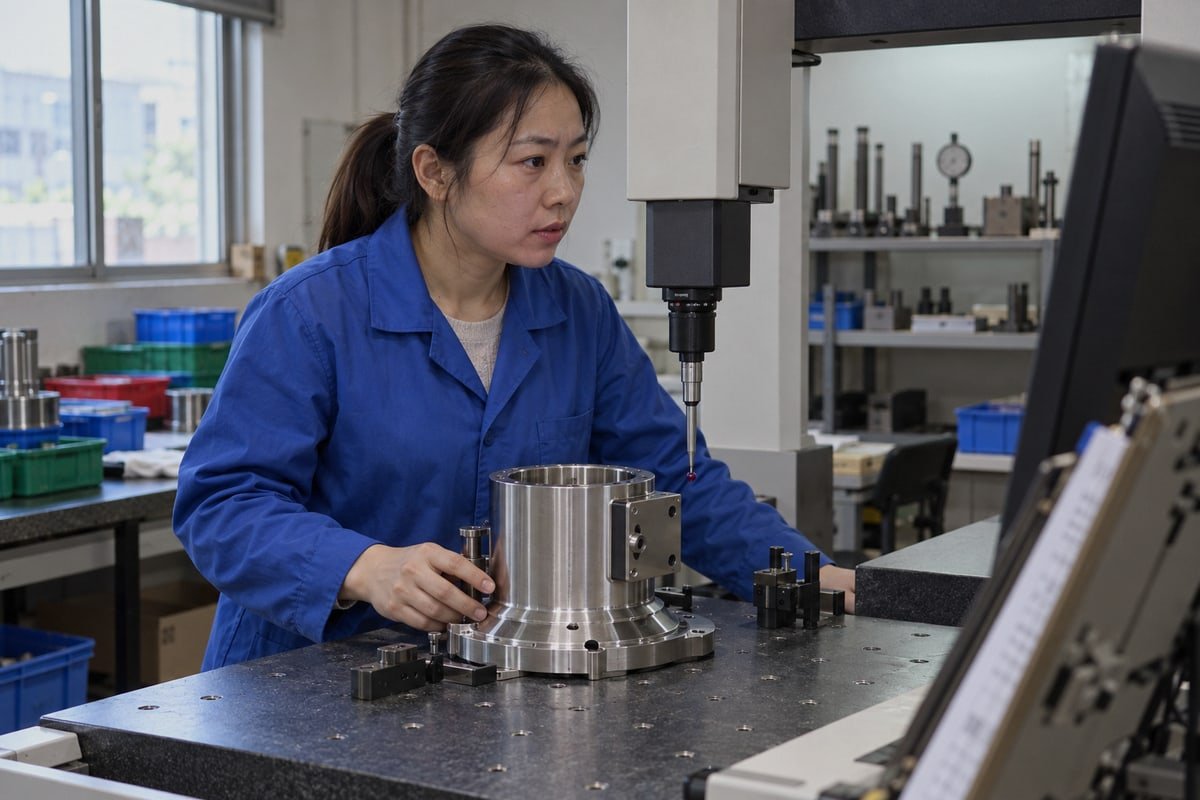
Look for tolerance claims tied to a specific stainless grade, feature, size, and batch quantity, not a generic number. Ask for sample parts with actual-versus-nominal inspection reports, CMM access, in-process probing, thermal control methods, and Cpk data of at least 1.33 on critical features for production runs.
Why Stainless Steel Is Harder Than Aluminum
I will state this plainly, because it shapes everything else: stainless steel is harder to machine than aluminum. It cuts slower. It hardens under the tool if the feed hesitates. It keeps heat in the part instead of carrying it away in the chip. A shop that is excellent on 6061 aluminum can still struggle on 316L. So the first thing I listen for is whether a supplier talks about stainless as a different problem, or as "just metal."
| Factor | Aluminum 6061 | Stainless 316L | What it means for your supplier |
|---|---|---|---|
| Cutting speed | High | Much lower | Longer cycle time, higher price per part |
| Work hardening | Minimal | Severe if the tool rubs | Needs correct chip load and sharp tooling |
| Heat in the part | Leaves with the chip | Stays in the workpiece | Thermal drift; coolant strategy matters |
| Tool wear | Slow | Fast | Tool-life monitoring and planned changes |
| Thin walls | Cut cleanly | Push away and spring back | Fixturing and light finishing passes matter |
The Four Levels of Tolerance Capability
A quoted ±0.01 mm means little by itself. I separate capability into four levels, and I ask which one the supplier is actually promising.
- One-time conformance. One part measured once passed. This proves almost nothing about stainless.
- Repeatability. Ten parts from one setup all pass.
- Batch stability. Part 1 and part 500 match, even after tool changes and thermal growth.
- Capability under production conditions. The supplier can show SPC data, and a Cpk of at least 1.33 on critical features is the common industry target.
Questions That Expose the Real Answer
Multi-axis milling capabilities are often advertised, but the detail matters. Ask whether the shop runs simultaneous 5-axis or indexed 3+2. Ask whether machines have probing and automatic tool measurement. Ask about high-pressure through-spindle coolant 1 above 1,000 PSI, which breaks chips and pulls heat out of deep stainless pockets. Some shops now add IoT sensors for real-time tool vibration and thermal wear monitoring. Ask how datums will be set and how thin walls will be held.
On our 3-, 4-, and 5-axis mills we hold 0.01 mm, and down to 0.005 mm on selected features. But we only commit to that number after we have seen the feature, the grade, and the quantity.
How Can I Verify That a CNC Machining Supplier Will Use the Correct Stainless Steel Grade for My Parts?
Every time we quote 316L against 304, we weigh two things: the customer's chloride exposure and the extra tool wear we absorb. The cheaper grade is rarely the cheaper part.
Verify the grade by specifying it exactly in your RFQ with the ASTM or EN standard and condition, requiring mill certificates and material test reports tied to heat numbers, prohibiting substitutions in writing, and asking for PMI testing where corrosion or safety matters.

Stainless Steel Is Not One Material
Buyers worry about material fraud for a good reason. The 304 and 316 grades look identical on a bench. Nobody can tell them apart by eye. The difference only shows up months later, as pitting in a marine or food-washdown environment. So I never accept "stainless steel" on a drawing without a grade and standard behind it.
| Grade | Corrosion resistance | Strength and hardness | Machining behavior | Typical use |
|---|---|---|---|---|
| 304 / 304L | Good general purpose | Moderate | Gummy, work-hardens, long stringy chips | Brackets, housings, general fittings |
| 316 / 316L | Higher; resists chlorides | Moderate | Slower cutting, more tool wear than 304 | Marine, chemical, medical, food processing |
| 17-4 PH | Good | High after precipitation hardening | Cuts well in solution-annealed condition; condition must be specified | Valve parts, aerospace fittings, shafts |
The 17-4 PH row shows why "condition" matters. Machining in H900 versus the annealed state changes tool life, achievable finish, and final dimensions after heat treatment.
What Your Request for Quote Process Must State
A complete Request for Quote process removes most grade risk before any chip is cut. In your RFQ, include:
- Exact grade and designation, for example 316L per ASTM A276 or EN 1.4404
- Heat treatment or delivered condition
- Required material test reports or mill certificates
- Heat or lot-number traceability on the parts or packaging
- A clear statement that substitutions are prohibited without written approval
- PMI requirements for regulated or safety-critical parts
- Country-of-origin, recycled-content, or ESG disclosure requirements if your supply chain audits them
The Traceability Chain We Follow
Material traceability is a chain, and every link must hold. Here is how we run it in Dongguan.
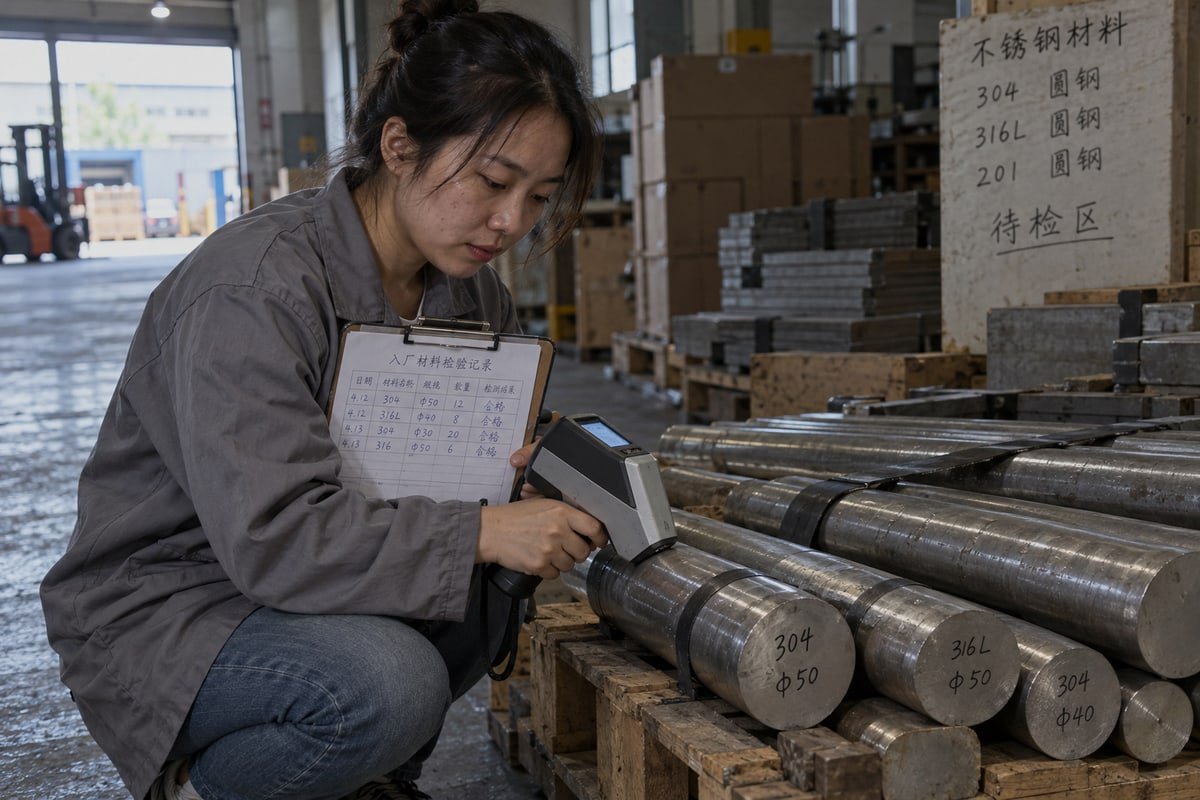
- Bar or plate arrives with the mill certificate. We check the heat number 4 against the delivery note.
- The heat number is written onto the job traveler before cutting begins.
- Offcuts are tagged and retained until the job ships.
- If the customer requests PMI, an alloy analyzer confirms the composition before machining.
- The certificate ships with the parts and is filed with the inspection report.
If a supplier cannot describe a chain like this, assume the chain does not exist.
What Questions Should I Ask to Make Sure My Supplier Can Handle Both Prototyping and Stable Batch Production?
One US automation buyer told me his previous shop made a perfect first sample, then shipped 200 parts with burred threads. That gap is the real test.
Ask whether one team handles prototyping to mass production, what changes in fixtures, tooling, and inspection as volume rises, how approved samples become the production reference, how batch-to-batch drift is monitored, how engineering changes are controlled, and whether capacity can be reserved for repeat orders.

What Changes Between One Part and One Thousand
A prototype answers the question "does the design work?" A production batch answers "does the process work, every time?" Those are different questions, and stainless steel makes the second one harder. Tool wear accelerates. Heat builds up over a shift. A fixture that held one part fine may let the fiftieth one spring.
| Phase | Goal | Fixturing | Inspection | Main risk |
|---|---|---|---|---|
| Prototype | Prove the design | Soft jaws, vise, general setup | 100% dimensional check | Design errors, tool access |
| Pilot run | Prove the process | Dedicated fixture, defined tool list | First article plus sampling | Fixture-induced variation |
| Production | Repeat reliably | Hardened or multi-part fixtures | SPC on critical features, Cpk tracking | Drift, tool wear, burrs, mixed lots |
The Prototype-Speed Objection
Some buyers tell me they want the fastest sample shop, then they will find a volume shop later. I understand the logic. But a shop built only for speed often lacks the process controls and documentation that production needs. You then re-qualify from zero. Our own approach is to keep the same engineers on the job from the first prototype through repeat orders. We can ship simple prototypes in as little as 5 days, but we build the fixture concept and inspection plan with production in mind from day one.
Questions I Would Ask Any Shop
- Which CNC turning and milling processes will this part use, and will that route change at volume?
- Do you have Swiss-turning centers for small, long stainless turned parts?
- How is the approved first sample stored and referenced for later batches?
- What is your engineering-change control process, and who signs off?
- How do you detect dimensional drift mid-batch: timed checks, probing, or SPC charts?
- Can you reserve capacity for our repeat schedule, and what is your surge capacity?
- Who inspects burrs and threads, and with what gauges?
A supplier who answers these in detail, and asks a few back, is thinking about your second order, not just your first.
How Do I Know If a Stainless Steel CNC Machining Supplier Can Provide Reliable Quality Documentation and On-Time Delivery?
We learned that a lead time is only as honest as its breakdown. An outside passivation vendor once added days we never quoted. Now we schedule every step.
Check for ISO 9001 certification backed by real evidence: first article inspection reports with actual-versus-nominal values, calibrated CMM records, material certificates linked to heat numbers, and retained corrective-action files. For delivery, demand a step-by-step lead-time breakdown covering material, machining, finishing, inspection, and shipping.
The Documents That Actually Matter
Buyers often tell me their internal acceptance process stalls because a supplier sent a one-line "passed" note. That is not documentation. Here is what I expect a serious stainless steel CNC machining supplier to provide, and the red flag that goes with each.
| Document | It should contain | Red flag |
|---|---|---|
| First article inspection report | Every drawing dimension, nominal, tolerance, actual value, gauge used | Only pass/fail marks |
| Material certificate | Grade, standard, heat number, chemistry, mechanical properties | Generic certificate with no heat number |
| In-process and final inspection records | Sampling frequency, critical features, operator, date | No record of mid-batch checks |
| Surface roughness report | Measured Ra values against surface roughness standards on the drawing | "Smooth finish" with no number |
| Passivation record | Specification such as ASTM A967, citric or nitric, test method | Passivation treated as an unlisted extra |
| Nonconformance and corrective action | Root cause, containment, verification | Supplier avoids the topic entirely |
Certificates Versus Real Performance
Our factory holds ISO 9001:2015. I value it, because it forces discipline in document control and corrective action. But I tell customers the same thing I tell new staff: a certificate proves the system exists, not that we can hit your bore tolerance in 316L. Medical buyers may also require ISO 13485 5 and aerospace buyers AS9100. Treat all of them as entry tickets. Then ask for inspection evidence on a part like yours.
Reading a Lead-Time Breakdown
Production lead times fail at the handoffs, not at the spindle. A credible schedule names each step:
- Material procurement, including certificate lead time for less common grades like 17-4 PH
- Programming and fixture preparation
- Setup and machining
- Outside or in-house finishing, such as passivation or electropolishing
- Inspection queue and report preparation
- Packaging that protects finished stainless surfaces
- Freight and customs
Buyers comparing China with a local shop should weigh time-zone friction honestly. We answer that with a named engineer on each project, quotations that list every assumption, and a 30-day warranty on shipped parts. Our quality assurance protocols check specifications during machining and again before shipment, and the reports travel with the box.
Conclusion
Stainless steel punishes guesswork. The right stainless steel CNC machining supplier proves grade control, tolerance repeatability, documentation, and honest lead times before you order. Send us a drawing and see.
Footnotes
1. NIST provides research and standards for advanced manufacturing processes like high-pressure cooling. ↩︎
2. Technical explanation of the specific class of stainless steel discussed in the machining context. ↩︎
3. Authoritative overview of the stainless steel grades mentioned in the article. ↩︎
4. ASTM International sets the standards for material identification and heat number traceability. ↩︎
5. Official ISO page for the medical device quality standard mentioned for specialized buyers. ↩︎

 עִבְרִית
 English
 Italiano
 Français
 日本語
 Deutsch (Sie)
 Español
 Русский
 العربية
 Български
 Čeština
 Dansk
 Suomi
 हिन्दी
 Nederlands
 Português
 Română
 Slovenčina
 Svenska
 ไทย
 Tiếng Việt
 Türkçe
 Slovenščina