
Picking the wrong CNC machining process for titanium parts wastes tools, money, and expensive stock. On our shop floor in Dongguan, we watch new buyers make this costly mistake often.
To choose the right CNC machining process for titanium parts, match the process to geometry: turn cylindrical parts, mill prismatic parts, use 5-axis milling for complex or thin-wall features, and add wire EDM for delicate internal cuts. Then confirm the shop controls heat, chips, and rigidity.
Titanium punishes guesswork. From two decades of cutting it, I can tell you its three defining traits: poor thermal conductivity 1 that traps heat at the cutting edge, fast work hardening, and chips that love to weld to the tool. Those three behaviors should drive every process decision you make. Let me walk you through the choices in the same order we make them for our own customers.
What Titanium Grade Should I Choose for CNC Machining My Parts?
A German medical device buyer once sent us a drawing marked only with the word titanium. Three quote revisions later, we settled on the right grade together and cut his tooling cost.
Choose Ti-6Al-4V (Grade 5) for most structural parts because it balances strength and machinability. Pick commercially pure grades 1–4 for corrosion resistance and easier cutting, and Grade 23 ELI for medical implants. Each grade needs different cutting speeds and feed rates.

Grade selection is the first fork in the road. It decides your speed and feed envelope, your tool life, and your final cost. It is not a detail to leave until after the process is chosen.
Common Titanium Grades Compared
| Grade | Type | Relative Machinability | Best For |
|---|---|---|---|
| Grade 1–2 (CP) | Commercially pure, alpha | Easiest | Chemical equipment, marine hardware, housings |
| Grade 5 (Ti-6Al-4V) | Alpha-beta alloy | Moderate to difficult | Aerospace structures, general engineering, fasteners |
| Grade 23 (Ti-6Al-4V ELI) | Alpha-beta, low interstitial | Similar to Grade 5 | Implants and medical grade titanium components |
| Grade 9 (Ti-3Al-2.5V) | Near-alpha | Between CP and Grade 5 | Tubing, hydraulic lines, sports equipment |
Why Grade Changes Your Machining Parameters
Alpha-beta alloys like Ti-6Al-4V Grade 5 2 demand significantly lower cutting speeds than commercially pure grades. On our machines, a CP Grade 2 part runs noticeably faster than the same geometry in Grade 5, with less tool wear per part. That difference flows straight into your quote.
Work hardening properties also vary. Every titanium grade hardens under a rubbing tool, but harder alloys punish light, hesitant cuts more severely. If the tool dwells, the surface glazes over and the next pass fights a hardened skin. Our programmers keep chip loads decisive for exactly this reason.
My practical advice: do not over-specify. Many buyers default to Grade 5 out of habit. If your part needs corrosion resistance more than raw strength, Grade 2 machines easier, costs less, and ships sooner. This is the kind of DFM feedback we give during quoting, because grade choice shapes everything that follows.
How Do I Decide Between CNC Milling and CNC Turning for Titanium Components?
Every titanium quote we prepare starts with one trade-off: fewer setups on an expensive machine, or more setups on a cheaper one. Geometry usually settles that argument quickly.
Use CNC turning for rotational parts like shafts, pins, and bushings because it is faster and cheaper. Use CNC milling for brackets, housings, and pockets. If the part combines both, turn the main body first, then mill secondary features in a second setup.
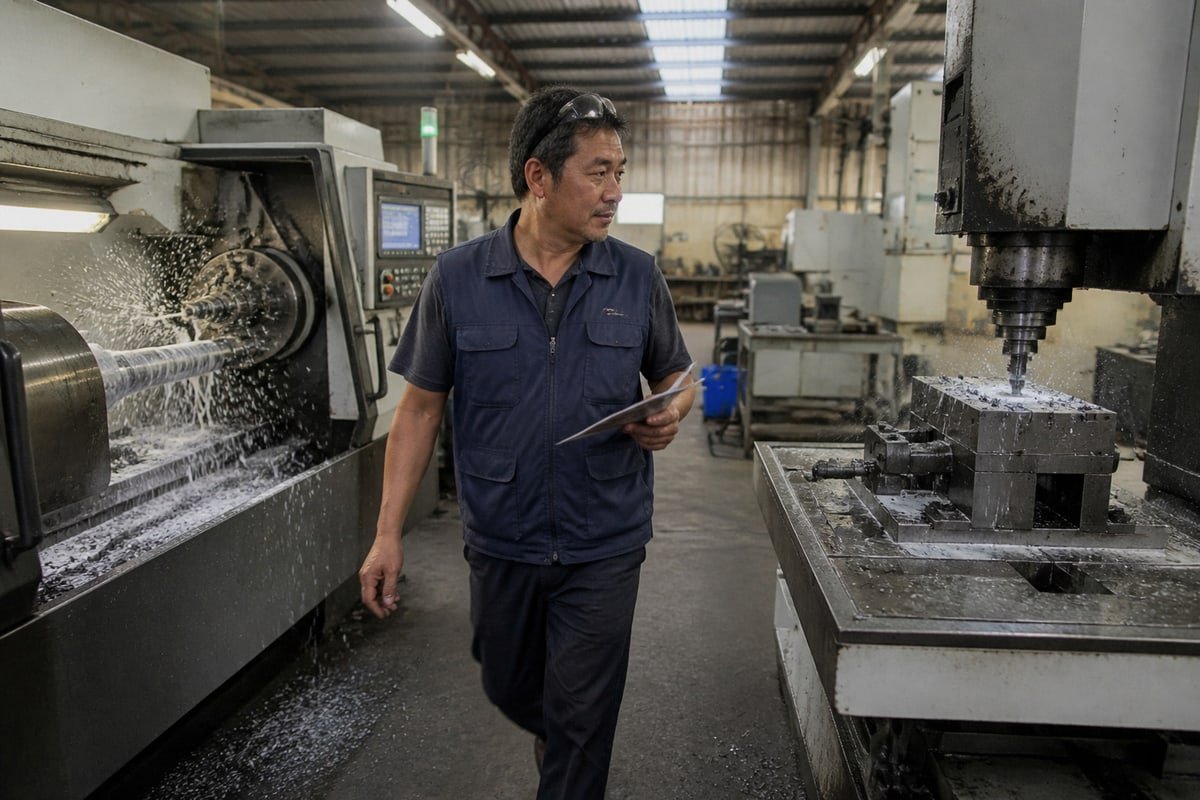
Here is the comparison we run through before programming a single toolpath.
| Process | Best For | Pros | Limitations |
|---|---|---|---|
| CNC-fräsning | Brackets, housings, pockets, contours | Flexible, handles most titanium parts | Heat buildup, tool wear, distortion on thin walls |
| CNC-svarvning | Shafts, rings, bushings, cylindrical parts | Efficient, accurate, good surface finish | Limited to rotational geometry |
| 5-Axis Machining | Angled faces, undercuts, thin walls | Fewer setups, better tool access | Higher hourly cost, complex programming |
| Drilling/Boring | Holes and internal bores | Precise when coolant is controlled | Chip evacuation is hard in titanium |
| Wire EDM | Delicate internal features, tight slots | Zero cutting force, no distortion | Slower, usually a secondary operation |
A Simple Decision Checklist
- Mostly rotational? Choose turning first.
- Prismatic with accessible faces? Choose 3-axis milling.
- Angled bores, undercuts, deep pockets, or thin walls? Move to 5-axis CNC milling.
- Features that would deflect under cutting load? Assign those features to wire EDM.
- High-value aerospace stock? Check the buy-to-fly ratio; hybrid routes using Directed Energy Deposition to build a near-net shape before CNC finishing can cut raw material waste dramatically.
When 5-Axis Earns Its Cost
Some buyers assume 5-axis is automatically the best CNC machining process for titanium parts. It is not. It is justified when setup reduction or tool access makes it economical, which is why aerospace component manufacturing leans on it heavily for angled features and thin-wall sections. For a simple prismatic bracket, our 3-axis mills with climb milling and trochoidal toolpaths deliver the same quality at a lower rate. Trochoidal paths keep radial engagement low and tool load constant, which prevents the thermal spikes titanium produces in sharp corners. Rigidity and smart toolpaths both matter; rigidity dominates roughing, and toolpath strategy dominates finishing.
What Tolerances Can I Realistically Achieve When Machining Titanium Parts?
Our CMM probe once caught a thin-wall titanium housing that drifted 0.03 mm after roughing. Heat and residual stress 3 caused it, not the operator, and that changed our workflow.
Realistic tolerances for machined titanium parts are ±0.05 mm for general features, ±0.01 mm for precision features, and ±0.005 mm for critical bores or datums on rigid setups. Tighter targets are possible but raise cost, cycle time, and scrap risk sharply.
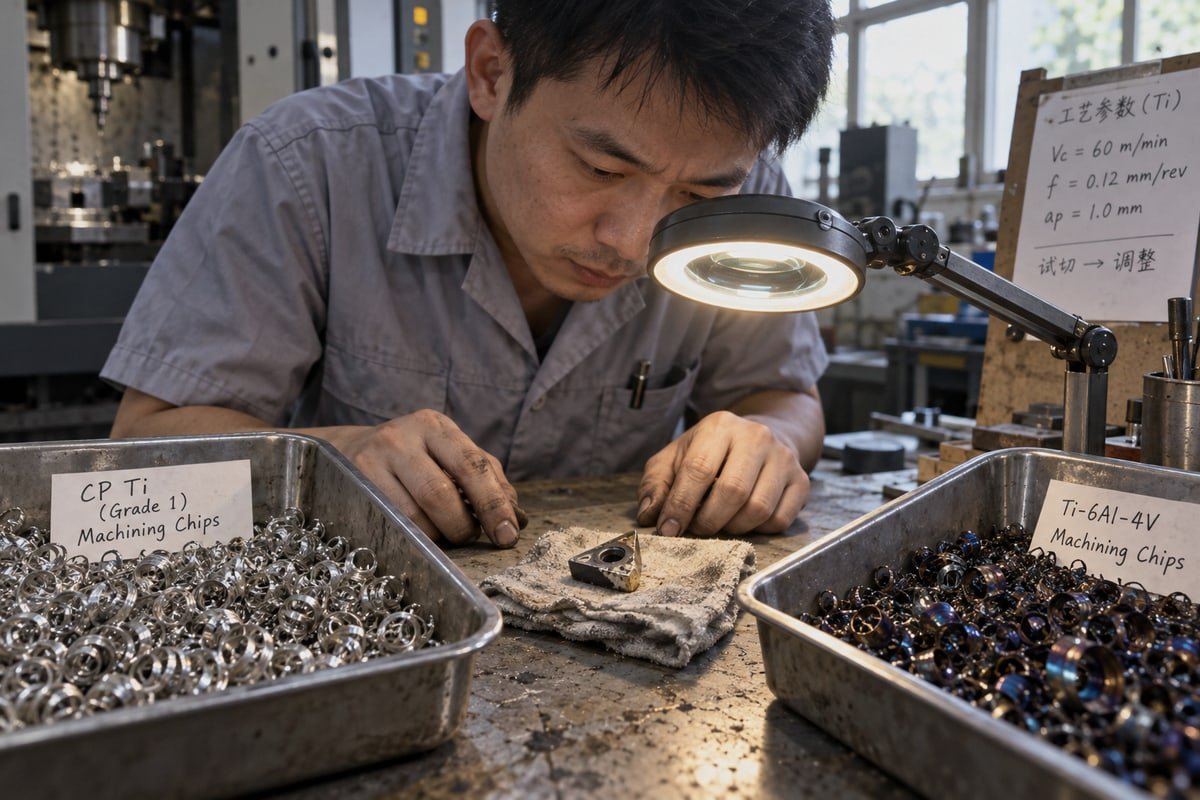
Tolerance in titanium is a fight against physics. Low thermal conductivity means the part grows while you cut it. High elastic modulus means thin sections spring away from the tool and back again. Both effects show up on the CMM report if the process ignores them.
Realistic Tolerance Targets by Feature
| Feature Type | Achievable Tolerance | Notes |
|---|---|---|
| General milled features | ±0.05 mm | Standard for non-critical surfaces |
| Precision milled features | ±0.01 mm | Needs rigid fixturing and sharp tools |
| Turned diameters, critical bores | ±0.005 mm | Requires finish passes and thermal control |
| Thin walls under 1 mm | ±0.05 mm or looser | Deflection and vibration limit accuracy |
The Workflow That Actually Holds Tolerance
- Rough conservatively at typical titanium speeds, around 20–60 m/min, with heavy but steady chip loads.
- Pause or stress-relieve so residual stress releases before final dimensions are cut.
- Semi-finish to a small, even stock allowance.
- Finish with sharp sub-micron grain carbide cutting tools coated in TiAlN or AlTiN, which keep their edge under titanium's cutting heat.
- Verify in-process, then confirm on the CMM before shipment.
High-pressure coolant systems are central here, not optional. Through-spindle delivery at 1,000 PSI (roughly 70 bar) flushes chips before they re-cut and stabilizes edge temperature. Some shops go further with cryogenic cooling using liquid nitrogen or CO2, which can support 30–50% higher cutting speeds than flood coolant. Advanced cells even add acoustic emission monitoring to catch tool micro-chipping before catastrophic failure, which is tool wear management at its most proactive. On our ISO 9001:2015 4 certified line, machine rigidity, high-torque spindles, and this staged workflow are what let us quote 0.01–0.005 mm with confidence.
How Do I Choose a Surface Finish for My Titanium CNC Machined Parts?
Years of finishing titanium for optical and medical customers taught our team one clear lesson: the finish specification deserves as much attention on the drawing as the tolerances do.
Choose an as-machined finish (Ra 1.6–3.2 µm) for hidden functional parts, bead blasting for a uniform matte look, polishing for sealing or low-friction surfaces, and anodizing or passivation when you need color coding, biocompatibility, or extra corrosion protection.
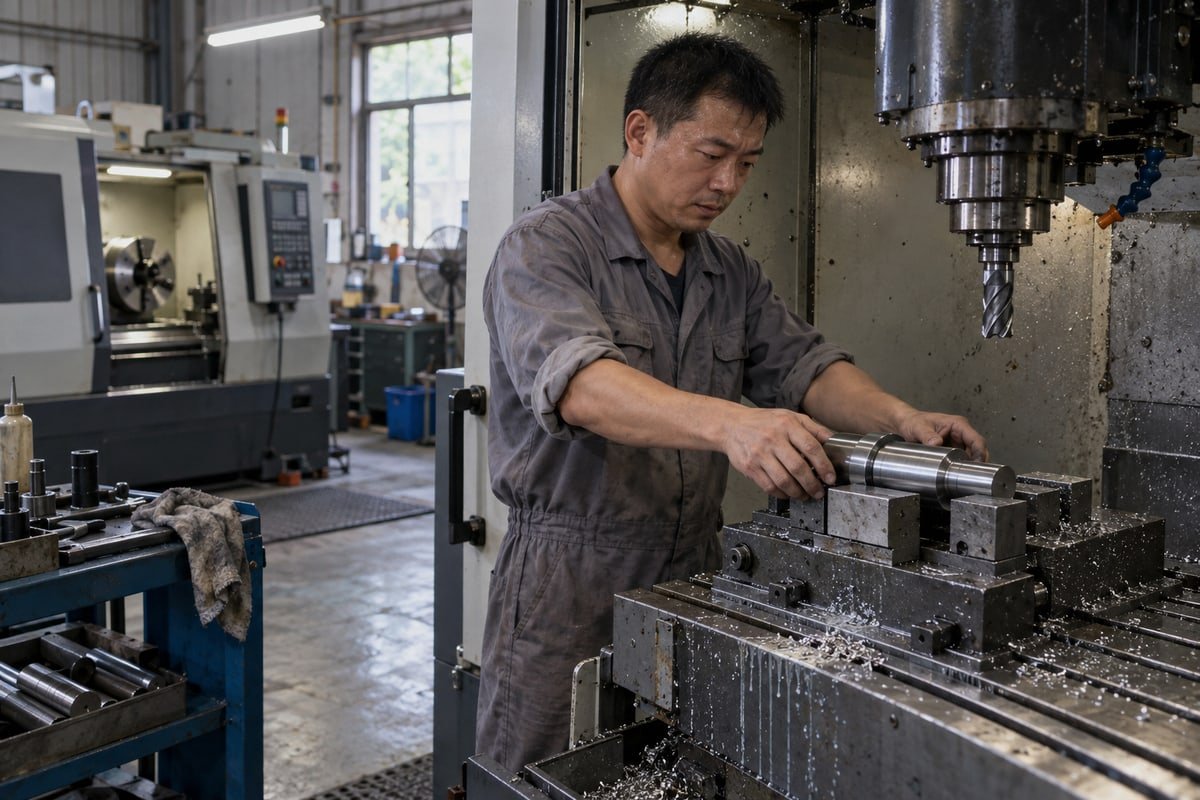
Surface finish on titanium is a function decision first and a cosmetic decision second. The right choice depends on where the part lives and what touches it.
Surface Finish Options for Titanium
| Finish | Typical Ra | Appearance | Best For |
|---|---|---|---|
| As-machined | 1.6–3.2 µm | Fine tool marks, bright | Internal or hidden functional parts |
| Bead blasted | 1.6–3.2 µm | Uniform satin matte | Housings, medical instruments, consumer parts |
| Polished | 0.2–0.8 µm | Mirror or near-mirror | Sealing faces, implants, low-friction surfaces |
| Anodized | Varies | Vivid oxide colors | Color coding, identification, wear resistance |
| Passivated | Unchanged | Clean, uniform | Medical and food-contact compliance |
Titanium anodizing is a nice bonus of this material. The oxide layer itself creates blues, golds, and purples through light interference, with no dyes involved. Medical customers use it to color-code instrument sizes.
Surface Integrity Comes First
Surface integrity matters more than surface appearance on fatigue-critical parts. A work-hardened, overheated skin can shorten fatigue life even when the Ra value looks perfect. That is why our finishing passes use sharp carbide cutting tools, climb milling so heat leaves with the chip, and constant feed with no dwelling. Any pause lets the tool rub, and rubbing hardens titanium instantly. Because titanium is also prone to smearing chips onto the cut surface, we keep coolant flowing hard through the final pass. If your part sees cyclic loads, put a surface integrity note on the drawing, not just an Ra number. We will plan the whole CNC machining process for titanium parts around it.
Conclusion
Titanium rewards planning and punishes shortcuts. Match the process to geometry, grade, tolerance, and finish, then verify your shop controls heat and rigidity. Send us your drawing for DFM feedback.
Footnotes
1. Peer-reviewed article discussing the thermal properties of titanium alloys in engineering contexts. ↩︎
2. Authoritative scientific data on the chemical composition and properties of this titanium alloy. ↩︎
3. Scientific explanation of the stresses that remain in a solid material after the original cause is removed. ↩︎
4. Official ISO page for the quality management standard used in the manufacturing process. ↩︎

 Svenska
  English
  Italiano
  Français
  日本語
日本語  Deutsch (Sie)
  Español
  Русский
  العربية
  Български
  Čeština
  Dansk
Dansk  Suomi
Suomi  עִבְרִית
  हिन्दी
  Nederlands
  Português
  Română
  Slovenčina
  ไทย
ไทย  Tiếng Việt
  Türkçe
  Slovenščina