
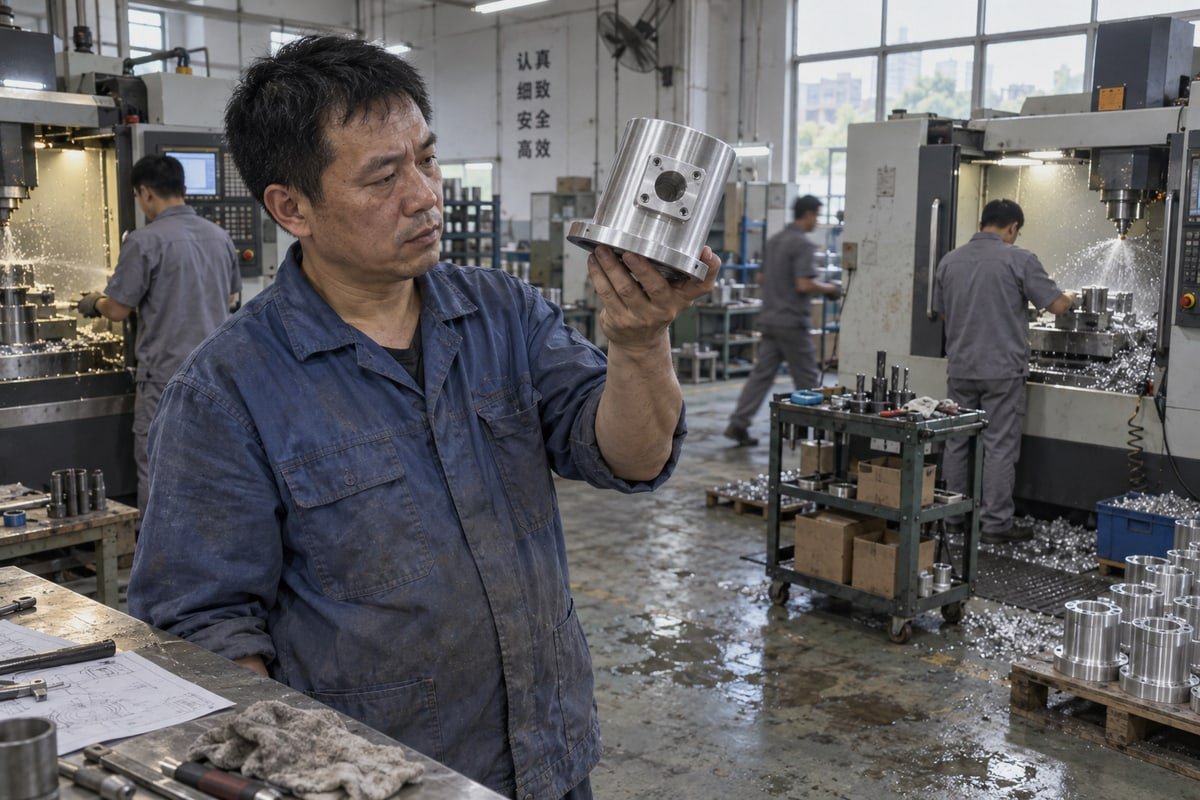
Sourcing custom CNC machining services in China feels risky. One bad supplier can sink a product launch. After twenty years running our Dongguan machine shop, I know exactly how buyers get burned.
To find custom CNC machining services in China, shortlist suppliers through B2B platforms, verified directories, and factory-direct websites. Then vet each on ISO 9001 certification, machine capability, DFM feedback, and inspection reports. Compare quotes against identical specs, validate a first-article sample, and only then commit to bulk production.
That answer is the short version. The long version is a repeatable process. In this guide, I will walk you through supplier vetting, quote comparison, drawing communication, and bulk production control, step by step.
How can I verify a CNC machining supplier's quality and certifications before placing an order?
A German buyer once asked me to video-call him from our shop floor before his first order. Smart move. He verified our machines and ISO paperwork in thirty minutes.
Verify a Chinese CNC supplier by requesting its business license, ISO 9001 certificate number, and full machine list. Confirm certificates with the issuing body, review real sample inspection reports, and commission a third-party factory audit from SGS, TÜV, or Intertek before paying any deposit.
Verification is where most sourcing mistakes are either caught or missed. On marketplaces like Alibaba, Made-in-China, and Global Sources, you can filter by trade assurance status, gold supplier level, and verified factory icons. Those filters are a useful first screen. But a "verified" badge only confirms that a company exists and paid a fee. It does not prove the shop can hold your precision tolerances. Independent due diligence is still your job.
Certifications That Actually Matter
Start with the paperwork, but match the certificate to your industry. Generic claims are not enough for regulated parts.
| Certification | What It Covers | When You Need It |
|---|---|---|
| ISO 9001:2015 | General quality management system | Any industrial or commercial part |
| IATF 16949 | Automotive-grade quality system | Automotive-grade components |
| ISO 13485 | Medical device quality system | Medical device components |
| Material test reports (MTR) | Alloy traceability per batch | Structural, corrosion-critical, or safety parts |
Our own factory holds ISO 9001:2015 certification 1, and I always tell buyers the same thing: do not take the PDF at face value. Ask for the certificate number and check it with the issuing registrar. At least one supplier source I trust makes the same point—certifications should be independently audited and verifiable, not self-declared.
Remote and On-Site Factory Audits
Next, verify capability. Request the equipment list and confirm the mix of 3-axis, 4-axis, and 5-axis machines 2, plus calibration records for measuring tools like calipers and CMM probes. If you cannot fly to China, hire SGS, TÜV, or Intertek 3 for an on-site factory audit, or ask for a live video walkthrough like my German customer did. Finally, cross-check reputation through Trustpilot, Google Reviews, and direct customer references.
What should I look for when comparing CNC machining quotes from Chinese manufacturers?
Many buyers assume China simply means cheap. In my quoting work with European engineers, the lowest price is never the goal—the best cost-to-quality ratio is.
Compare CNC quotes by sending identical CAD files, tolerances, materials, finishes, quantities, and Incoterms to every supplier. Evaluate total landed cost, DFM feedback quality, payment terms, and lead times—not just unit price. A quote far below the others usually hides weak QC or later surcharges.
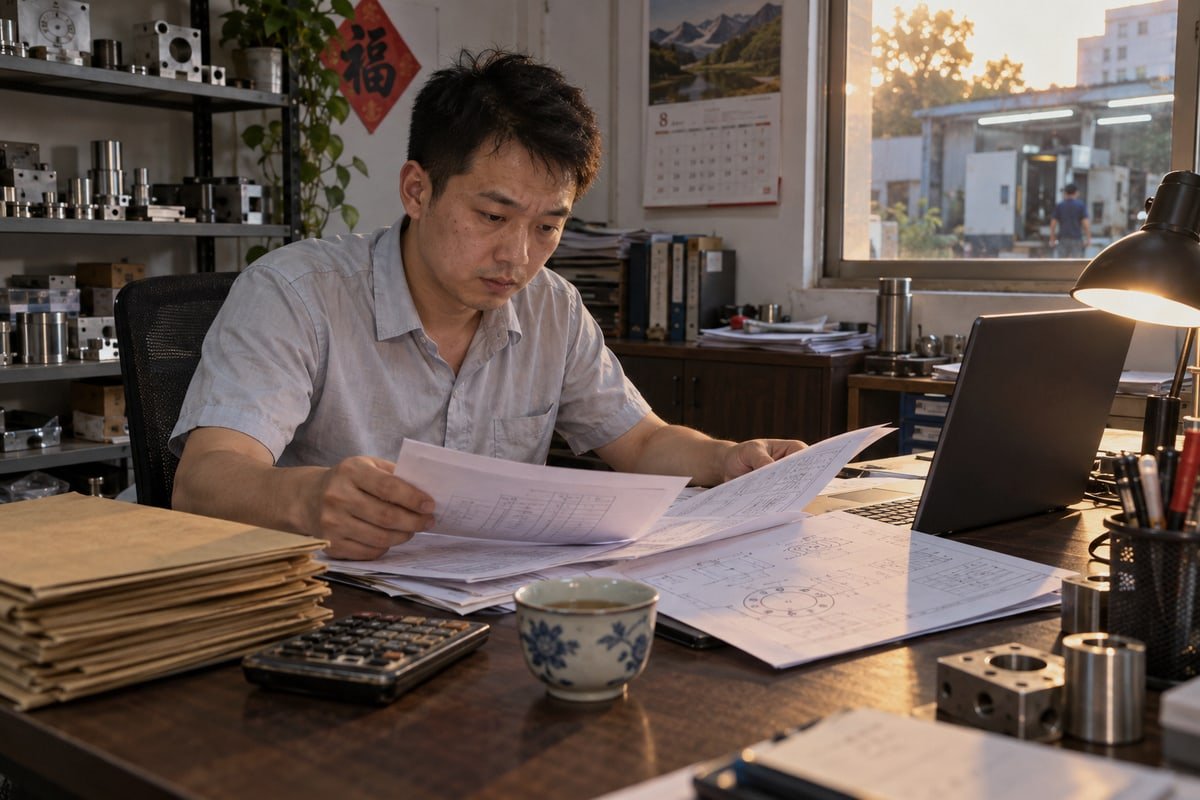
The RFQ process only works when every supplier prices the same job. If one shop quotes 6061-T6 aluminum with anodizing and another quotes bare generic aluminum, the numbers mean nothing. So lock the spec first: same STEP file, same 2D drawing, same material grade, same surface finishing, same quantity breaks, same delivery terms. Then the differences you see are real.
Read the Quote Beyond the Unit Price
I have reviewed thousands of quotes from our side of the table, and the cheapest line item is rarely the cheapest project. Here is what I would check:
| Cost Element | Question to Ask | Red Flag |
|---|---|---|
| Unit price | Does it include the specified material grade? | Vague "aluminum" instead of Aluminum 6061-T6 |
| Setup and tooling | Are one-time charges listed separately? | Hidden fees appearing after order confirmation |
| Surface finishing | Is anodizing, plating, or polishing included? | "Finishing extra" with no stated price |
| Inspection and documents | Are FAIR reports and material certs included? | Charging extra for basic dimensional report 4s |
| Shipping and Incoterms | EXW, FOB, or DDP—which is quoted? | Comparing an EXW quote against a DDP quote |
| Payment terms | Is it the standard 30% deposit, 70% balance? | Demanding 100% payment before production |
Speed and Transparency as Maturity Signals
Quoting behavior tells you a lot. Serious suppliers now respond within about 24 hours, often with DFM notes attached. That speed signals a mature operation, not a trading desk forwarding your files. Our team aims to return quotes with manufacturability feedback because catching a problem at the quoting stage costs nothing; catching it after machining costs everyone. And remember the standard payment structure most checklists recommend: 30% deposit, 70% balance tied to inspection or the bill-of-lading copy. That structure protects both sides.
How do I make sure my drawings and tolerances are correctly understood by an overseas CNC supplier?
Years ago, a drawing arrived at our Dongguan factory with an ambiguous thread callout. We caught it during DFM review, but it taught me how easily details slip across borders.
Send both 3D CAD files and 2D drawings with GD&T callouts, marked critical dimensions, exact material grades, and surface finish specs. Ask the supplier to restate key tolerances in writing, provide DFM feedback, and confirm understanding with a first-article sample before approving production.

Miscommunication is the single biggest pain point buyers describe to me. Many trading companies employ salespeople without engineering backgrounds, so tolerances, threads, hole positions, and assembly relationships get lost in translation. The fix is structural, not hopeful: build a complete drawing package and demand a technical response, not just a price.
Build a Complete Drawing Package
| Item | Why It Matters |
|---|---|
| 3D CAD file (STEP or IGES) | Defines geometry without translation errors |
| 2D PDF with GD&T | Communicates precision tolerances, datums, and fits |
| Marked critical dimensions | Tells the shop where inspection effort must concentrate |
| Exact material grade | Prevents substitution, e.g., generic alloy for 6061-T6 |
| Surface finishing spec | Anodize type, color, roughness, and masking zones |
| Thread and hole standards | Metric vs. imperial, class of fit, depth callouts |
Be realistic about tolerance bands too. Standard CNC machining typically holds about ±0.1 mm. If your part needs ±0.01 mm, say so explicitly and make the supplier confirm capability in writing. Our 3-, 4-, and 5-axis milling lines hold 0.01–0.005 mm on critical features, but we only promise that after reviewing the actual geometry—any shop that promises it blind is guessing.
Close the Loop with DFM and Samples
Modern shops increasingly run AI-assisted DFM tools that flag thin walls, deep pockets, and unreachable features before a human engineer even opens the file. Use that feedback loop. Then validate with rapid prototyping: one first-article sample with a full dimensional report proves the supplier understood your drawing better than any email thread ever will. If your assembly contains sensitive IP, consider a fragmented manufacturing strategy—splitting critical components of one assembly across different, non-competing vendors—alongside a signed NDA.
What steps can I take to ensure stable quality and on-time delivery for bulk CNC production orders?
Early in our export business, one delayed anodizing batch pushed a customer's assembly line back a full week. That lesson reshaped how we plan every bulk order today.
Ensure stable bulk production by approving a first-article inspection report, locking process parameters, requiring in-process dimensional checks and material test reports, agreeing on 30/70 payment tied to pre-shipment inspection, and scheduling weekly progress updates with buffer time built into shipping.
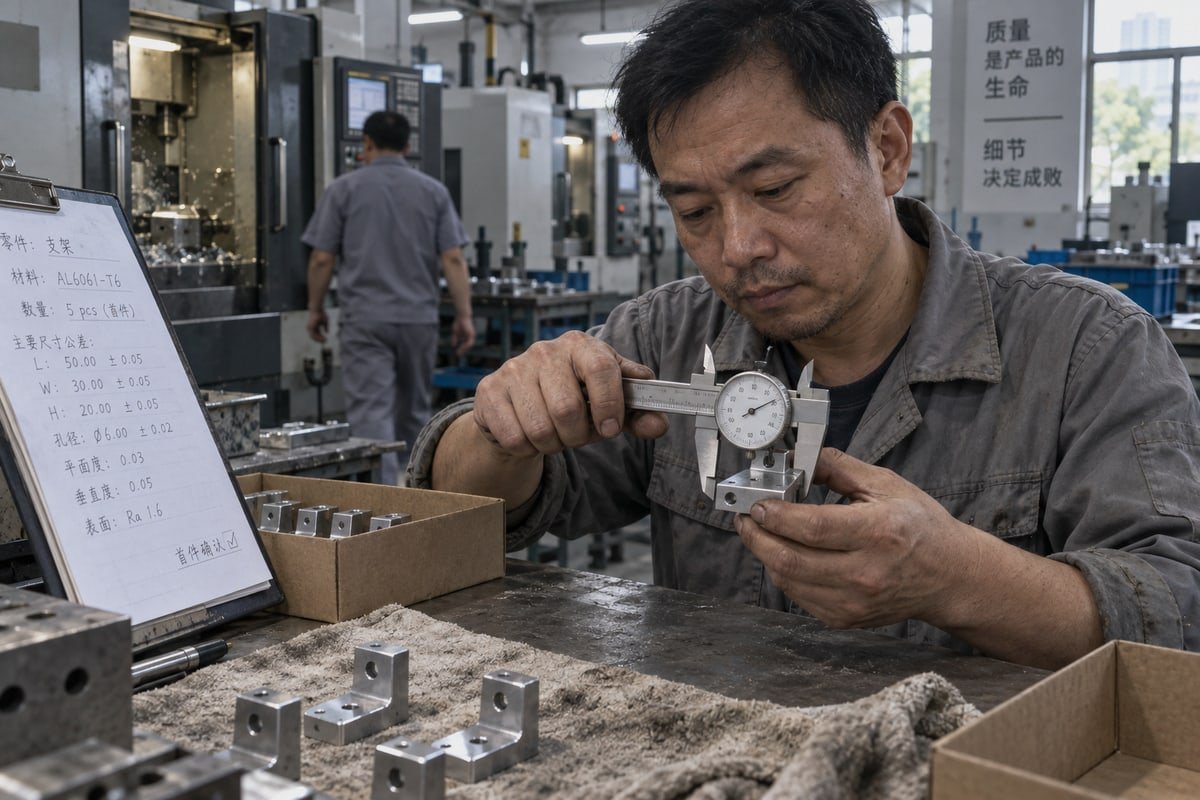
The classic failure mode is simple: the sample passes, then batch parts drift. Dimensions wander, burrs appear, hole positions shift, and assembly fails on your floor. Preventing that takes a disciplined sequence, not trust. Here is the workflow I recommend to every buyer moving from low-volume production to mass production:
- Approve a first-article inspection (FAIR) report. Full dimensional data on the first production part, measured on a CMM, becomes your baseline.
- Lock the process. Fixturing, tooling, machine assignment, and CNC milling and turning parameters should be frozen after FAIR approval.
- Require in-process checks. Operators should measure critical dimensions at set intervals, not only at final inspection.
- Demand material test reports for every batch. This blocks silent substitution, like mixing 304 and 316 stainless steel.
- Tie payment to inspection. The 30% deposit / 70% balance structure, with the balance released after pre-shipment inspection, keeps incentives aligned.
- Specify packaging. Precision parts need individual protection so nothing arrives scratched, deformed, or mixed up.
- Set a communication rhythm. One named contact and weekly updates catch delays while they are still fixable.
On logistics, build buffers and ask about resilience. Established air freight relationships can support a 3–5 day shipping window on urgent orders—our shortest lead times run as fast as 5 days for qualifying parts. Also ask about two newer risks: whether the factory complies with China's Dual Control energy policies, which can interrupt non-compliant production, and whether it offers China Plus One options, with finishing or assembly capacity in Southeast Asia to soften tariff and shipping swings.
Conclusion
Finding custom CNC machining services in China rewards process over luck. Shortlist, verify, compare on value not price, sample, then scale. Follow that sequence and your risk drops dramatically.
Footnotes
1. Official international standard for quality management systems used to verify the operational reliability of Chinese CNC machining suppliers. ↩︎
2. Technical overview of advanced CNC machining configurations used for producing complex geometries in precision manufacturing. ↩︎
3. Global inspection and certification body providing independent third-party factory audits to verify manufacturing capabilities and quality standards. ↩︎
4. Technical documentation used to verify that a first-article sample meets all specified design and tolerance requirements. ↩︎

 Türkçe
  English
  Italiano
  Français
  日本語
日本語  Deutsch (Sie)
  Español
  Русский
  العربية
  Български
  Čeština
  Dansk
Dansk  Suomi
Suomi  עִבְרִית
  हिन्दी
  Nederlands
  Português
  Română
  Slovenčina
  Svenska
  ไทย
ไทย  Tiếng Việt
  Slovenščina