
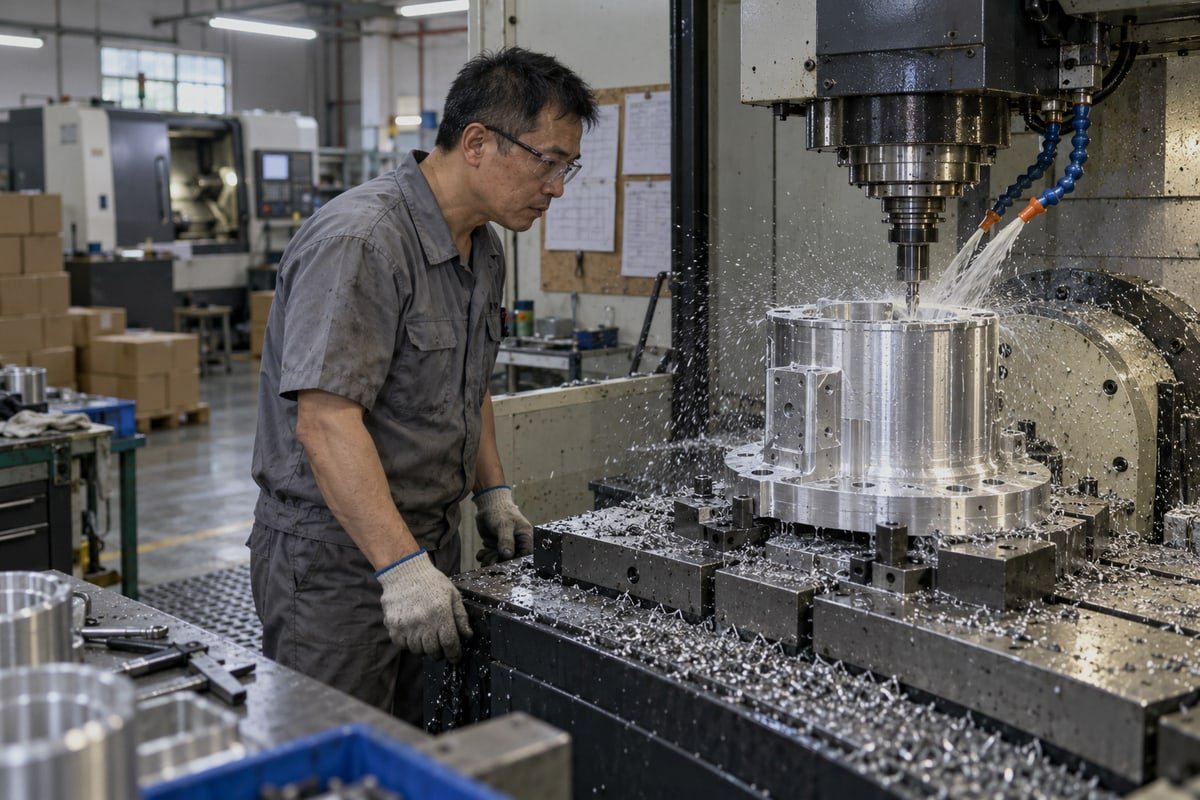
Precision CNC machining for electric vehicle component manufacturing faces one tension on our Dongguan floor: tighter tolerances, shrinking budgets. Miss one bore and assembly stops. Smart process planning fixes that.
CNC machining improves electric vehicle component manufacturing by holding tight dimensional tolerances on motor housings, battery enclosures, and cooling plates, enabling rapid prototyping without hard tooling, and finishing cast or extruded parts with precision. It works best as the precision layer within a hybrid production chain.
Below, I walk through the four questions EV buyers ask us most. Each one links a benefit to a real machining mechanism, not a slogan. Let’s start with batch consistency.
How can I ensure my EV component tolerances stay consistent across large production batches?
A German buyer once sent us a motor end plate where sample one passed and piece 300 did not. The drift came from tool wear, not the machine.
You keep EV component tolerances consistent across large batches by controlling tool wear, fixturing, and temperature, using in-process probing and CMM sampling, applying statistical process control, and documenting first article inspection. Machine capability of ±0.005 mm only holds when these controls stay active throughout the run.

That end-plate story taught me something I now repeat to every new customer. A good first sample proves the machine can do it. It does not prove the process will keep doing it. Those are two different questions, and batch consistency lives in the second one.
Machine capability is not production tolerance
Our 5-axis milling centers 1 can reach 0.01–0.005 mm on suitable features. I still refuse to put that number on a quote without qualification. Achieved tolerance depends on the alloy, the part geometry, how the part is clamped, the cutting tool's condition, and the shop temperature that day. A thin-wall inverter housing in 6061 aluminum behaves differently from a solid steel shaft. So we ask which features truly need the tight band. Bearing bores, rotor-stator interfaces, and sealing faces usually do. A cosmetic pocket usually does not. Spending precision where it matters is the first step to holding it.
Where batch variation comes from
| Variation source | What drifts | How we control it |
|---|---|---|
| Tool wear | Bore diameter, surface finish | Tool-life counters, automatic offset compensation |
| Fixturing | Hole position, flatness | Dedicated fixtures, repeat clamping force |
| Thermal growth | Length, concentricity | Warm-up cycles, climate-controlled inspection |
| Material lot | Cutting behavior, burrs | Material certificates, lot traceability |
| Operator handoff | Setup repeatability | Digital work instructions, standard setup sheets |
Inspection closes the loop
Repeatable machining reduces variation. Inspection confirms the process is still inside the spec. On EV motor stator components and battery housing fabrication 2 jobs, we combine in-process probing with CMM sampling at defined intervals. The data feeds a simple SPC chart. When a dimension starts walking toward a limit, we adjust the offset before a reject appears, not after. Every batch ships with a first article inspection report and outgoing dimensional records. That paperwork is what lets a procurement manager accept the lot without re-measuring everything on arrival. Under our ISO 9001:2015 system, this is not optional. It is how the process stays honest.
Which materials should I choose for CNC machining high-performance electric vehicle parts?
Every quote forces one trade-off on our side: 6061 aluminum cuts fast and cheap, while 7075-T6 or copper costs more but changes what the part can do.
Choose lightweight aluminum alloys like 6061 and 7075-T6 for housings, trays, and cooling plates; copper for busbars and high-conductivity contacts; titanium or alloy steel for high-load shafts and mounts; and PEEK or POM for electrical insulation. Match each material to thermal, structural, and conductivity demands.
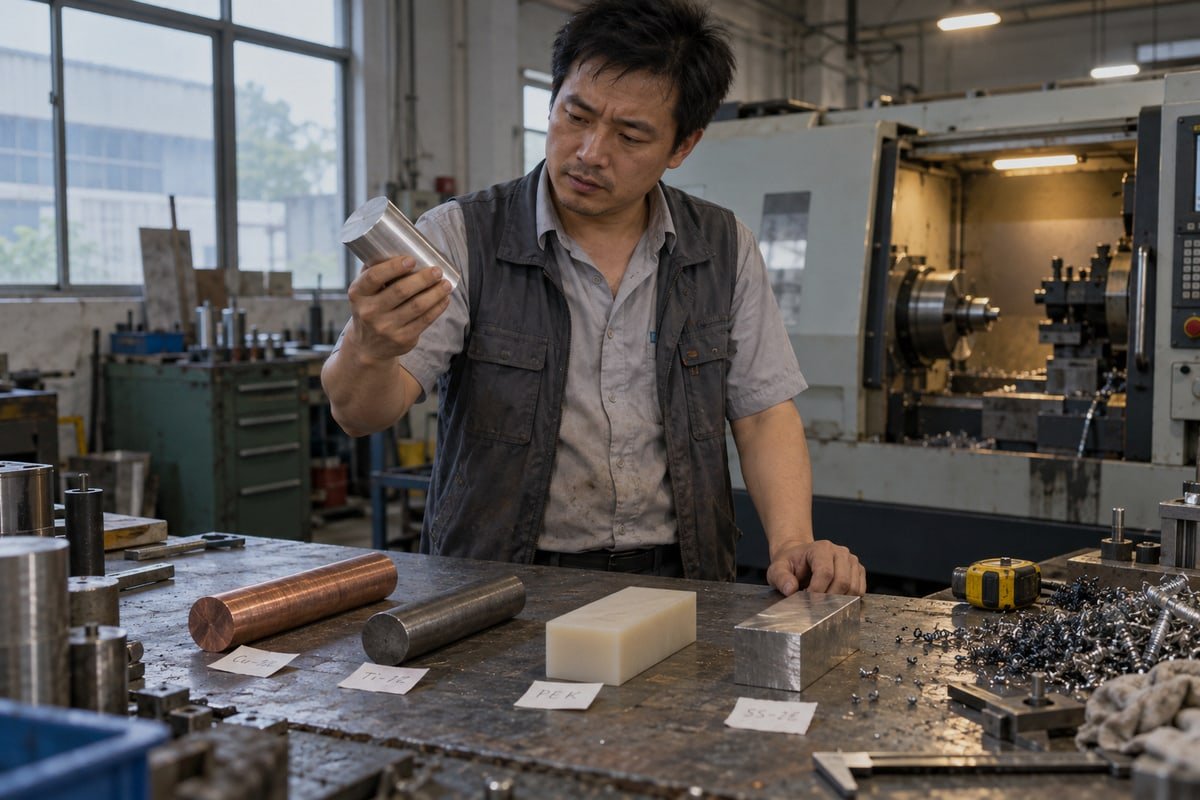
Material choice decides half the cost and most of the performance before a single chip is cut. I always start a material discussion with the component's job, not with a price list. Here is the comparison we share with EV engineers who send us drawings.
| Material | Typical EV use | Why it fits | Machining note |
|---|---|---|---|
| 6061 aluminum | Battery trays, inverter housings, brackets | Light, weldable, corrosion resistant, affordable | Fast cutting, easy anodizing |
| 7075-T6 aluminum | Structural mounts, high-load housings | High yield strength at low mass | Harder on tools, more care on thin walls |
| Copper | Busbars, connector contacts | High electrical and thermal conductivity | Gummy, needs sharp tooling and good chip control |
| Alloy / tool steel | Shafts, bearing seats, gears | Stiffness, wear resistance | Slower cycles, may need heat treatment |
| Titanium | Lightweight fasteners, select structural parts | Strength-to-weight, corrosion resistance | Low cutting speeds, high tool cost |
| PEEK / POM / nylon | Insulators, bushings, spacers | Electrical isolation 3, chemical resistance | Low cutting forces, dimensional stability varies |
Why aluminum dominates EV housings
Aluminum is about 66% lighter than steel by volume. That single figure explains why most battery housing fabrication, motor housings, and power electronics cooling plates 4 land on aluminum. It also conducts heat well, which matters for thermal management systems. But the alloy matters. 6061 is our workhorse for cold plates and enclosures. When a customer needs a structural mount that carries crash loads, 7075-T6 offers a much higher yield strength. We do flag one thing in DFM feedback: thermal performance depends on wall thickness, flatness, and contact quality, not just the alloy name on the drawing.
Copper and plastics complete the system
Copper busbar machining is a growing share of our EV work. Copper carries the high-voltage current 5, so conductivity cannot be traded away. It is also unpleasant to machine. It smears, work-hardens, and clogs flutes. We use sharp, polished tooling and tight chip evacuation to keep burrs off the contact faces. On the insulation side, PEEK and POM give us electrical isolation inside connector bodies and high-voltage junction boxes. Both are in our standard material list, alongside ABS, PC, PPSU, and HDPE.
The objection I hear most
Buyers sometimes ask whether CNC wastes too much material to be worth it for lightweighting. It is a fair point. Cutting a tray from a solid billet creates a lot of chips. Our answer is to combine processes: let casting or extrusion create the bulk shape, and let CNC finish the interfaces. Aluminum chips are also recycled when properly segregated. So the material choice and the process route must be decided together.
Can CNC machining help me reduce costs while meeting strict automotive quality standards?
The lesson we learned the hard way: cutting cost by loosening a sealing-face flatness spec saved cents and cost a whole battery tray rework.
Yes. CNC machining reduces EV part costs by removing hard tooling from development, enabling DFM changes before production, and finishing near-net-shape castings instead of cutting from billet. Quality stays intact when ISO 9001 inspection, material certificates, and first article reports back every batch.

My stance on cost is simple and non-negotiable: control cost, but never compromise product performance. That sealing-face episode is why. The saving on the drawing looked clever. The leak at assembly did not. So when we talk about cost reduction with EV customers, we only mean reductions that leave function untouched.
Four cost levers that do not touch performance
- Skip hard tooling during development. A casting die or stamping tool costs real money and weeks of lead time. CNC goes from CAD to a functional prototype with no tooling. Design updates mean editing a program, not rebuilding a die. On our side, lead times can be as short as 5 days for prototypes, which compresses the R&D loop for inverter and drivetrain concepts.
- Apply DFM before the first chip. Our engineers review every uploaded drawing for manufacturability. Common fixes include relaxing non-functional tolerances, standardizing hole sizes, and adding corner radii so standard tools work. These changes cut cycle time without changing the part's job.
- Use CNC as a finishing step. Most production EV parts are not milled from solid. Casting, forging, or extrusion creates the shape. CNC machines the bores, threads, sealing faces, and locating features. This hybrid route keeps material waste and cycle time down while keeping the critical surfaces precise.
- Pick the right volume strategy. Rapid prototyping, low-volume runs, and mass production have different economics. Knowing which one you are in avoids paying tooling costs for 50 pieces or paying CNC cycle time for 500,000.
When CNC is not the cheapest path
| Scenario | CNC cost position | Better primary process |
|---|---|---|
| 1–500 complex housings | Favorable | CNC from billet or near-net blank |
| 500–20,000 parts with precise interfaces | Favorable as finishing | Casting or extrusion plus CNC |
| Very high volume, simple geometry | Unfavorable | Stamping, die casting, molding |
| Large parts with heavy material removal | Unfavorable | Extrusion or fabrication plus CNC |
| Complex internal cooling channels | Mixed | Additive or specialized casting plus CNC |
Quality is the part of cost you cannot cut
Automotive buyers want inspection reports, material certificates, and first article confirmation. These documents cost us time. They also prevent the far larger cost of a failed lot reaching a vehicle line. Our "German Quality, Asia Price" positioning only works if the quality half is real. That means no material substitution, no surprise charges after the quote, and a 30-day warranty that we stand behind. Cheap parts that fail are the most expensive parts a buyer can order.
Why does 5-axis CNC machining matter for complex EV battery and motor housing designs?
When a Canadian inverter-housing customer asked why our quote listed one setup instead of four, the answer was our 5-axis milling centers.
5-axis CNC machining matters for EV battery and motor housings because it reaches angled ports, cooling channels, and bearing bores in one setup, cutting accumulated alignment error between features. Fewer re-clampings mean truer rotor-stator concentricity, flatter sealing faces, and shorter cycle times on complex geometries.
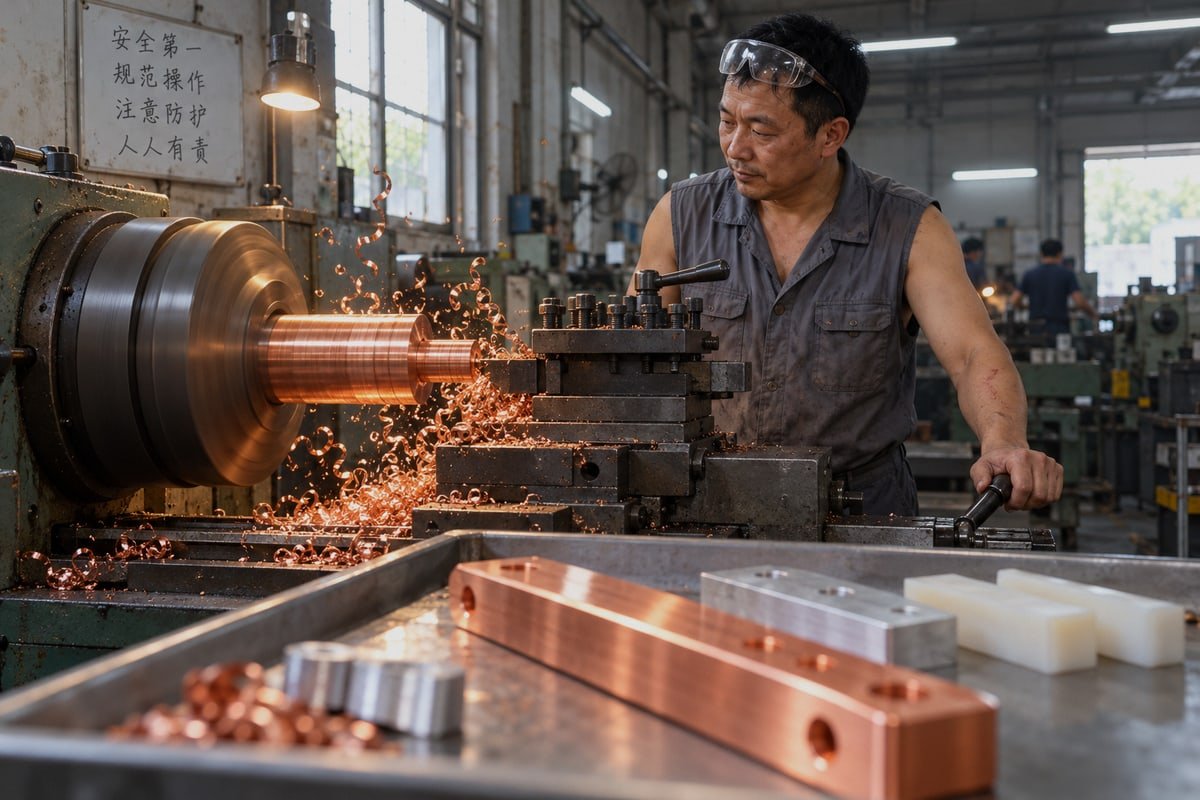
That customer's housing had coolant ports on three faces, a bearing bore on a fourth, and mounting bosses on the fifth. On a 3-axis machine, each face means a new clamp. Each clamp introduces a small positional error. By the fourth setup, those errors stack up. On 5-axis, the part stays fixed and the tool tilts to reach everything. The relationships between features are set by the machine, not by how carefully someone re-indicated the part.
The cause-and-effect chain inside a motor
I want to be careful here. 5-axis machining does not make a motor efficient by itself. Winding quality, magnet design, balancing, and bearings all matter. What machining controls is geometry. A truer bearing bore and a flatter mounting face reduce air-gap variation between rotor and stator. Less air-gap variation lowers vibration and noise. Lower vibration means more even bearing loading and longer life. That is the honest chain. Precision supports performance; it does not replace the rest of the engineering.
3-axis versus 5-axis on EV housings
| Factor | 3-axis | 5-axis |
|---|---|---|
| Setups for a multi-face housing | 3–5 | 1–2 |
| Feature-to-feature accuracy | Depends on re-clamping skill | Set by machine kinematics |
| Angled ports and undercuts | Need angle fixtures or extra ops | Reached directly |
| Fixture cost | Multiple fixtures | Fewer, simpler fixtures |
| Programming skill needed | Moderate | High, with collision simulation |
| Capital cost | Lower | Higher |
Where it pays off most
Battery enclosures need hermetic sealing faces that are flat across the whole perimeter. Machining the full face in one pass, without re-clamping, keeps that flatness continuous. Cooling plates in thermal management systems need ports positioned accurately relative to internal channels so coolant flows as designed, with predictable pressure drop. Inverter and ECU housings increasingly carry EMI shielding geometries, such as stepped lips and gasket grooves, cut directly into the enclosure walls. And one trend we see in production scalability is post-machining of large structural castings, where 5-axis equipment trues mounting points on the cast shape so modules and subframes align.
The honest trade-offs
5-axis is not a free productivity upgrade. Programs are harder to write. Collision avoidance must be simulated. Tooling is more specialized. Thin walls and deep cavities can still chatter or distort, whatever the axis count. We also follow newer approaches with interest, such as adaptive toolpaths that react to sensor feedback on recycled aluminum lots, and cryogenic-assisted cutting for thermoplastic composite fire barriers. But most EV housing work still comes down to a stable machine, a solid fixture, and a programmer who knows aluminum. 5-axis multiplies the benefit of those fundamentals; it does not substitute for them.
Conclusion
EV programs fail on drift, not design. CNC machining for electric vehicle component manufacturing delivers precision and speed when used as the finishing layer—control cost, never compromise performance.
Footnotes
1. Technical overview of multi-axis machining capabilities and configurations used in precision manufacturing. ↩︎
2. Official government resource regarding electric vehicle technologies and battery system manufacturing standards. ↩︎
3. Technical specifications for high-performance polymers like PEEK used for insulation in EV components. ↩︎
4. Authoritative industry source for aluminum applications in automotive thermal management and structural components. ↩︎
5. Leading authority on copper’s electrical conductivity properties for EV busbars and connectors. ↩︎

 English
 Italiano
 Français
 日本語
 Deutsch (Sie)
 Español
 Русский
 العربية
 Български
 Čeština
 Dansk
 Suomi
 עִבְרִית
 हिन्दी
 Nederlands
 Português
 Română
 Slovenčina
 Svenska
 ไทย
 Tiếng Việt
 Türkçe
 Slovenščina